Guatemalan Civil War in the context of "Ixil people"

Play Trivia Questions online!

or

Skip to study material about Guatemalan Civil War in the context of "Ixil people"

Ad spacer

⭐ Core Definition: Guatemalan Civil War

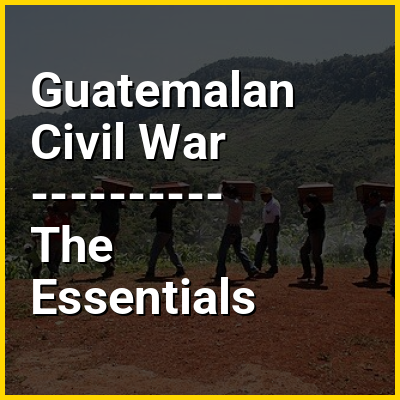
The Guatemalan Civil War was fought from 1960 to 1996 between the government of Guatemala and various leftist rebel groups. The Guatemalan government forces committed genocide against the Maya population of Guatemala during the civil war and there were widespread human rights violations against civilians. The context of the struggle was based on longstanding issues over land distribution. Wealthy Guatemalans, mainly of European descent, and foreign companies like the American United Fruit Company had control over much of the land leading to conflicts with the rural, disproportionately indigenous, peasants who worked the land.

Democratic elections in 1944 and 1951 which were during the Guatemalan Revolution had brought popular leftist governments to power, who sought to ameliorate working conditions and implement land distribution. A United States-backed coup d'état in 1954 installed the military regime of Carlos Castillo Armas to prevent reform. Armas was followed by a series of right-wing military dictators.

↓ Menu

>>>PUT SHARE BUTTONS HERE<<<

👉 Guatemalan Civil War in the context of Ixil people

The Ixil (pronounced [iʂil]) are a Maya people located in the states of Campeche and Quintana Roo in Mexico and in the municipalities of Santa María Nebaj, San Gaspar Chajul, and San Juan Cotzal in the northern part of the Cuchumatanes mountains of the department of Quiché, Guatemala. These three municipalities are known as the Ixil Triangle and are the place of origin of the Ixil culture and where the majority of the population lives.

During the Guatemalan Civil War (1960-1996), the Ixil people were victims of repression and violence by the Guatemalan military government in what is known as the Guatemalan genocide; many were displaced forcibly to Mexico to escape the violence. Once on Mexican territory, they established refugee camps that later turned to new towns and permanent communities.

↓ Explore More Topics
In this Dossier

Guatemalan Civil War in the context of Guatemala

Guatemala, officially the Republic of Guatemala, is a country in Central America. It is bordered to the north and west by Mexico, to the northeast (in the adjacency zone) by Belize, to the east by Honduras, and to the southeast by El Salvador. It is bounded by the Pacific Ocean to the south and the Gulf of Honduras to the northeast.

The territory of modern Guatemala hosted the core of the Maya civilization, which extended across Mesoamerica; in the 16th century, most of this was conquered by the Spanish and claimed as part of the viceroyalty of New Spain. Guatemala attained independence from Spain and Mexico in 1821. From 1823 to 1841, it was part of the Federal Republic of Central America. For the latter half of the 19th century, Guatemala suffered instability and civil strife. From the early 20th century, it was ruled by a series of dictators backed by the United States. In 1944, authoritarian leader Jorge Ubico was overthrown by a pro-democratic military coup, initiating a decade-long revolution that led to social and economic reforms. In 1954, a U.S.-backed military coup ended the revolution and installed a dictatorship. From 1960 to 1996, Guatemala endured a bloody civil war fought between the U.S.-backed government and leftist rebels, including genocidal massacres of the Maya population perpetrated by the Guatemalan military. The United Nations negotiated a peace accord, resulting in economic growth and successive democratic elections.

↑ Return to Menu

Guatemalan Civil War in the context of Guatemalan Revolution

The period in the history of Guatemala between the coups against Jorge Ubico in 1944 and Jacobo Árbenz in 1954 is known locally as the Revolution (Spanish: La Revolución). It has also been called the Ten Years of Spring, highlighting the peak years of representative democracy in Guatemala from 1944 until the end of the civil war in 1996. It saw the implementation of social, political, and especially agrarian reforms that were influential across Latin America.

From the late 19th century until 1944, Guatemala was governed by a series of authoritarian rulers who sought to strengthen the economy by supporting the export of coffee. Between 1898 and 1920, Manuel Estrada Cabrera granted significant concessions to the United Fruit Company, an American corporation that traded in tropical fruit, and dispossessed many indigenous people of their communal lands. Under Jorge Ubico, who ruled as a dictator between 1931 and 1944, this process was intensified, with the institution of harsh labor regulations and a police state.

↑ Return to Menu

Guatemalan Civil War in the context of Guatemalan genocide

The Guatemalan genocide, also referred to as the Maya genocide, or the Silent Holocaust (Spanish: Genocidio guatemalteco, Genocidio maya, or Holocausto silencioso), was the mass killing of the Maya Indigenous people during the Guatemalan Civil War (1960–1996) by successive Guatemalan military governments that first took power following the CIA-instigated 1954 Guatemalan coup d'état. Massacres, forced disappearances, torture and summary executions of guerrillas and especially civilians at the hands of security forces had been widespread since 1965, and was a longstanding policy of the U.S. backed military regimes. Human Rights Watch (HRW) has documented "extraordinarily cruel" actions by the armed forces, mostly against civilians.

The repression reached genocidal levels in the predominantly indigenous northern provinces where the Guerrilla Army of the Poor operated. There, the Guatemalan military viewed the Maya as siding with the insurgency and began a campaign of mass killings and disappearances of Mayan peasants. While massacres of indigenous peasants had occurred earlier in the war, the systematic use of terror against them began around 1975 and peaked during the first half of the 1980s. The military carried out 626 massacres against the Maya during the conflict and acknowledged destroying 440 Mayan villages between 1981 and 1983. In some municipalities, at least one-third of the villages were evacuated or destroyed. A March 1985 study by the Juvenile Division of the Supreme Court estimated that over 200,000 children had lost at least one parent in the war, and that between 45,000 and 60,000 adult Guatemalans were killed between 1980 and 1985. Children were often targets of mass killings by the army, including in the Río Negro massacres between 1980 and 1982. A 1984 report by HRW discussed "the murder of thousands by a military government that maintains its authority by terror". In fact, the rights abuses were so severe that even the U.S. with its fervent anticommunist policy "kept its assistance comparatively limited. For most of the 1980's the Guatemalan army relied on fellow pariah-states like Argentina and South Africa for supplies."
↑ Return to Menu

Guatemalan Civil War in the context of Decree 900

Decree 900 (Spanish: Decreto 900), also known as the Agrarian Reform Law, was a Guatemalan land-reform law passed on June 17, 1952, during the Guatemalan Revolution. The law was introduced by President Jacobo Árbenz Guzmán and passed by the Guatemalan Congress. It redistributed unused land greater than 90 hectares (224 acres) in area to local peasants, compensating landowners with government bonds. Land from at most 1,700 estates was redistributed to about 500,000 individuals—one-sixth of the country's population. The goal of the legislation was to move Guatemala's economy from pseudo-feudalism into capitalism. Although in force for only eighteen months, the law had a major effect on the Guatemalan land-reform movement.

Indigenous groups, deprived of land since the Spanish conquest, were major beneficiaries of the decree. In addition to raising agricultural output by increasing the cultivation of land, the reform is credited with helping many Guatemalans find dignity and autonomy. The expropriation of land led major landowners–including the United Fruit Company–to lobby the United States government to intervene by construing the Guatemalan government as communist. Decree 900 was thus a direct impetus for the 1954 coup d'état, which deposed Árbenz and instigated decades of civil war.

↑ Return to Menu

Guatemalan Civil War in the context of Guatemalan Party of Labour

The Guatemalan Labour Party (Partido Guatemalteco del Trabajo) was a Marxist-Leninist party in Guatemala. It existed from 1949 to 1998. It gained prominence during the government of Jacobo Arbenz. It was one of the main forces of opposition to the various regimes that followed Arbenz's overthrow, and later became a constituent of the URNG guerrilla coalition during the later phase of the country's Civil War.

↑ Return to Menu

Guatemalan Civil War in the context of Guerrilla Army of the Poor

The Guerrilla Army Of The Poor (Spanish: Ejército Guerrillero de los Pobres, EGP) was a Guatemalan leftist guerrilla movement, which commanded significant support among indigenous Maya people during the Guatemalan Civil War.

↑ Return to Menu

Guatemalan Civil War in the context of Anti-communist mass killings

Anti-communist mass killings are the politically motivated mass killings of communists, alleged communists, or their alleged supporters which were committed by anti-communists and political organizations or governments which opposed communism. The communist movement has faced opposition since it was founded and the opposition to it has often been organized and violent. Many anti-communist mass killing campaigns waged during the Cold War were supported and backed by the United States and its Western Bloc allies. Some U.S.-supported mass killings, including the Indonesian mass killings of 1965–66 and the killings by the Guatemalan military during the Guatemalan Civil War, are considered acts of genocide. In Nazi Germany and the countries occupied by it during World War II, anti-communism was one of the motivations for the Holocaust, the extermination of the Jews, who were perceived as creators of the "Jewish Bolshevism"; during the revolutions after World War I, the "Jewish Bolshevism" conspiracy theory justified the antisemitic violence carried out by anti-communist counter-revolutionary troops in the former Russian Empire and Hungary.

↑ Return to Menu

Guatemalan Civil War in the context of Pan-Maya movement

The Pan-Mayan Movement is an ethno-political movement among the Maya peoples of Guatemala and Mexico. The movement emerged in the late 1980s and early 1990s in response to a long tradition of the political marginalization of the large Indigenous population of Guatemala, and particularly in response to the violent counter-insurgency policies that disproportionately affected Indigenous communities during the Guatemalan Civil War. The movement was organized around an ideology seeking to unite the speakers of Guatemala's many Mayan languages under a single shared cultural/ethnic identity. It was an alternative to either of the parties of the civil war - the communist revolutionaries and the conservative government. Indigenous Mayan linguists trained by North American linguists in the Proyecto linguistico Francisco Marroquin played a major role in organizing the movement. With the 1996 peace accords the movement gained a significant position in Guatemalan politics.

↑ Return to Menu