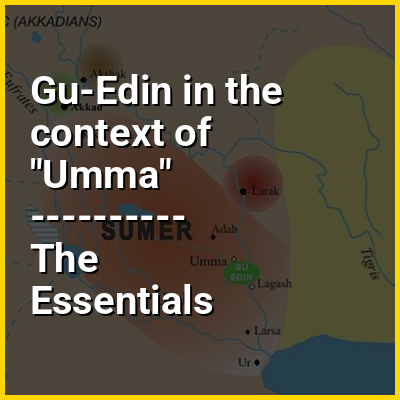
Gu-Edin (also transcribed "Gu'edena" or "Guedena") was a fertile plain in Sumer, in modern-day Iraq. It lay between Umma and Lagash, and claims made on it by each side were a cause of the Umma-Lagash war. Argument over the territory continued for around 150 years.
>>>PUT SHARE BUTTONS HERE<<<
In this Dossier
Gu-Edin in the context of Lugal-zage-si
Lugal-Zage-Si (LUGAL.ZAG.GE.SI 𒈗𒍠𒄀𒋛; frequently spelled Lugalzaggesi, sometimes Lugalzagesi or "Lugal-Zaggisi") of Umma (died c. 2334 BC) was the last Sumerian king before the conquest of Sumer by Sargon of Akkad and the rise of the Akkadian Empire, and was considered as the only king of the third dynasty of Uruk, according to the Sumerian King List. Initially, as king of Umma, he led the final victory of Umma in the generation-long conflict with the city-state Lagash for the fertile plain of Gu-Edin. Following up on this success, he then united Sumer briefly as a single kingdom.
Gu-Edin in the context of Ur-Lumma
Ur-Lumma (Sumerian: 𒌨𒀭𒈝𒈠, Ur Lum-ma; fl. c. 2425 BC) was a ruler of the Sumerian city-state of Umma. His father was King Enakalle, who had been vanquished by Eannatum of Lagash. Ur-Lumma claimed the title of "King" (Lugal). His reign lasted at least 12 years.
Ur-Lumma again entered in a territorial conflict with Lagash, for the fertile plain of Gu-Edin. Ur-Lumma, attacked Lagash and its king Enannatum, successor of Eannatum, managing to "destroy with fire the stele of Eannatum and the shrines of the gods set up beside it". Ur-Lumma vanquished Enannatum and occupied Lagash, but he was eventually repelled by Entemena, the son of Enannatum.