Greeks in Albania in the context of "Epirus"

Play Trivia Questions online!

or

Skip to study material about Greeks in Albania in the context of "Epirus"

Ad spacer

⭐ Core Definition: Greeks in Albania

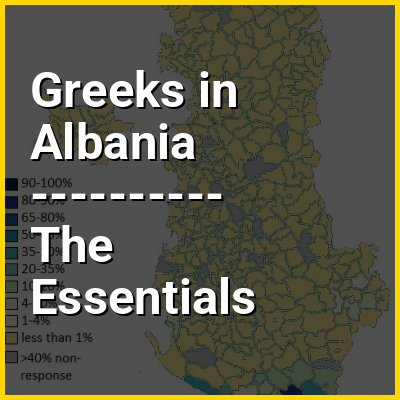
The Greeks in Albania are ethnic Greeks who live in or originate from areas within modern Albania. They form the largest minority group in the country. They are mostly concentrated in the south of the country, in the areas of the northern part of the historical region of Epirus, in parts of Vlorë County, Gjirokastër, Korçë, and Berat County. The area is also known by them as Northern Epirus. Consequently, the Greeks hailing specifically from Southern Albania are also known as Northern Epirotes (Greek: Βορειοηπειρώτες Vorioipirotes, Albanian: Vorioepirot). The Greeks who live in the "minority zones" of Albania are officially recognised by the Albanian government as the Greek National Minority of Albania (Greek: Ελληνική Μειονότητα στην Αλβανία, Elliniki Mionotita stin Alvania; Albanian: Minoriteti Grek në Shqipëri).

In 1913, after the end of five centuries of Ottoman rule, the area was included under the sovereignty of the newly founded Albanian state. The following year, Greeks revolted and declared their independence, and with the following Protocol of Corfu the area was recognised as an autonomous region under nominal Albanian sovereignty. However, this was never implemented.

↓ Menu

>>>PUT SHARE BUTTONS HERE<<<
In this Dossier

Greeks in Albania in the context of Greeks

Greeks or Hellenes (/ˈhɛlnz/; Greek: Έλληνες, Éllines [ˈelines]) are an ethnic group and nation native to Greece, Cyprus, southern Albania, Anatolia, parts of Italy and Egypt, and to a lesser extent, other countries surrounding the Eastern Mediterranean and Black Sea. They also form a significant diaspora (omogenia), with many Greek communities established around the world.

Greek colonies and communities have been historically established on the shores of the Mediterranean Sea and Black Sea, but the Greek people themselves have always been centered on the Aegean and Ionian seas, where the Greek language has been spoken since the Bronze Age. Until the early 20th century, Greeks were distributed between the Greek peninsula, the western coast of Asia Minor, the Black Sea coast, Cappadocia in central Anatolia, Egypt, the Balkans, Cyprus, and Constantinople. Many of these regions coincided to a large extent with the borders of the Byzantine Empire of the late 11th century and the Eastern Mediterranean areas of ancient Greek colonization. The cultural centers of the Greeks have included Athens, Thessalonica, Alexandria, Smyrna, and Constantinople at various periods.

↑ Return to Menu

Greeks in Albania in the context of Greek diaspora

The Greek diaspora, also known as Omogenia (Greek: Ομογένεια, romanizedOmogéneia), are the communities of Greeks living outside of Greece and Cyprus.

Such places historically (dating to the ancient period) include, Albania, North Macedonia, southern Russia, Ukraine, Asia Minor and Pontus (in today's Turkey), Georgia, Egypt, Sudan, southern Italy (Magna Graecia), Sicily, Cargèse and Marseille in France.

↑ Return to Menu

Greeks in Albania in the context of Sarandë

Sarandë (Albanian: [saˈɾandə]; Albanian definite form: Saranda; Greek: Άγιοι Σαράντα) is a city in Albania and the seat of Sarandë Municipality. Geographically, the city is located on an open sea gulf of the Ionian Sea within the Mediterranean Sea. Stretching along the Albanian Ionian Sea Coast, Sarandë has a Mediterranean climate with over 300 sunny days a year.

In ancient times, the city was known as Onchesmus or Onchesmos, and was a port-town of Chaonia in ancient Epirus. It owes its modern name to the nearby Byzantine monastery of the Forty Saints by which it became known from the High Middle Ages. Sarandë today is known for its deep blue Mediterranean waters. Near Sarandë are the remains of the ancient city of Butrint, a UNESCO World Heritage site. In recent years, Sarandë has seen a steady increase in tourists, many of them coming by cruise ships. Visitors are attracted by the natural environment of Sarandë and its archaeological sites. Sarandë is inhabited by a majority of ethnic Albanians, and also has a minority Greek community and as such has been considered one of the two centers of the Greek minority in Albania.

↑ Return to Menu

Greeks in Albania in the context of Northern Epirus

Northern Epirus (Greek: Βόρεια Ήπειρος, Vóreia Ípeiros; Albanian: Epiri i Veriut) is a term used for specific parts of southern Albania which were first claimed by the Kingdom of Greece in the Balkan Wars and later were associated with the Greek minority in Albania and Greece-Albania diplomatic relations in the region. First used by Greece in 1913, upon the creation of the Albanian state following the Balkan Wars, it was originally used in a political and diplomatic context rather than a clearly defined geographical one. Today, the term is used mostly by Greeks and is associated with the existence of a substantial ethnic Greek minority in the region and had acquired in the past irredentist connotations (Autonomous Republic of Northern Epirus).

With the outbreak of the First Balkan War (1912–13) and the Ottoman defeat, the Greek army entered the region and claimed it. The term started to be used by the Kingdom of Greece in 1913, upon the creation of the Albanian state following the Balkan Wars, and the area's incorporation into the latter. During this period, the Greek Army and Greece-backed irregulars used violence against local Albanians and have been accused of atrocities against civilians. In the spring of 1914, the Autonomous Republic of Northern Epirus was proclaimed by ethnic Greeks and pro-Greek parts of the population with official support by Greece and recognized by the Albanian government, though it proved short-lived as the First World War started. Greece held the area between 1914 and 1916 and unsuccessfully tried to annex it in March 1916. In 1917 Greek forces were driven from the area by Italy, in accordance with a general consensus in the Entente, and as a result Italy took over most of southern Albania and part of northwestern Greece. The Paris Peace Conference of 1919 awarded the area to Greece, however the area reverted to Albanian control in November 1921, following Greece's defeat in the Greco-Turkish War and local politics like the creation of the Albanian Autonomous Province of Korçë under French-Albanian administration. During the interwar period, Greece and Albania followed a détente while Greece officially recognized Albanian control over the region and focused more on promoting minority rights for Greek language and culture. The situation of the Greeks in Albania during this period was influenced by the fluctuations in the relations between the two countries, which was also linked with Greece's treatment of its Cham minority.
↑ Return to Menu