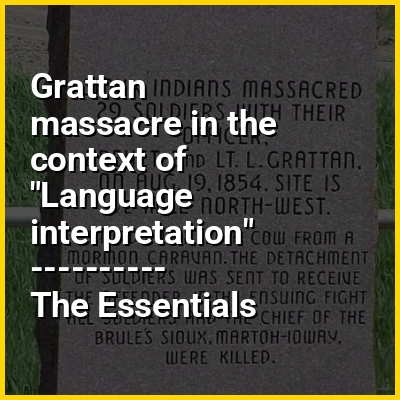
The Treaty of Fort Laramie (also the Sioux Treaty of 1868) is an agreement between the United States and the Oglala, Miniconjou, and Brulé bands of Lakota people, Yanktonai Dakota, and Arapaho Nation. The first Fort Laramie treaty, signed in 1851, had been a resounding failure. The United States had almost immediately violated it, with American miners and settlers immigrating into Indian territory. The United States Army had further broken the 1851 treaty when it initiated an armed invasion that resulted in the Grattan massacre in 1854, which sparked the first Sioux War. The 1868 treaty negotiations were thus initiated to replace the 1851 treaty, which had proven entirely ineffective.
The treaty is divided into 17 articles. It established the Great Sioux Reservation including ownership of the Black Hills, and set aside additional lands as "unceded Indian territory" in the areas of South Dakota, Wyoming, Nebraska, and possibly Montana. It established that the US government would hold authority to punish not only white settlers who committed crimes against the tribes but also tribe members who committed crimes and were to be delivered to the government, rather than to face charges in tribal courts. It stipulated that the government would abandon forts along the Bozeman Trail and included a number of provisions designed to encourage a transition to farming and to move the tribes "closer to the white man's way of life." The treaty protected specified rights of third parties not partaking in the negotiations and effectively ended Red Cloud's War. That provision did not include the Ponca, who were not a party to the treaty and so had no opportunity to object when the American treaty negotiators "inadvertently" broke a separate treaty with the Ponca by unlawfully selling the entirety of the Ponca Reservation to the Lakota, pursuant to Article II of this treaty. The United States never intervened to return the Ponca land. Instead, the Lakota claimed the Ponca land as their own and set about attacking and demanding tribute from the Ponca until 1876, when US President Ulysses S. Grant chose to resolve the situation by unilaterally ordering the Ponca removed to the Indian Territory. The removal, known as the Ponca Trail of Tears, was carried out by force the following year and resulted in over 200 deaths.