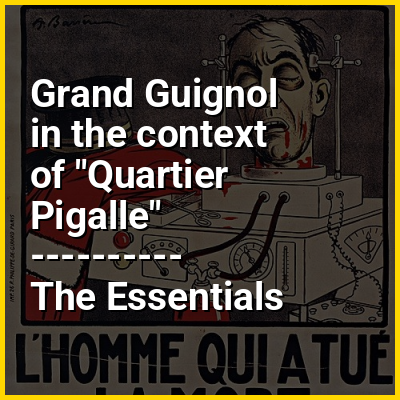
The Théâtre du Grand-Guignol (French pronunciation: [lə teɑtʁ dy ɡʁɑ̃ ɡiɲɔl]) was a theater in the Pigalle district of Paris (7, cité Chaptal). From its opening in 1897 until its closing in 1962, it specialized in horror shows. Its name is often used as a general term for graphic, amoral horror entertainment, a genre popular from Elizabethan and Jacobean theater (for instance Shakespeare's Titus Andronicus, and Webster's The Duchess of Malfi and The White Devil), to today's splatter films.
HINT:
In this Dossier
- ⭐ Core Definition: Grand Guignol
- Grand Guignol in the context of Mystery fiction
- Grand Guignol in the context of Splatter film
- Grand Guignol in the context of Little Theatre in the Adelphi
Grand Guignol in the context of Mystery fiction
Mystery is a fiction genre where the nature of an event, usually a murder or other crime, remains mysterious until the end of the story. Often within a closed circle of suspects, each suspect is usually provided with a credible motive and a reasonable opportunity for committing the crime. The central character is often a detective (such as Sherlock Holmes), who eventually solves the mystery by logical deduction from facts presented to the reader. Some mystery books are non-fiction. Mystery fiction can be detective stories in which the emphasis is on the puzzle or suspense element and its logical solution such as a whodunit. Mystery fiction can be contrasted with hardboiled detective stories, which focus on action and gritty realism.
Mystery fiction can involve a supernatural mystery in which the solution does not have to be logical and even in which there is no crime involved. This usage was common in the pulp magazines of the 1930s and 1940s, whose titles such as Dime Mystery, Thrilling Mystery, and Spicy Mystery offered what were then described as complicated to solve and weird stories: supernatural horror in the vein of Grand Guignol. That contrasted with parallel titles of the same names which contained conventional hardboiled crime fiction. The first use of "mystery" in that sense was by Dime Mystery, which started out as an ordinary crime fiction magazine but switched to "weird menace" during the later part of 1933.
View the full Wikipedia page for Mystery fictionGrand Guignol in the context of Splatter film
A splatter film is a subgenre of horror film that deliberately focuses on graphic portrayals of gore and graphic violence. These films, usually through the use of special effects, display a fascination with the vulnerability of the human body and the theatricality of its mutilation. The term "splatter cinema" was coined by George A. Romero to describe his film Dawn of the Dead, though Dawn of the Dead is generally considered by critics as possessing higher aspiration (such as social commentary) rather than simply being exploitative for its own sake.
The term was popularized by John McCarty's 1981 book Splatter Movies, subtitled: Breaking The Last Taboo: A Critical Survey of the Wildly Demented Sub Genre of the Horror Film that Is Changing the Face of Film Realism Forever. The first significant publication to attempt to define and analyse the 'splatter film', McCarty suggests that splatter is indicative of broader trends in film production. Though splatter is associated with fairly extreme horror films, and such works form the main focus of the book, a relatively diverse range of titles dating mainly from the 1960s to late 1970s are also included; examples include John Waters' Female Trouble, Ted Post's Magnum Force, Terry Gilliam's Jabberwocky, and Walter Hill's Western The Long Riders. This filmography implies that the influence of film-makers such as Sam Peckinpah or Andy Warhol, to name two, is as significant to the development of the form as Grand Guignol, Hammer Films or Herschell Gordon Lewis.
View the full Wikipedia page for Splatter filmGrand Guignol in the context of Little Theatre in the Adelphi
The Little Theatre in the Adelphi was a 250-seat theatre in London, in a site to the south of the Strand. It was opened in 1910, damaged in a German air raid in the First World War and rebuilt in 1919–20. German bombs again hit the theatre in 1941 so severely damaging it that it remained empty until it was demolished in 1949.
The theatre was home to a wide variety of productions, from plays by Bernard Shaw and Laurence Housman presented by Gertrude Kingston, to Grand Guignol melodramas presented by Sybil Thorndike and Lewis Casson, revue, heavyweight drama staged by Nancy Price and her People's National Theatre company and Restoration comedy presented by Herbert Farjeon.
View the full Wikipedia page for Little Theatre in the Adelphi