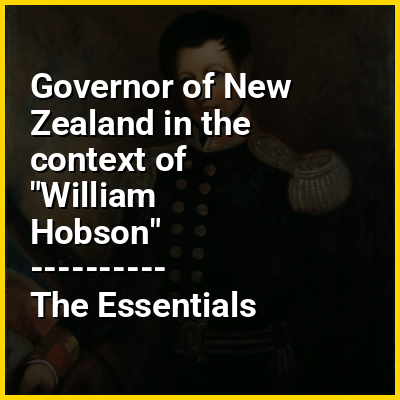
Captain William Hobson (26 September 1792 – 10 September 1842) was a Royal Navy officer and colonial administrator who served as the first governor of New Zealand from 1841 to 1842. He was a co-author of the Treaty of Waitangi which he, as Crown representative, and several Maori chiefs signed on 6 February 1840. On 3 May 1840, he proclaimed British sovereignty over New Zealand. He also selected the site for a new capital, which he named Auckland. In May 1841, New Zealand was constituted as a separate Crown colony with Hobson promoted to governor and commander-in-chief. In his final months, Hobson was dogged by poor health which left him detached from political affairs. He died in office in September 1842.
>>>PUT SHARE BUTTONS HERE<<<
In this Dossier
Governor of New Zealand in the context of Robert FitzRoy
Vice-Admiral Robert FitzRoy FRS (5 July 1805 – 30 April 1865) was an English officer of the Royal Navy, politician and scientist who served as the second governor of New Zealand between 1843 and 1845.
He achieved lasting fame as the captain of HMS Beagle during FitzRoy's famous survey expedition to Tierra del Fuego and the Southern Cone, which took Charles Darwin round the world.
Governor of New Zealand in the context of Ranfurly, New Zealand
Ranfurly is a town in the Central Otago District of Otago, New Zealand. Located 110 kilometres (68 miles) north of Dunedin, it lies in the dry rough plain of Maniototo at a moderately high altitude (around 430 metres or 1,410 feet above sea level) close to a small tributary of the Taieri River. It operates as a service town for the local farming community. The town was formerly known as Eweburn, one of the "farmyard" names bestowed by former Otago Chief Surveyor John Turnbull Thomson on many small streams and locations in the district. The modern name honours the Fifth Earl of Ranfurly, who served as Governor of New Zealand (1897–1904) at the time of the extension of the Otago Central Railway to the area. Ranfurly is well known for its Art Deco buildings, such as its hotel and the dairy.
Governor of New Zealand in the context of Grey River (New Zealand)
The Grey River / Māwheranui is located in the northwest of the South Island of New Zealand. It rises 12 kilometres southwest of the Lewis Pass in Lake Christabel, one of numerous small lakes on the western side of the Southern Alps, and runs westward for 120 kilometres before draining into the Tasman Sea at Greymouth. Thomas Brunner, who explored the area in the late 1840s, named the river in honour of Sir George Grey, who first served as Governor of New Zealand from 1845 to 1854. The Ngāi Tahu Claims Settlement Act 1998 changed the official name of the river to Grey River / Māwheranui in 1998. The Māori name for the river system and surrounding area is Māwhera, with Māwheranui being distinguished from the northern branch Little Grey River / Māwheraiti.
The New Zealand Ministry for Culture and Heritage gives a translation of "broad and widespread (river mouth)" for Māwheranui.