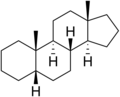
Gonane in the context of "Estrane"

Play Trivia Questions online!

or

Skip to study material about Gonane in the context of "Estrane"


⭐ Core Definition: Gonane

Gonane (cyclopentanoperhydrophenanthrene) is a chemical compound with formula C
17
H
28
, whose structure consists of four hydrocarbon rings fused together: three cyclohexane units and one cyclopentane. It can also be viewed as the result of fusing a cyclopentane molecule with a fully hydrogenated molecule of phenanthrene, hence the more descriptive name "perhydrocyclopenta[a]phenanthrene". The non-systematic version of the above name is "cyclopentanoperhydrophenanthrene".

It has no double bonds, that is, it is completely saturated and is considered the main structure of steroids, often referred to as the steroid nucleus. There are many forms of gonane, but only a few occur naturally in living organisms. Some common forms include 5α-gonane and 5β-gonane. Estrane, androstane, and pregnane are derivatives of gonane with additional methyl or ethyl groups attached to certain carbon positions. The term gonane is also used to describe a group of progestins that are similar to levonorgestrel but have a slightly different structure than other hormones like estranes.

↓ Menu

👉 Gonane in the context of Estrane

Estrane is a C18 steroid derivative, with a gonane core.

Estrenes are estrane derivatives that contain a double bond, with an example being nandrolone. Estratrienes (estrins) are estrane derivatives that contain three double bonds, for instance estrin (estra-1,3,5(10)-triene). A class of female sex hormones, estrogens, such as estradiol, estrone, and estriol are estratrienes.

↓ Explore More Topics
In this Dossier

Gonane in the context of Sterol

A sterol is any organic compound with a skeleton closely related to cholestan-3-ol and having a hydroxyl group at carbon 3. The simplest sterol is gonan-3-ol, which has a formula of C
17
H
28
O
, and is derived from that of gonane by replacement of a hydrogen atom on C3 position by a hydroxyl group. It is therefore an alcohol of gonane.

More generally, any compounds that contain the gonane structure, additional functional groups, and/or modified ring systems derived from gonane are called steroids. Therefore, sterols are a subgroup of the steroids. They occur naturally in most eukaryotes, including plants, animals, and fungi, and can also be produced by some bacteria (however likely with different functions). The most familiar type of animal sterol is cholesterol, which is vital to the structure of the cell membrane, and functions as a precursor to fat-soluble vitamins and steroid hormones. While technically alcohols, sterols are classified by biochemists as lipids (fats in the broader sense of the term).

↑ Return to Menu

Gonane in the context of Pregnane

Pregnane, also known as 17β-ethylandrostane or as 10β,13β-dimethyl-17β-ethylgonane, is a C21 steroid and, indirectly, a parent of progesterone. It is a parent hydrocarbon for two series of steroids stemming from 5α-pregnane (originally allopregnane) and 5β-pregnane (17β-ethyletiocholane). It has a gonane core.

5β-Pregnane is the parent of pregnanediones, pregnanolones, and pregnanediols, and is found largely in urine as a metabolic product of 5β-pregnane compounds.

↑ Return to Menu

Gonane in the context of Androstane

Androstane is a C19 steroidal hydrocarbon with a gonane core. Androstane can exist as either of two isomers, known as 5α-androstane and 5β-androstane.

↑ Return to Menu

Gonane in the context of Sterols

A sterol is any organic compound with a skeleton closely related to cholestan-3-ol and having a hydroxyl group at carbon 3. The simplest sterol is gonan-3-ol, which has a formula of C
17
H
28
O
, and is derived from that of gonane by replacement of a hydrogen atom on C3 position by a hydroxyl group. It is therefore an alcohol of gonane.

More generally, any compounds that contain the gonane structure, additional functional groups, and/or modified ring systems derived from gonane are called steroids. Therefore, sterols are a subgroup of the steroids. They occur naturally in most eukaryotes, including plants, animals, and fungi, and can also be produced by some bacteria (but likely with different functions). The most familiar type of animal sterol is cholesterol, which is vital to the structure of the cell membrane, and functions as a precursor to fat-soluble vitamins and steroid hormones. While technically alcohols, sterols are classified by biochemists as lipids (fats in the broader sense of the term).

↑ Return to Menu