Glomerular filtration rate in the context of "Basic metabolic panel"

Play Trivia Questions online!

or

Skip to study material about Glomerular filtration rate in the context of "Basic metabolic panel"

Ad spacer

⭐ Core Definition: Glomerular filtration rate

Renal functions include maintaining an acid–base balance; regulating fluid balance; regulating sodium, potassium, and other electrolytes; clearing toxins; absorption of glucose, amino acids, and other small molecules; regulation of blood pressure; production of various hormones, such as erythropoietin; and activation of vitamin D.

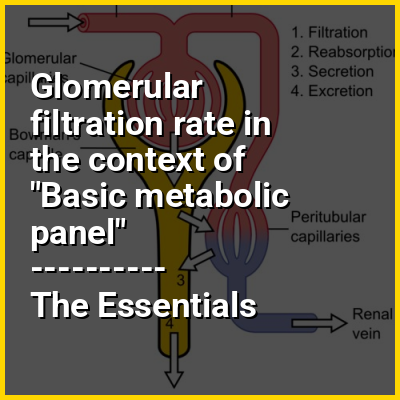
The kidney has many functions, which a well-functioning kidney realizes by filtering blood in a process known as glomerular filtration. A major measure of kidney function is the glomerular filtration rate (GFR).The glomerular filtration rate is the flow rate of filtered fluid through the kidney. The creatinine clearance rate (CCr or CrCl) is the volume of blood plasma that is cleared of creatinine per unit time and is a useful measure for approximating the GFR. Creatinine clearance exceeds GFR due to creatinine secretion, which can be blocked by cimetidine. Both GFR and CCr may be accurately calculated by comparative measurements of substances in the blood and urine, or estimated by formulas using just a blood test result (eGFR and eCCr). The results of these tests are used to assess the excretory function of the kidneys. Staging of chronic kidney disease is based on categories of GFR as well as albuminuria and cause of kidney disease.
↓ Menu

>>>PUT SHARE BUTTONS HERE<<<

👉 Glomerular filtration rate in the context of Basic metabolic panel

A basic metabolic panel (BMP) is a blood test consisting of a set of seven or eight biochemical tests and is one of the most common lab tests ordered by health care providers. Outside the United States, blood tests made up of the majority of the same biochemical tests are called urea and electrolytes (U&E or "U and Es"), or urea, electrolytes, creatinine (UEC or EUC or CUE), and are often referred to as 'kidney function tests' as they also include a calculated estimated glomerular filtration rate. The BMP provides key information regarding fluid and electrolyte status, kidney function, blood sugar levels, and response to various medications and other medical therapies. It is frequently employed as a screening tool during a physical exam.

The basic metabolic panel is a simpler version of the comprehensive metabolic panel (CMP), which includes tests for liver function.

↓ Explore More Topics
In this Dossier

Glomerular filtration rate in the context of Kidney failure

Kidney failure, also known as renal failure or end-stage renal disease (ESRD), is a medical condition in which the kidneys can no longer adequately filter waste products from the blood, functioning at less than 15% of normal levels. Kidney failure is classified as either acute kidney failure, which develops rapidly and may resolve; and chronic kidney failure, which develops slowly and can often be irreversible. Symptoms may include leg swelling, feeling tired, vomiting, loss of appetite, and confusion. Complications of acute and chronic failure include uremia, hyperkalemia, and volume overload. Complications of chronic failure also include heart disease, high blood pressure, and anaemia.

Causes of acute kidney failure include low blood pressure, blockage of the urinary tract, certain medications, muscle breakdown, and hemolytic uremic syndrome. Causes of chronic kidney failure include diabetes, high blood pressure, nephrotic syndrome, and polycystic kidney disease. Diagnosis of acute failure is often based on a combination of factors such as decreased urine production or increased serum creatinine. Diagnosis of chronic failure is based on a glomerular filtration rate (GFR) of less than 15 or the need for renal replacement therapy. It is also equivalent to stage 5 chronic kidney disease.

↑ Return to Menu

Glomerular filtration rate in the context of Chronic kidney failure

Chronic kidney disease (CKD) is a type of long-term kidney disease, defined by the sustained presence of abnormal kidney function and/or abnormal kidney structure. To meet the criteria for CKD, the abnormalities must be present for at least three months. Early in the course of CKD, patients are usually asymptomatic, but later symptoms may include leg swelling, feeling tired, vomiting, loss of appetite, and confusion. Complications can relate to hormonal dysfunction of the kidneys and include high blood pressure (often related to activation of the renin–angiotensin system), insulin resistance, bone disease, and anemia. Additionally CKD patients have markedly increased cardiovascular complications with increased risks of death and hospitalization. CKD can lead to end-stage kidney failure requiring kidney dialysis or kidney transplantation.

Causes of chronic kidney disease include diabetes, high blood pressure, glomerulonephritis, and polycystic kidney disease. Risk factors include a family history of chronic kidney disease. Diagnosis is by blood tests to measure the estimated glomerular filtration rate (eGFR), and a urine test to measure albumin. Ultrasound or kidney biopsy may be performed to determine the underlying cause. Several severity-based staging systems are in use.

↑ Return to Menu

Glomerular filtration rate in the context of Diabetic nephropathy

Diabetic nephropathy, also known as diabetic kidney disease, is the chronic loss of kidney function occurring in those with diabetes mellitus. Diabetic nephropathy is the leading cause of chronic kidney disease (CKD), and end-stage renal disease (ESRD) globally. The triad of protein leaking into the urine (proteinuria or albuminuria), rising blood pressure with hypertension and then falling renal function is common to many forms of CKD. Protein loss in the urine due to damage of the glomeruli may become massive, and cause a low serum albumin with resulting generalized body swelling (edema) so called nephrotic syndrome. Likewise, the estimated glomerular filtration rate (eGFR) may progressively fall from a normal of over 90 ml/min/1.73m to less than 15, at which point the patient is said to have end-stage renal disease. It usually is slowly progressive over years.

Pathophysiologic abnormalities in diabetic nephropathy usually begin with long-standing poorly controlled blood glucose levels. This is followed by multiple changes in the filtration units of the kidneys, the nephrons. (There are normally about 750,000–1.5 million nephrons in each adult kidney). Initially, there is constriction of the efferent arterioles and dilation of afferent arterioles, with resulting glomerular capillary hypertension and hyperfiltration particularly as nephrons become obsolescent and the adaption of hyperfiltration paradoxically causes further shear stress related damage to the delicate glomerular capillaries, further proteinuria, rising blood pressure and a vicious circle of additional nephron damage and decline in overall renal function. Concurrently, there are changes within the glomerulus itself: these include a thickening of the basement membrane, a widening of the slit membranes of the podocytes, an increase in the number of mesangial cells, and an increase in mesangial matrix. This matrix invades the glomerular capillaries and produces deposits called Kimmelstiel-Wilson nodules. The mesangial cells and matrix can progressively expand and consume the entire glomerulus, shutting off filtration.

↑ Return to Menu

Glomerular filtration rate in the context of Kidney dialysis

Kidney dialysis is the process of removing excess water, solutes, and toxins from the blood in people whose kidneys can no longer perform these functions naturally. Along with kidney transplantation, it is a type of renal replacement therapy.

Dialysis may need to be initiated when there is a sudden rapid loss of kidney function, known as acute kidney injury (previously called acute renal failure), or when a gradual decline in kidney function, chronic kidney failure, reaches stage 5. Stage 5 chronic renal failure is reached when the glomerular filtration rate is less than 15% of the normal, creatinine clearance is less than 10 mL per minute, and uremia is present.

↑ Return to Menu