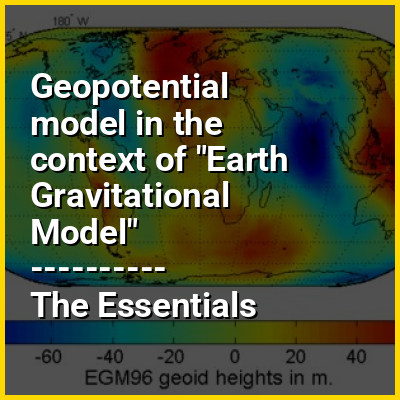
In geophysics and physical geodesy, a geopotential model is the theoretical analysis of measuring and calculating the effects of Earth's gravitational field (the geopotential).The Earth is not exactly spherical, mainly because of its rotation around the polar axis that makes its shape slightly oblate. However, a spherical harmonics series expansion captures the actual field with increasing fidelity.
If Earth's shape were perfectly known together with the exact mass density ρ = ρ(x, y, z), it could be integrated numerically (when combined with a reciprocal distance kernel) to find an accurate model for Earth's gravitational field. However, the situation is in fact the opposite: by observing the orbits of spacecraft and the Moon, Earth's gravitational field can be determined quite accurately. The best estimate of Earth's mass is obtained by dividing the product GM as determined from the analysis of spacecraft orbit with a value for the gravitational constant G, determined to a lower relative accuracy using other physical methods.