Geometric series in the context of Arithmetic series


Geometric series in the context of Arithmetic series

Geometric series Study page number 1 of 1

Play TriviaQuestions Online!

or

Skip to study material about Geometric series in the context of "Arithmetic series"


⭐ Core Definition: Geometric series

In mathematics, a geometric series is a series summing the terms of an infinite geometric sequence, in which the ratio of consecutive terms is constant. For example, the series is a geometric series with common ratio , which converges to the sum of . Each term in a geometric series is the geometric mean of the term before it and the term after it, in the same way that each term of an arithmetic series is the arithmetic mean of its neighbors.
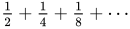
While Greek philosopher Zeno's paradoxes about time and motion (5th century BCE) have been interpreted as involving geometric series, such series were formally studied and applied a century or two later by Greek mathematicians, for example used by Archimedes to calculate the area inside a parabola (3rd century BCE). Today, geometric series are used in mathematical finance, calculating areas of fractals, and various computer science topics.

↓ Menu
HINT:

In this Dossier

Geometric series in the context of Quadrature of the Parabola

Quadrature of the Parabola (Greek: Τετραγωνισμὸς παραβολῆς) is a treatise on geometry, written by Archimedes in the 3rd century BC and addressed to his Alexandrian acquaintance Dositheus. It contains 24 propositions regarding parabolas, culminating in two proofs showing that the area of a parabolic segment (the region enclosed by a parabola and a line) is that of a certain inscribed triangle.

It is one of the best-known works of Archimedes, in particular for its ingenious use of the method of exhaustion and in the second part of a geometric series. Archimedes dissects the area into infinitely many triangles whose areas form a geometric progression. He then computes the sum of the resulting geometric series, and proves that this is the area of the parabolic segment. This represents the most sophisticated use of a reductio ad absurdum argument in ancient Greek mathematics, and Archimedes' solution remained unsurpassed until the development of integral calculus in the 17th century, being succeeded by Cavalieri's quadrature formula.

View the full Wikipedia page for Quadrature of the Parabola
↑ Return to Menu

Geometric series in the context of Kerala school of astronomy and mathematics

The Kerala school of astronomy and mathematics or the Kerala school was a school of mathematics and astronomy founded by Madhava of Sangamagrama in Tirur, Malappuram, Kerala, India, which included among its members: Parameshvara, Neelakanta Somayaji, Jyeshtadeva, Achyuta Pisharati, Melpathur Narayana Bhattathiri, Achyuta Panikkar,Govinda Menon, Madhava Nair, Keshava Menon. The school flourished between the 14th and 16th centuries and its original discoveries seem to have ended with Narayana Bhattathiri (1559–1632). In attempting to solve astronomical problems, the Kerala school independently discovered a number of important mathematical concepts. Their most important results—series expansion for trigonometric functions—were described in Sanskrit verse in a book by Neelakanta called Tantrasangraha (around 1500), and again in a commentary on this work, called Tantrasangraha-vakhya, of unknown authorship. The theorems were stated without proof, but proofs for the series for sine, cosine, and inverse tangent were provided a century later in the work Yuktibhasa (c. 1530), written in Malayalam, by Jyesthadeva, and also in a commentary on Tantrasangraha.

Their work, completed two centuries before the invention of calculus in Europe, provided what is now considered the first example of a power series (apart from geometric series).

View the full Wikipedia page for Kerala school of astronomy and mathematics
↑ Return to Menu