Geography of Uzbekistan in the context of "Turkmenistan–Uzbekistan border"

Play Trivia Questions online!

or

Skip to study material about Geography of Uzbekistan in the context of "Turkmenistan–Uzbekistan border"

Ad spacer

⭐ Core Definition: Geography of Uzbekistan

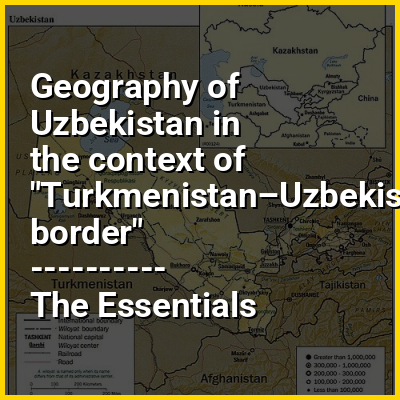
Uzbekistan is a country in Central Asia, located north of Turkmenistan and Afghanistan. With an area of approximately 448,900 square kilometers, Uzbekistan stretches 1,425 km (885 mi) from west to east and 930 km (580 mi) from north to south. It borders Turkmenistan to the southwest, Kazakhstan to the north and Tajikistan and Kyrgyzstan to the south and east. Uzbekistan also has four small exclaves in Kyrgyzstan.

Uzbekistan is the only Central Asian state to border all of the other four. Uzbekistan also shares a short border with Afghanistan to the south. As the Caspian Sea is an inland sea with no direct link to the oceans, Uzbekistan is one of only two "doubly landlocked" countries—countries completely surrounded by other landlocked countries. The other is Liechtenstein.
↓ Menu

>>>PUT SHARE BUTTONS HERE<<<

👉 Geography of Uzbekistan in the context of Turkmenistan–Uzbekistan border

The Turkmenistan–Uzbekistan border is the border between the countries of Turkmenistan and the Republic of Uzbekistan. At 1,793 km (1,114 mi), it is Turkmenistan's longest border and Uzbekistan's second longest (behind Uzbekistan's border with Kazakhstan). The border runs from the tripoint with Kazakhstan to the tripoint with Afghanistan.

The Turkmenistan–Uzbekistan border was first established in 1925, when both countries were part of the Soviet Union as the Turkmen SSR and the Uzbek SSR respectively. With the dissolution of the Soviet Union in 1991, Turkmenistan and Uzbekistan became independent countries, making the Turkmenistan–Uzbekistan border an international border. A joint treaty was signed between Turkmenistan and Uzbekistan in 2000, recognizing the post-independence border as the official border between the two countries, ending a decade of disputes and establishing the border's current shape. A border fence was constructed afterward.

↓ Explore More Topics
In this Dossier