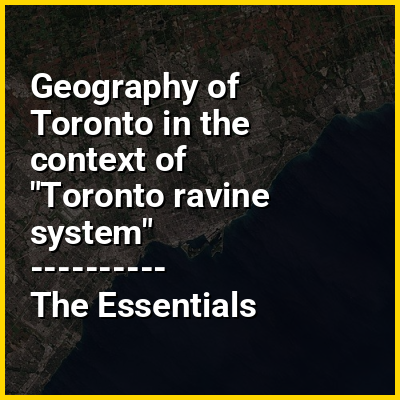
The geography of Toronto, Ontario, covers an area of 630 km (240 sq mi) and is bounded by Lake Ontario to the south; Etobicoke Creek, Eglinton Avenue, and Highway 427 to the west; Steeles Avenue to the north; and the Rouge River and the Scarborough–Pickering Townline to the east. In addition to Etobicoke Creek and the Rouge River, the city is trisected by two minor rivers and their tributaries, the Humber River in the west end and the Don River east of downtown. Both flow southward to Lake Ontario at Humber Bay and Toronto Harbour respectively, which are part of the longer Waterfront, as well as Etobicoke Creek and the Rouge River.
The concentration and protection of Toronto's many deep ravines allows for large tracts of densely forested valleys with recreational trails within the city. Approximately 26 to 28 percent of Toronto is covered with over ten million trees, a fairly high percentage within a large city in North America and there are ambitious proposals to double the coverage. Some parts of Toronto, such as High Park, Swansea and the lower Humber River, are located in the northernmost reaches of the Carolinian forest zone found in North America.