Genetic recombination in the context of "Genetic variation"

Play Trivia Questions online!

or

Skip to study material about Genetic recombination in the context of "Genetic variation"

Ad spacer

⭐ Core Definition: Genetic recombination

Genetic recombination (also known as genetic reshuffling) is the exchange of genetic material between different organisms which leads to production of offspring with combinations of traits that differ from those found in either parent. In eukaryotes, genetic recombination during meiosis can lead to a novel set of genetic information that can be further passed on from parents to offspring. Most recombination occurs naturally and can be classified into two types: (1) interchromosomal recombination, occurring through independent assortment of alleles whose loci are on different but homologous chromosomes (random orientation of pairs of homologous chromosomes in meiosis I); & (2) intrachromosomal recombination, occurring through crossing over.

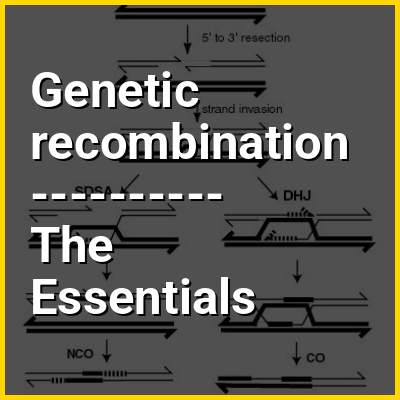
During meiosis in eukaryotes, genetic recombination involves the pairing of homologous chromosomes. This may be followed by information transfer between the chromosomes. The information transfer may occur without physical exchange (a section of genetic material is copied from one chromosome to another, without the donating chromosome being changed) (see SDSA – Synthesis Dependent Strand Annealing pathway in Figure); or by the breaking and rejoining of DNA strands, which forms new molecules of DNA (see DHJ pathway in Figure).
↓ Menu

>>>PUT SHARE BUTTONS HERE<<<
In this Dossier

Genetic recombination in the context of Asexual reproduction

Asexual reproduction is a type of reproduction that does not involve the fusion of gametes or change in the number of chromosomes. The offspring that arise by asexual reproduction from either unicellular or multicellular organisms inherit the full set of genes of their single parent and thus the newly created individual is genetically and physically similar to the parent or an exact clone of the parent. Asexual reproduction is the primary form of reproduction for single-celled organisms such as archaea and bacteria. Many eukaryotic organisms including plants, animals, and fungi can also reproduce asexually. In vertebrates, the most common form of asexual reproduction is parthenogenesis, which is typically used as an alternative to sexual reproduction in times when reproductive opportunities are limited. Some monitor lizards, including Komodo dragons, can reproduce asexually.

While all prokaryotes reproduce without the formation and fusion of gametes, mechanisms for lateral gene transfer such as conjugation, transformation and transduction can be likened to sexual reproduction in the sense of genetic recombination in meiosis.

↑ Return to Menu

Genetic recombination in the context of Mating

In biology, mating is the pairing of either opposite-sex or hermaphroditic organisms for the purposes of sexual reproduction. Fertilization is the fusion of two gametes. Copulation is the union of the sex organs of two sexually reproducing animals for insemination and subsequent internal fertilization. Mating may also lead to external fertilization, as seen in amphibians, bony fishes and plants. For most species, mating is between two individuals of opposite sexes. However, for some hermaphroditic species, copulation is not required because the parent organism is capable of self-fertilization (autogamy); for example, banana slugs.

The term mating is also applied to related processes in bacteria, archaea and viruses. Mating in these cases involves the pairing of individuals, accompanied by the pairing of their homologous chromosomes and then exchange of genomic information leading to formation of recombinant progeny (see mating systems).

↑ Return to Menu

Genetic recombination in the context of Recombinant proteins

Recombinant DNA (rDNA) molecules are DNA molecules formed by laboratory methods of genetic recombination (such as molecular cloning) that bring together genetic material from multiple sources, creating sequences that would not otherwise be found in the genome.

Recombinant DNA is the general name for a piece of DNA that has been created by combining two or more fragments from different sources. Recombinant DNA is possible because DNA molecules from all organisms share the same chemical structure, differing only in the nucleotide sequence. Recombinant DNA molecules are sometimes called chimeric DNA because they can be made of material from two different species like the mythical chimera. rDNA technology uses palindromic sequences and leads to the production of sticky and blunt ends.

↑ Return to Menu

Genetic recombination in the context of Human reproduction

Human sexual reproduction, to produce offspring, begins with fertilization. Successful reproduction typically involves sexual intercourse between a healthy, sexually mature and fertile male and female. During sexual intercourse, sperm cells are ejaculated into the vagina through the penis, resulting in fertilization of an ovum to form a zygote.

While normal cells contain 46 chromosomes (23 pairs), gamete cells contain only half that number, and it is when these two cells merge into one combined zygote cell that genetic recombination occurs. The zygote then undergoes a defined development process that is known as human embryogenesis, and this starts the typical 38-week gestation period for the embryo (and eventually foetus) that is followed by childbirth.

↑ Return to Menu

Genetic recombination in the context of Evolutionary algorithm

Evolutionary algorithms (EA) reproduce essential elements of biological evolution in a computer algorithm in order to solve "difficult" problems, at least approximately, for which no exact or satisfactory solution methods are known. They are metaheuristics and population-based bio-inspired algorithms and evolutionary computation, which itself are part of the field of computational intelligence. The mechanisms of biological evolution that an EA mainly imitates are reproduction, mutation, recombination and selection. Candidate solutions to the optimization problem play the role of individuals in a population, and the fitness function determines the quality of the solutions (see also loss function). Evolution of the population then takes place after the repeated application of the above operators.

Evolutionary algorithms often perform well approximating solutions to all types of problems because they ideally do not make any assumption about the underlying fitness landscape. Techniques from evolutionary algorithms applied to the modeling of biological evolution are generally limited to explorations of microevolution (microevolutionary processes) and planning models based upon cellular processes. In most real applications of EAs, computational complexity is a prohibiting factor. In fact, this computational complexity is due to fitness function evaluation. Fitness approximation is one of the solutions to overcome this difficulty. However, seemingly simple EA can solve often complex problems; therefore, there may be no direct link between algorithm complexity and problem complexity.

↑ Return to Menu

Genetic recombination in the context of Barbara McClintock

Barbara McClintock (June 16, 1902 – September 2, 1992) was an American scientist and cytogeneticist who was awarded the 1983 Nobel Prize in Physiology or Medicine. McClintock received her PhD in botany from Cornell University in 1927. There she started her career as the leader of the development of maize cytogenetics, the focus of her research for the rest of her life. From the late 1920s, McClintock studied chromosomes and how they change during reproduction in maize. She developed the technique for visualizing maize chromosomes and used microscopic analysis to demonstrate many fundamental genetic ideas. One of those ideas was the notion of genetic recombination by crossing-over during meiosis—a mechanism by which chromosomes exchange information. She is often erroneously credited with producing the first genetic map for maize, linking regions of the chromosome to physical traits. She demonstrated the role of the telomere and centromere, regions of the chromosome that are important in the conservation of genetic information. She was recognized as among the best in the field, awarded prestigious fellowships, and elected a member of the National Academy of Sciences in 1944.

During the 1940s and 1950s, McClintock discovered transposons and used it to demonstrate that genes are responsible for turning physical characteristics on and off. She developed theories to explain the suppression and expression of genetic information from one generation of maize plants to the next. Due to skepticism of her research and its implications, she stopped publishing her data in 1953.

↑ Return to Menu

Genetic recombination in the context of Mutagen

In genetics, a mutagen is a physical or chemical agent that permanently changes genetic material, usually DNA, in an organism and thus increases the frequency of mutations above the natural background level. As many mutations can cause cancer in animals, such mutagens can therefore be carcinogens, although not all necessarily are. All mutagens have characteristic mutational signatures with some chemicals becoming mutagenic through cellular processes.

The process of DNA becoming modified is called mutagenesis. Not all mutations are caused by mutagens: so-called "spontaneous mutations" occur due to spontaneous hydrolysis, errors in DNA replication, repair and recombination.

↑ Return to Menu

Genetic recombination in the context of Chromosomal crossover

Chromosomal crossover, or crossing over, is the exchange of genetic material during sexual reproduction between two homologous chromosomes' non-sister chromatids that results in recombinant chromosomes. It is one of the final phases of genetic recombination, which occurs in the pachytene stage of prophase I of meiosis during a process called synapsis. Synapsis is usually initiated before the synaptonemal complex develops and is not completed until near the end of prophase I. Crossover usually occurs when matching regions on matching chromosomes break and then reconnect to the other chromosome, resulting in chiasma which are the visible evidence of crossing over.

↑ Return to Menu