Fullerene in the context of "Carbon nanotube"

Play Trivia Questions online!

or

Skip to study material about Fullerene in the context of "Carbon nanotube"

Ad spacer

⭐ Core Definition: Fullerene

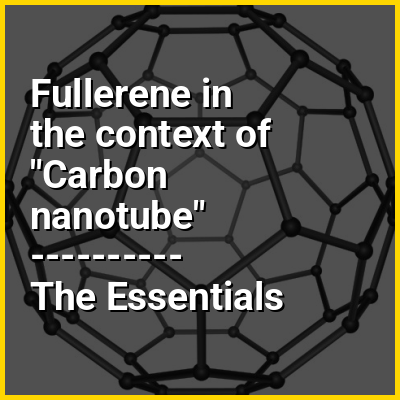
A fullerene is an allotrope of carbon whose molecules consist of carbon atoms connected by single and double bonds so as to form a closed or partially closed mesh, with fused rings of five to six atoms. The molecules may have hollow sphere- and ellipsoid-like forms, tubes, or other shapes.

Fullerenes with a closed mesh topology are informally denoted by their empirical formula Cn, often written Cn, where n is the number of carbon atoms. However, for some values of n there may be more than one isomer.

↓ Menu

>>>PUT SHARE BUTTONS HERE<<<
In this Dossier

Fullerene in the context of Allotrope

Allotropy or allotropism (from Ancient Greek ἄλλος (allos) 'other' and τρόπος (tropos) 'manner, form') is the property of some chemical elements to exist in two or more different forms, in the same physical state, known as allotropes of the elements. Allotropes are different structural modifications of an element: the atoms of the element are bonded together in different manners.For example, the allotropes of carbon include diamond (the carbon atoms are bonded together to form a cubic lattice of tetrahedra), graphite (the carbon atoms are bonded together in sheets of a hexagonal lattice), graphene (single sheets of graphite), and fullerenes (the carbon atoms are bonded together in spherical, tubular, or ellipsoidal formations).

The term allotropy is used for elements only, not for compounds. The more general term, used for any compound, is polymorphism, although its use is usually restricted to solid materials such as crystals. Allotropy refers only to different forms of an element within the same physical phase (the state of matter, i.e. plasmas, gases, liquids, or solids). The differences between these states of matter would not alone constitute examples of allotropy. Allotropes of chemical elements are frequently referred to as polymorphs or as phases of the element.
↑ Return to Menu

Fullerene in the context of Buckminster Fuller

Richard Buckminster Fuller Jr. (/ˈfʊlər/; July 12, 1895 – July 1, 1983) was an American architect, systems theorist, writer, designer, inventor, philosopher, and futurist. He styled his name as R. Buckminster Fuller in his writings, publishing more than 30 books and coining or popularizing such terms as "Spaceship Earth", "Dymaxion" (e.g., Dymaxion house, Dymaxion car, Dymaxion map), "ephemeralization", "synergetics", and "tensegrity".

Fuller developed numerous inventions, mainly architectural designs, and popularized the widely known geodesic dome; carbon molecules known as fullerenes were later named by scientists for their structural and mathematical resemblance to geodesic spheres. He also served as the second World President of Mensa International from 1974 to 1983.

↑ Return to Menu

Fullerene in the context of Allotropes of carbon

Carbon is capable of forming many allotropes (structurally different forms of the same element) due to its valency (tetravalent). Well-known forms of carbon include diamond and graphite. In recent decades, many more allotropes have been discovered and researched, including ball shapes such as buckminsterfullerene and sheets such as graphene. Larger-scale structures of carbon include nanotubes, nanobuds and nanoribbons. Other unusual forms of carbon exist at very high temperatures or extreme pressures. Around 500 hypothetical 3‑periodic allotropes of carbon are known at the present time, according to the Samara Carbon Allotrope Database (SACADA).

↑ Return to Menu

Fullerene in the context of Computational chemistry

Computational chemistry is a branch of chemistry that uses computer simulations to assist in solving chemical problems. It uses methods of theoretical chemistry incorporated into computer programs to calculate the structures and properties of molecules, groups of molecules, and solids. The importance of this subject stems from the fact that, with the exception of some relatively recent findings related to the hydrogen molecular ion (dihydrogen cation), achieving an accurate quantum mechanical depiction of chemical systems analytically, or in a closed form, is not feasible. The complexity inherent in the many-body problem exacerbates the challenge of providing detailed descriptions of quantum mechanical systems. While computational results normally complement information obtained by chemical experiments, it can occasionally predict unobserved chemical phenomena.

↑ Return to Menu