Fu Xi in the context of "Chinese gods and immortals"

Play Trivia Questions online!

or

Skip to study material about Fu Xi in the context of "Chinese gods and immortals"


⭐ Core Definition: Fu Xi

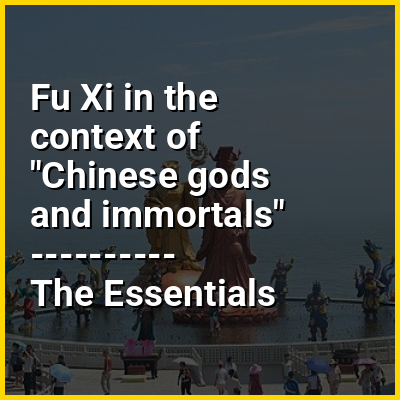
Fuxi or Fu Hsi (Chinese: 伏羲) is a culture hero in Chinese mythology, credited along with his sister and wife Nüwa with creating humanity and the invention of music, hunting, fishing, domestication, and cooking, as well as the Cangjie system of writing Chinese characters around 2900 BC or 2000 BC. He is also said to be the originator of bagua (the eight trigrams) after observing that there were eight fundamental building blocks in nature: heaven, earth, water, fire, thunder, wind, mountain, and lake. These eight are all made of different combinations of yin and yang, which are what came to be called bagua.

Fuxi was counted as the first mythical emperor of China, "a divine being with a serpent's body" who was miraculously born, a Taoist deity, and/or a member of the Three Sovereigns at the beginning of the Chinese dynastic period. Some representations show him as a human with snake-like characteristics, "a leaf-wreathed head growing out of a mountain", "or as a man clothed with animal skins."
↓ Menu

In this Dossier

Fu Xi in the context of King Wen sequence

The King Wen sequence (Chinese: 文王卦序) is an arrangement of the sixty-four divination figures in the I Ching (often translated as the Book of Changes). They are called hexagrams in English because each figure is composed of six 爻 yáo—broken or unbroken lines, that represent yin or yang respectively.

The King Wen sequence is also known as the "received" or "classical" sequence because it is the oldest surviving arrangement of the hexagrams. Its true age and authorship are unknown. Traditionally, it is said that King Wen of Zhou arranged the hexagrams in this sequence while imprisoned by King Zhou of Shang in the 12th century BC. A different arrangement, the "binary sequence" named in honor of the mythic culture hero Fu Xi, originated in the Song dynasty. It is believed to be the work of scholar Shao Yong (1011–1077 AD). As mirrored by the 先天 Earlier Heaven and 後天 Later Heaven arrangements of the eight trigrams, or bagua, it was customary to attribute authorship to these legendary figures. Of the two hexagram arrangements, the King Wen sequence is, however, of much greater antiquity than the Fu Xi sequence.

↑ Return to Menu