Frobisher Bay in the context of "Martin Frobisher"

Play Trivia Questions online!

or

Skip to study material about Frobisher Bay in the context of "Martin Frobisher"

Ad spacer

⭐ Core Definition: Frobisher Bay

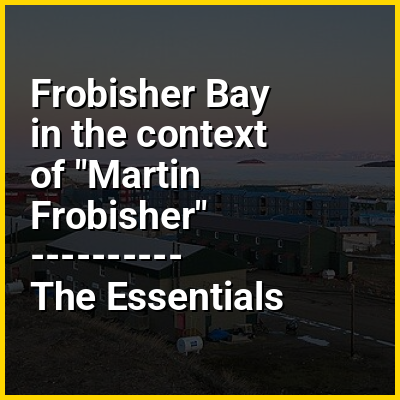
Frobisher Bay is an inlet of the Davis Strait in the Qikiqtaaluk Region of Nunavut, Canada. It is located in the southeastern corner of Baffin Island. Its length is about 230 km (140 mi) and its width varies from about 40 km (25 mi) at its outlet into the Davis Strait to roughly 20 km (12 mi) towards its inner end.

The capital of Nunavut, Iqaluit, known as Frobisher Bay from 1942 to 1987, lies near the innermost end of the bay.

↓ Menu

>>>PUT SHARE BUTTONS HERE<<<

👉 Frobisher Bay in the context of Martin Frobisher

Sir Martin Frobisher (/ˈfrbɪʃər/; c. 1535/1539 – 22 November 1594) was an English sea captain and privateer who made three voyages to the New World looking for the North-west Passage. He probably sighted Resolution Island near Labrador in eastern Canada, before entering Frobisher Bay and landing on present-day Baffin Island.

On his second voyage, Frobisher found what he thought was gold ore and carried 200 short tons (180 t) of it home on three ships, where initial assaying determined it to be worth a profit of £5.20 per ton (equivalent to £1,900 per ton in 2023). Encouraged, Frobisher returned to Canada with an even larger fleet and dug several mines around Frobisher Bay. He carried 1,350 tons of the ore back to England, where, after years of smelting, it was realized that the ore was a worthless rock containing the mineral hornblende. As an English privateer, he plundered riches from French ships. He was later knighted for his service in repelling the Spanish Armada in 1588.

↓ Explore More Topics
In this Dossier

Frobisher Bay in the context of Hudson Strait

The Hudson Strait (French: Détroit d'Hudson) in Nunavut links the Atlantic Ocean and the Labrador Sea to Hudson Bay in Canada. This strait lies between Baffin Island and Nunavik, with its eastern entrance marked by Cape Chidley in Newfoundland and Labrador and Nunavut and Resolution Island, off Baffin Island. The strait is about 750 km (470 mi) long with an average width of 125 km (78 mi), varying from 70 km (43 mi) at the eastern entrance to 240 km (150 mi) at Deception Bay.

English navigator Sir Martin Frobisher was the first European to report entering the strait, in 1578. He named a tidal rip at the entrance the Furious Overfall and called the strait Mistaken Strait, since he felt it held less promise as an entrance to the Northwest Passage than the body of water that was later named Frobisher Bay. Later in his 1587 voyage, explorer John Davis sailed by the entrance to the strait. The first European to explore the strait was George Weymouth who sailed 300 nautical miles (560 km; 350 mi) beyond the Furious Overfall in 1602.

↑ Return to Menu

Frobisher Bay in the context of Iqaluit

Iqaluit is the capital of the Canadian territory of Nunavut. It is the territory's largest community and its only city, and the northernmost city in Canada. It was known as Frobisher Bay from 1942 to 1987, after the large bay on the coast on which the city is situated. Its traditional Inuktitut name was restored in 1987.

In 1999, Iqaluit was designated the capital of Nunavut after the division of the Northwest Territories into two separate territories. Before this event, Iqaluit was a small city and not well known outside the Canadian Arctic or Canada, with population and economic growth highly limited. This is due to Iqaluit's isolation and heavy dependence on expensive imported supplies, as the city, like the rest of Nunavut, has no road or rail connections to the rest of Canada, and has ship connections for only part of the year. Iqaluit has a polar climate, influenced by the cold deep waters of the Labrador Current just off Baffin Island, which makes the city cold, although it is well south of the Arctic Circle.
↑ Return to Menu