List of poets who have written in the French language:
HINT:
👉 French poet in the context of Arthur Rimbaud
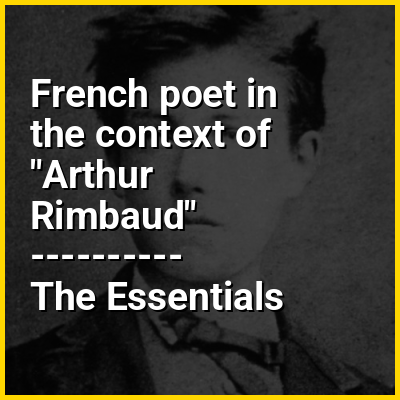
Jean Nicolas Arthur Rimbaud (UK: /ˈræ̃boʊ/, US: /ræmˈboʊ/; French: [ʒɑ̃ nikɔla aʁtyʁ ʁɛ̃bo] ; 20 October 1854 – 10 November 1891) was a French poet known for his transgressive and surreal themes and for his influence on modern literature and arts, prefiguring surrealism.
Born in Charleville, he started writing at a very young age and excelled as a student, but abandoned his formal education in his teenage years to run away to Paris amidst the Franco-Prussian War. During his late adolescence and early adulthood, he produced the bulk of his literary output. Rimbaud completely stopped writing literature at age 20 after assembling his last major work, Illuminations.
In this Dossier
- ⭐ Core Definition: French poet
- 👉 French poet in the context of Arthur Rimbaud
- French poet in the context of Paul Verlaine
- French poet in the context of Robert de Boron
- French poet in the context of Théophile Gautier
French poet in the context of Paul Verlaine
Paul-Marie Verlaine (/vɛərˈlɛn/ vair-LEN; French: [pɔl maʁi vɛʁlɛn]; 30 March 1844 – 8 January 1896) was a French poet, writer and critic associated with the Symbolist, Parnassianist, and Decadent movements. He is considered one of the paramount exponents of the fin de siècle in French and international poetry.
Born in Metz to a petit-bourgeois family, Verlaine bore a lifelong interest in the arts, whether literary, musical or visual. His début collection, Poèmes saturniens (1866), were released at the age of twenty-two; they were published by Alphonse Lemerre. Verlaine's tempestuous sexual relationship with young poet Arthur Rimbaud (ten years his junior and under eighteen years, and while he himself had a wife and infant son), a member of the Zutistes, aroused great controversy; the couple peregrinated throughout England and Belgium until their split in 1873, which was caused by him wounding Rimbaud with a revolver. Following trial, Verlaine was sentenced to two years in prison for battery and sodomy. During his sentence, Verlaine reverted to practising Catholicism and composed Sagesse (published 1880), Jadis et naguère (published 1884) and Parallèlement (published 1889). As his reputation grew, he became increasingly haunted by guilt and paranoia, lapsing into depression, alcohol and chemical abuse and disease, culminating in his death in Paris from acute pneumonia.
View the full Wikipedia page for Paul VerlaineFrench poet in the context of Robert de Boron
Robert de Boron (also spelled in the manuscripts "Roberz", "Borron", "Bouron", "Beron") was a French poet active around the late 12th and early 13th centuries, notable as the reputed author of the poems Joseph d'Arimathie and Merlin. Although little is known of Robert apart from the poems he allegedly wrote, these works and subsequent prose redactions of them had a strong influence on later incarnations of the Arthurian legend and its prose cycles, in particular through their Christianisation and redefinition of the previously ambiguous Grail motif and the character of Merlin, as well as vastly increasing the prominence of the latter.
View the full Wikipedia page for Robert de BoronFrench poet in the context of Théophile Gautier
Pierre Jules Théophile Gautier (US: /ɡoʊˈtjeɪ/ goh-TYAY; French: [pjɛʁ ʒyl teɔfil ɡotje]; 30 August 1811 – 23 October 1872) was a French poet, dramatist, novelist, journalist, and art and literary critic.
While an ardent defender of Romanticism, Gautier's work is difficult to classify and remains a point of reference for many subsequent literary traditions such as Parnassianism, Symbolism, Decadence and Modernism. He was widely esteemed by writers as disparate as Balzac, Baudelaire, the Goncourt brothers, Flaubert, Pound, Eliot, James, Proust and Wilde.
View the full Wikipedia page for Théophile Gautier