Foveaux Strait in the context of "Te Wai Pounamu"

Play Trivia Questions online!

or

Skip to study material about Foveaux Strait in the context of "Te Wai Pounamu"

Ad spacer

⭐ Core Definition: Foveaux Strait

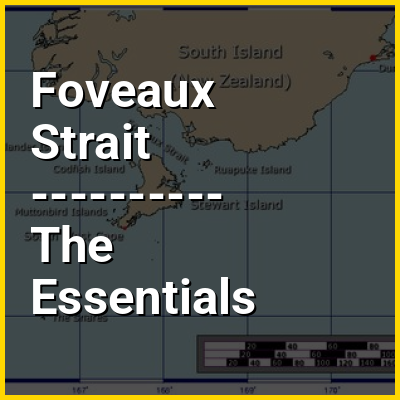
Foveaux Strait (/fv/ FOH-voh; Māori: Te Ara-a-Kiwa, lit.'the Path of Kiwa') is a strait that separates Stewart Island from the South Island of New Zealand. The width of the strait ranges from about 23 to 53 km (14 to 33 mi), and the depth varies between 18 and 46 m (59 and 151 ft). The earliest known chart of the strait was prepared by American sealer, Owen Folger Smith from a whaleboat of the sealing brig Union in 1804.

The passage was named Foveaux Strait in March 1809, after Joseph Foveaux, the Lieutenant-Governor of New South Wales in Australia. Ferry services across Foveaux Strait began in 1877 and continue to operate regularly between Bluff Harbour and Oban. The strait has been described as "one of the roughest and most unpredictable stretches of water in the world". Severe weather and sea conditions in the strait have contributed to multiple shipwrecks and fatalities. One of these losses was the wreck of the SS Tararua in 1881—the worst maritime disaster for civilian vessels in New Zealand's history, with 131 fatalities. There are currently no formal definitions of the eastern and western boundaries of the strait.
↓ Menu

>>>PUT SHARE BUTTONS HERE<<<

👉 Foveaux Strait in the context of Te Wai Pounamu

The South Island (official alternative name Te Waipounamu, from Māori) is the larger of the two main islands of New Zealand by surface area, the other being the smaller but more populous North Island. It is bordered to the north by Cook Strait, to the west by the Tasman Sea, to the south by the Foveaux Strait and Southern Ocean, and to the east by the Pacific Ocean. The South Island covers 150,437 square kilometres (58,084 sq mi), making it the world's 12th-largest island, constituting 56% of New Zealand's land area. At low altitudes, it has an oceanic climate. The most populous cities are Christchurch, Dunedin, Nelson and Invercargill.

Prior to European settlement, Te Waipounamu was sparsely populated by three major iwiKāi Tahu, Kāti Māmoe, and the historical Waitaha – with major settlements including in Kaiapoi Pā near modern-day Christchurch. During the Musket Wars expanding iwi colonised Te Tau Ihu, a region comprising parts of modern-day Tasman, Nelson and Marlborough, including Ngāti Kuia, Rangitāne, Ngāti Tama, and later Ngāti Toarangatira after Te Rauparaha's wars of conquest. British settlement began with expansive and cheap land purchases early on, and settlers quickly outnumbered Māori. As a result the Wairau Affray was the only conflict of the New Zealand Wars to occur in the South Island. The island became rich and prosperous and Dunedin boomed during the 1860s Otago gold rush, which was shaped by extensive Chinese immigration. After the gold rush the "drift to the north" meant the North Island displaced the South as the most populous.

↓ Explore More Topics
In this Dossier

Foveaux Strait in the context of South Island

The South Island (Māori: Te Waipounamu [tɛ wɐ.i.pɔ.ʉ.nɐ.mʉ], lit. 'the waters of Greenstone') is the larger of the two main islands of New Zealand by surface area, the other being the smaller but more populous North Island. It is bordered to the north by Cook Strait, to the west by the Tasman Sea, to the south by the Foveaux Strait and Southern Ocean, and to the east by the Pacific Ocean. The South Island covers 150,437 square kilometres (58,084 sq mi), making it the world's 12th-largest island, constituting 56% of New Zealand's land area. At low altitudes, it has an oceanic climate. The most populous cities are Christchurch, Dunedin, Nelson and Invercargill.

Prior to European settlement, Te Waipounamu was sparsely populated by three major iwiKāi Tahu, Kāti Māmoe, and the historical Waitaha – with major settlements including in Kaiapoi Pā near modern-day Christchurch. During the Musket Wars expanding iwi colonised Te Tau Ihu, a region comprising parts of modern-day Tasman, Nelson and Marlborough, including Ngāti Kuia, Rangitāne, Ngāti Tama, and later Ngāti Toarangatira after Te Rauparaha's wars of conquest. British settlement began with expansive and cheap land purchases early on, and settlers quickly outnumbered Māori. As a result the Wairau Affray was the only conflict of the New Zealand Wars to occur in the South Island. The island became rich and prosperous and Dunedin boomed during the 1860s Otago gold rush, which was shaped by extensive Chinese immigration. After the gold rush the "drift to the north" meant the North Island displaced the South as the most populous.

↑ Return to Menu

Foveaux Strait in the context of Geography of New Zealand

New Zealand (Māori: Aotearoa) is an island country located in the southwestern Pacific Ocean, near the centre of the water hemisphere. It consists of a large number of islands, estimated around 700, mainly remnants of a larger landmass now beneath the sea. The land masses by size are the South Island (Te Waipounamu) and the North Island (Te Ika-a-Māui), separated by the Cook Strait. The third-largest is Stewart Island (Rakiura), located 30 kilometres (19 miles) off the tip of the South Island across Foveaux Strait. Other islands are significantly smaller in area. The three largest islands stretch 1,600 kilometres (990 miles) across latitudes 35° to 47° south. New Zealand is the sixth-largest island country in the world, with a land size of 268,680 km (103,740 sq mi).

New Zealand's landscapes range from the fiord-like sounds of the southwest to the sandy beaches of the subtropical Far North. The South Island is dominated by the Southern Alps while a volcanic plateau covers much of the central North Island. Temperatures commonly fall below 0 °C (32 °F) and rise above 30 °C (86 °F) then conditions vary from wet and cold on the South Island's west coast to dry and continental a short distance away across the mountains and to the tundra like climate in the Deep South of Southland.

↑ Return to Menu

Foveaux Strait in the context of Stewart Island

Stewart Island (Māori: Rakiura, lit. 'glowing skies', officially Stewart Island / Rakiura, formerly New Leinster) is the third-largest and southernmost inhabited island of New Zealand, lying 30 kilometres (16 nautical miles) south of the South Island, separated by Foveaux Strait.

It is a roughly triangular island with a land area of 1,746 km (674 sq mi). Its 164-kilometre (102 mi) coastline is indented by Paterson Inlet (east), Port Pegasus (south), and Mason Bay (west). The island is generally hilly (rising to 980 metres or 3,220 feet at Mount Anglem) and densely forested. Flightless birds, including penguins, thrive because there are few introduced predators. Almost all the island is owned by the New Zealand government, and over 80 percent of the island forms Rakiura National Park.

↑ Return to Menu

Foveaux Strait in the context of Solander Islands

The Solander Islands / Hautere are three eroded remnant volcanic islets towards the western entrance of the Foveaux Strait just beyond New Zealand's South Island. The islands lie 40 km (25 mi) south of the coastline of Fiordland.

The islands are andesite rocks with the tip being a larger submerged stratovolcano, roughly equivalent in size to Mount Taranaki. It was formerly believed that the volcano last erupted roughly 2 million years ago, but in 2008 radiometric dating of rock samples from the main island found that it was between 150,000 and 400,000 years old. In 2013 it was discovered that Little Solander Island had been active even more recently at between 20 and 50,000 years ago.

↑ Return to Menu