The Ford Ranges (77°0′S 144°0′W / 77.000°S 144.000°W) are a collection of mountain groups and ranges standing east of Sulzberger Ice Shelf and Block Bay in the northwest part of Marie Byrd Land, Antarctica.

The Ford Ranges (77°0′S 144°0′W / 77.000°S 144.000°W) are a collection of mountain groups and ranges standing east of Sulzberger Ice Shelf and Block Bay in the northwest part of Marie Byrd Land, Antarctica.
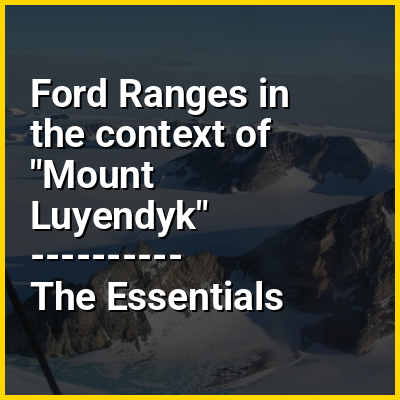
Mount Luyendyk is a summit in the western Fosdick Mountains of the Ford Ranges of Marie Byrd Land, West Antarctica. It forms a prominent exposure in the northwestern Iphigene massif. The peak is named in recognition of Professor Bruce P. Luyendyk of the University of California, Santa Barbara, who was active in ground- and ocean-based Antarctic research from 1989 to 2015, significantly advancing the scientific knowledge of the Ross Embayment region of Antarctica. Luyendyk led two on-land expeditions in the Ford Ranges, and was principal investigator for five marine geophysical expeditions in the Ross Sea.
In December, 1989, geologists of the UC Santa Barbara FORCE expedition traveled by snowmobile-sledge to Mt. Luyendyk, for the purpose of sampling for rock magnetism, petrology, and geochronology studies. Between 2005 and 2012, geologists from Colorado College, University of Maryland, and Curtin University (Perth) returned to Mt. Luyendyk for structural geology and petrology investigations.
Bruce Peter Luyendyk (born 1943) is an American geophysicist and oceanographer, currently professor emeritus of marine geophysics at the University of California, Santa Barbara. His work spans marine geology of the major ocean basins, the tectonics of southern California, marine hydrocarbon seeps, and the tectonics and paleoclimate of Antarctica. His research includes tectonic rotations of the California Transverse Ranges, participation in the discovery of deep-sea hydrothermal vents, quantitative studies of marine hydrocarbon seeps, and geologic exploration of the Ford Ranges in Marie Byrd Land, Antarctica.
Antarctica's Mount Luyendyk is named in honor of his research in the area.
The Rockefeller Plateau in Antarctica is the portion of the interior ice plateau of Marie Byrd Land lying eastward of the Shirase Coast and Siple Coast and southward of the Ford Ranges, Flood Range and the Executive Committee Range, centering near the coordinates given above. Much of its extensive, ice-covered surface is from 1,000 meters to 1,500 meters above sea level. It was discovered by Rear Admiral Richard E. Byrd in 1934 and named for John D. Rockefeller Jr., patron of the Byrd expeditions.