Forbidden fruit in the context of "The Garden of Eden with the Fall of Man"

Play Trivia Questions online!

or

Skip to study material about Forbidden fruit in the context of "The Garden of Eden with the Fall of Man"

Ad spacer

⭐ Core Definition: Forbidden fruit

In Abrahamic religions, forbidden fruit is a name given to the fruit growing in the Garden of Eden that God commands mankind not to eat. In the Biblical story of Genesis, Adam and Eve disobey God and commit the original sin, eating the forbidden fruit from the tree of the knowledge of good and evil, and are exiled from Eden:

As a metaphor outside of the Abrahamic religions, the phrase typically refers to any indulgence or pleasure that is considered illegal or immoral.

↓ Menu

>>>PUT SHARE BUTTONS HERE<<<

👉 Forbidden fruit in the context of The Garden of Eden with the Fall of Man

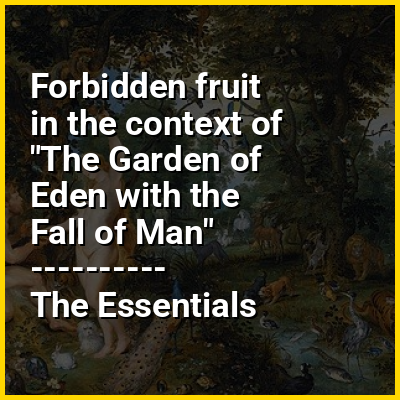
The Garden of Eden with the Fall of Man or The Earthly Paradise with the Fall of Adam and Eve (ca. 1615) is a painting by Peter Paul Rubens (figures) and Jan Brueghel the Elder (flora and fauna). It is housed in the Mauritshuis art museum in The Hague, Netherlands. The painting depicts the moment just before the consumption of forbidden fruit and the fall of man.

Adam and Eve are depicted beneath the tree of the knowledge of good and evil, where various fruits grow. On the opposite side the tree of life is depicted, also laden with fruits.

↓ Explore More Topics
In this Dossier

Forbidden fruit in the context of Fall of man

The fall of man, the fall of Adam, or simply the Fall, is a term used in Christianity to describe the transition of the first man and woman from a state of innocent obedience to God to a state of guilty disobedience. The doctrine of the Fall comes from a biblical interpretation of Genesis, chapters 1–3. At first, Adam and Eve lived with God in the Garden of Eden, but the serpent tempted them into eating the fruit from the tree of knowledge of good and evil, which God had forbidden. After doing so, they became ashamed of their nakedness and God expelled them from the Garden to prevent them from eating the fruit of the tree of life and becoming immortal.

In Nicene Christianity, the doctrine of the Fall is closely related to that of original sin or ancestral sin. Nicene Christians believe that the Fall brought sin into the world, corrupting the entire natural world, including human nature, causing all humans to be born into original sin, a state from which they cannot attain eternal life without the grace of God. The Eastern Orthodox Church accepts the concept of the Fall but rejects the idea that the guilt of original sin is passed down through generations, based in part on the passage Ezekiel 18:20, which says a son is not guilty of the sins of his father.
↑ Return to Menu

Forbidden fruit in the context of Grapefruit

The grapefruit (Citrus × paradisi) is a subtropical citrus tree known for its relatively large, sour to semi-sweet, somewhat bitter fruit. The flesh of the fruit is segmented and varies in color from pale yellow to dark red.

Grapefruits originated in Barbados in the 18th century. They are a citrus hybrid that was created through an accidental cross between the sweet orange (C. × sinensis) and the pomelo (C. maxima), both of which were introduced to the Caribbean from Asia in the 17th century. It has also been called the 'forbidden fruit'. In the past it was called the pomelo, but that term is now mostly used as the common name for Citrus maxima.

↑ Return to Menu

Forbidden fruit in the context of Fig leaf

In culture, a "fig leaf" is a literal or figurative method of obscuring an act or object considered embarrassing or distasteful with something of innocuous appearance. The use of an actual fig leaf for the purpose originates in Western painting and sculpture, where leaves would be used by artists themselves or by later censors in order to hide the genitalia of a subject. Use of the fig plant in particular came about as a Biblical reference to the Book of Genesis, in which Adam and Eve used fig leaves to cover their nudity after eating the forbidden fruit from the tree of the knowledge of good and evil.

A "fig-leaf edition" of a work is known as an expurgation or Bowdlerization.

↑ Return to Menu