Folly in the context of "Banqueting houses"

Play Trivia Questions online!

or

Skip to study material about Folly in the context of "Banqueting houses"

Ad spacer

⭐ Core Definition: Folly

In architecture, a folly is a building constructed primarily for decoration, but suggesting through its appearance some other purpose, or of such extravagant appearance that it transcends the range of usual garden buildings.

Eighteenth-century English landscape gardening and French landscape gardening often featured mock Roman temples, symbolising classical virtues. Other 18th-century garden follies imitated Chinese temples, Egyptian pyramids, ruined medieval castles, abbeys, or Tatar tents, to represent different continents or historical eras. Sometimes they represented rustic villages, mills and cottages, to symbolise rural virtues. Many follies, particularly during times of famine, such as the Great Famine in Ireland, were built as a form of poor relief, to provide employment for peasants and unemployed artisans.
↓ Menu

>>>PUT SHARE BUTTONS HERE<<<

👉 Folly in the context of Banqueting houses

In English architecture, mainly from the Tudor period onwards, a banqueting house is a separate pavilion-like building reached through the gardens from the main residence, whose use is purely for entertaining, especially eating. Or it may be built on the roof of a main house, as in many 16th-century prodigy houses. It may be raised for additional air or a vista, with a simple kitchen below, as at Hampton Court Palace and Wrest Park, and it may be richly decorated, but it normally contains no bedrooms, and typically a single grand room apart from any service spaces. The design is often ornamental, if not downright fanciful, and some are also follies, as in Paxton's Tower. There are usually plenty of windows, as appreciating the view was a large part of their purpose. Often they are built on a slope, so that from the front, only the door to the main room can be seen; the door to the servants' spaces underneath was hidden at the back (Wrest Park). The Banqueting House, Gibside is an example.

In the English of the period, "banquet" had two distinct meanings: firstly a grand formal celebratory meal (the usual modern sense), but also a course or light meal taken in a special place away from the main dining place, the relevant sense here (Whitehall apart). In large meals a banqueting house was most likely to be used for eating dessert, if reasonably close to the main house. Otherwise it might be used on fine days for taking tea, or any kind of drink, snack or meal.

↓ Explore More Topics
In this Dossier

Folly in the context of Swallow's Nest

The Swallow's Nest (Russian: Ласточкино гнездо, romanizedLastochkino gnezdo, Ukrainian: Ластівчине гніздо, romanizedLastivchyne hnizdo) is a decorative castle located at Gaspra, a small spa town between Yalta and Alupka on the Crimean peninsula. It was built between 1911 and 1912, on top of the 40-metre-high (130 ft) Aurora Cliff, in a Neo-Gothic design by the Russian architect Leonid Sherwood for Pavel Leonardovich von Steingel, a Russian noble with German roots.

The castle overlooks the Cape of Ai-Todor on the Black Sea coast and is located near the remains of the Roman castrum of Charax. The Swallow's Nest is one of the most popular visitor attractions in Crimea, having become the symbol of Crimea's southern coastline.

↑ Return to Menu

Folly in the context of English landscape garden

The English landscape garden, also called English landscape park or simply the English garden (French: Jardin à l'anglaise, Italian: Giardino all'inglese, German: Englischer Landschaftsgarten, Portuguese: Jardim inglês, Spanish: Jardín inglés), is a style of "landscape" garden which emerged in England in the early 18th century, and spread across Europe, replacing the more formal, symmetrical French formal garden which had emerged in the 17th century as the principal gardening style of Europe. The English garden presented an idealized view of nature. Created and pioneered by William Kent and others, the "informal" garden style originated as a revolt against the architectural garden and drew inspiration from landscape paintings by Salvator Rosa, Claude Lorrain, and Nicolas Poussin, as well as from the classic Chinese gardens of the East, which had recently been described by European travellers and were realized in the Anglo-Chinese garden.

The English garden usually included a lake, sweeps of gently rolling lawns set against groves of trees, and recreations of classical temples, Gothic ruins, bridges, and other picturesque architecture, designed to recreate an idyllic pastoral landscape. The work of Lancelot "Capability" Brown was particularly influential. By the end of the 18th century the English garden was being imitated by the French landscape garden, and as far away as St. Petersburg, Russia, in Pavlovsk, the gardens of the future Emperor Paul. It also had a major influence on the forms of public parks and gardens which appeared around the world in the 19th century. The English landscape garden was usually centred on the English country house, and many examples in the United Kingdom are popular visitor attractions today.

↑ Return to Menu

Folly in the context of Ashton Memorial

The Ashton Memorial is a folly in Williamson Park, Lancaster, Lancashire, England, built between 1907 and 1909 by the millionaire industrialist Lord Ashton in memory of his second wife, Jessy, at a cost of £87,000 (equivalent to £10.5 million in 2023).

↑ Return to Menu

Folly in the context of Garden

A garden is a planned space, usually outdoors, set aside for the cultivation, display, and enjoyment of plants and other forms of nature. The single feature identifying even the wildest wild garden is control. The garden can incorporate both natural and artificial materials.

Gardens often have design features including statuary, follies, pergolas, trellises, stumperies, dry creek beds, and water features such as fountains, ponds (with or without fish), waterfalls or creeks. Some gardens are for ornamental purposes only, while others also produce food crops, sometimes in separate areas, or sometimes intermixed with the ornamental plants. Food-producing gardens are distinguished from farms by their smaller scale, more labor-intensive methods, and their purpose (enjoyment of a pastime or self-sustenance rather than producing for sale, as in a market garden). Flower gardens combine plants of different heights, colors, textures, and fragrances to create interest and delight the senses.

↑ Return to Menu

Folly in the context of Broadway Tower, Worcestershire

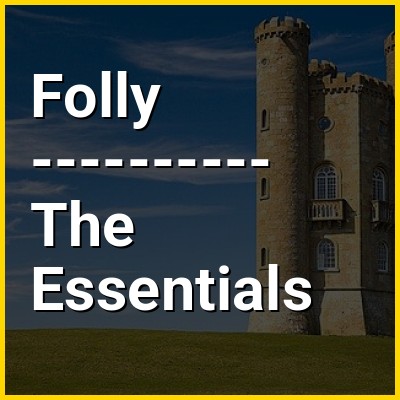
Broadway Tower is an 18th-century building near the village of Broadway, in the English county of Worcestershire. It is a Grade II listed building.

The tower is built of limestone ashlar and is four storeys high, hexagonal, with three round corner turrets, battlements and gargoyles. It stands above the village of Broadway on Broadway Hill, the second-highest point of the Cotswolds, at an elevation of 1,024 feet (312 m). The tower itself is 65 feet (20 m) tall. Although sometimes referred to as a folly, it is a functional building with interior rooms, the top three floors being used as a museum. The rooftop viewing platform can be accessed for good views. Two of the turrets each contain a spiral staircase leading from the ground to the roof.

↑ Return to Menu

Folly in the context of Dunmore Pineapple

The Dunmore Pineapple is a folly in Dunmore Park, near Airth in Stirlingshire, Scotland. In 1995, it was ranked "as the most bizarre building in Scotland".

↑ Return to Menu

Folly in the context of Painshill

Painshill (formally Painshill Park) is a restored, 18th-century English park and landscape garden in Cobham, Surrey, England. It was created between 1738 and 1773 by the owner, Charles Hamilton, from an area of heathland and woodland. Painshill is laid out as a series of scenes, crafted by combining architectural features with trees and shrubs, many of which are non-native species. Several of the surviving follies are listed in their own right, including the Gothic Tower, at the western end of the park, and the Gothic Temple, which overlooks the northern part of the lake. The Grotto, the largest in England, is decorated with crystalline mineral stones, including quartz, feldspar and Blue John.

In designing Painshill, Hamilton was influenced by 17th-century landscape artists, whose works he had encountered on Grand Tours in continental Europe. Instead of trying to replicate specific artworks, Hamilton used the techniques of landscape painting to create scenes with contrasting emotional tones – from the solemnity of the dark evergreens surrounding the Mausoleum, to the brighter trees and flowers at the Temple of Bacchus. Advocates of the Picturesque were complimentary of Hamilton's work, particularly the hillier, western half of the park, which Horace Walpole likened to a "kind of Alpine scene". International visitors to the park and garden included John Adams, the future American president, who wrote that "Paines Hill is the most striking piece of art that I have yet seen."

↑ Return to Menu