Fluxus in the context of "Joseph Beuys"

Play Trivia Questions online!

or

Skip to study material about Fluxus in the context of "Joseph Beuys"

Ad spacer

⭐ Core Definition: Fluxus

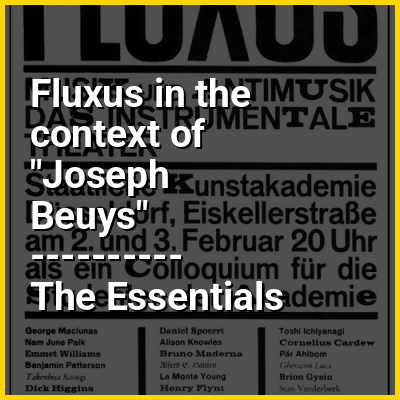
Fluxus was an international, interdisciplinary community of artists, composers, designers, and poets during the 1960s and 1970s who, inspired by John Cage, engaged in experimental art performances which emphasized the artistic tradition of chance-based process over the finished product. Fluxus is known for experimental contributions to different artistic media and disciplines and for generating new art forms. These art forms include intermedia, a term coined by Fluxus artist Dick Higgins; conceptual art, first developed by Henry Flynt, an artist contentiously associated with Fluxus; and video art, first pioneered by Nam June Paik and Wolf Vostell. Dutch gallerist and art critic Harry Ruhé describes Fluxus as "the most radical and experimental art movement of the sixties".

They produced performance "events", which included enactments of scores, "Neo-Dada" noise music, and time-based works, as well as concrete poetry, visual art, urban planning, architecture, design, literature, and publishing. Many Fluxus artists share anti-commercial and anti-art sensibilities. Fluxus is sometimes described as "intermedia". The ideas and practices of composer John Cage heavily influenced Fluxus, especially his notions that one should embark on an artwork without a conception of its end, and his understanding of the work as a site of interaction between artist and audience. The process of creating was privileged over the finished product. Another notable influence were the readymades of Marcel Duchamp, a French artist who was active in Dada (1916 – c. 1922). George Maciunas, largely considered to be the founder of this fluid movement, coined the name Fluxus in 1961 to title a proposed magazine.
↓ Menu

>>>PUT SHARE BUTTONS HERE<<<

👉 Fluxus in the context of Joseph Beuys

Joseph Heinrich Beuys (/bɔɪs/ BOYSS; German: [ˈjoːzɛf ˈbɔʏs]; 12 May 1921 – 23 January 1986) was a German artist, teacher, performance artist, and art theorist whose work reflected concepts of humanism and sociology. With Heinrich Böll, Johannes Stüttgen (de; fr), Caroline Tisdall, Robert McDowell, and Enrico Wolleb, Beuys created the Free International University for Creativity & Interdisciplinary Research (FIU). Through his talks and performances, he also formed The Party for Animals and The Organisation for Direct Democracy. He was a member of a Dadaist art movement Fluxus and singularly inspirational in developing of Performance Art, called Kunst Aktionen, alongside Wiener Aktionismus that Allan Kaprow and Carolee Schneemann termed Art Happenings.

According to his biographer Reinhard Ermen, he can be seen as the “ideal antagonist” of Andy Warhol..

↓ Explore More Topics
In this Dossier

Fluxus in the context of Noise music

Noise music (or simply noise) is a subgenre of experimental music that is characterised by its use of unwanted noise as a primary musical element. The genre has roots in early 20th century avant-garde music, but later drew influence from industrial music. It is characterized by a rejection of conventional music theory and traditional song structures, often featuring little or no melody, rhythm, or harmony. This type of music tends to challenge the conventional distinction between musical and non-musical sound.

"Noise as music" originated as an avant-garde music style in the 1910s through the work of Luigi Russolo an Italian Futurist, who published the manifesto The Art of Noises in 1913. Elements of noise music were later explored by artists in the Dada and Fluxus movements, as well as through electroacoustic music, modern classical and musique concrète. Composers such as John Cage, Edgard Varèse and James Tenney would explicitly use the term "noise" to describe some of their experimental practices. During the 1960s and 1970s, compositions such as Robert Ashley's "The Wolfman" (1964) and Pauline Oliveros "A Little Noise In The System" (1967) were among the earliest examples of contemporary noise music. While works by non-academic artists such as Lou Reed's Metal Machine Music were influential for later noise artists.

↑ Return to Menu

Fluxus in the context of Dada

Dada (/ˈdɑːdɑː/) or Dadaism was an international art movement that developed in the context of the Great War and Futurism first established in Zürich, Switzerland, and later quickly spread to Berlin, Paris, New York City and a variety of artistic centers in Europe and Asia. The Dada movement's principles were first collected in Hugo Ball's Dada Manifesto in 1916. Ball is seen as the founder of the Dada movement. Key figures in the movement included Hugo Ball, Emmy Hennings, Jean Arp, Johannes Baader, Marcel Duchamp, Max Ernst, Elsa von Freytag-Loringhoven, George Grosz, Raoul Hausmann, John Heartfield, Hannah Höch, Richard Huelsenbeck, Francis Picabia, Man Ray, Hans Richter, Kurt Schwitters, Sophie Taeuber-Arp, Tristan Tzara, and Beatrice Wood, among others. The movement influenced later styles like the avant-garde and downtown music movements, and groups including Surrealism, nouveau réalisme, pop art, and Fluxus.

↑ Return to Menu

Fluxus in the context of La Monte Young

La Monte Thornton Young (born October 14, 1935) is an American composer, musician, and performance artist recognized as one of the first American minimalist composers and a central figure in post-war avant-garde music. He is best known for his exploration of sustained tones, beginning with his 1958 composition Trio for Strings. His compositions have called into question the nature and definition of music, most prominently in the text scores of his Compositions 1960. While few of his recordings remain in print, his work has inspired prominent musicians across various genres, including avant-garde, rock, and ambient music.

Young played jazz saxophone and studied composition in California during the 1950s, and subsequently moved to New York in 1960, where he was a central figure in the downtown music and Fluxus art scenes. He then became known for his pioneering work in drone music (originally called dream music) with his Theatre of Eternal Music collective, alongside collaborators such as Tony Conrad, John Cale, and his wife, the multimedia artist Marian Zazeela. In 1964, he began work on his unfinished improvisatory composition The Well-Tuned Piano, iterations of which he has performed throughout subsequent decades.

↑ Return to Menu

Fluxus in the context of Sound collage

In music, montage (literally "putting together") or sound collage ("gluing together") is a technique where newly branded sound objects or compositions, including songs, are created from collage, also known as musique concrète. This is often done through the use of sampling, while some sound collages are produced by gluing together sectors of different vinyl records. Like its visual cousin, sound collage works may have a completely different effect than that of the component parts, even if the original parts are recognizable or from a single source. Audio collage was a feature of the audio art of John Cage, Fluxus, postmodern hip-hop and postconceptual digital art.

↑ Return to Menu

Fluxus in the context of Intermedia

Intermedia is an art theory term coined in the mid-1960s by Fluxus artist Dick Higgins to describe the strategies of interdisciplinarity that occur within artworks existing between artistic genres. It was also used by John Brockman to refer to works in expanded cinema that were associated with Jonas Mekas' Film-Makers’ Cinematheque. Gene Youngblood also described intermedia, beginning in his Intermedia column for the Los Angeles Free Press beginning in 1967 as a part of a global network of multiple media that was expanding consciousness. Youngblood gathered and expanded upon intermedia ideas from this series of columns in his 1970 book Expanded Cinema, with an introduction by Buckminster Fuller. Over the years, intermedia has been used almost interchangeably with multi-media and more recently with the categories of digital media, technoetics, electronic media and post-conceptualism.

↑ Return to Menu

Fluxus in the context of Nam June Paik

Nam June Paik (Korean백남준; July 20, 1932 – January 29, 2006) was a South Korean artist. He worked with a variety of media and is considered to be the founder of video art. He is credited with the first use (1974) of the term "electronic super highway" to describe the future of telecommunications.

Born in Seoul to a wealthy business family, Paik trained as a classical musician, spending time in Japan and West Germany, where he joined the Fluxus collective and developed a friendship with experimental composer John Cage. He moved to New York City in 1964 and began working with cellist Charlotte Moorman to create performance art. Soon after, he began to incorporate televisions and video tape recorders into his work, acquiring growing fame. A stroke in 1996 left him partially paralyzed for the last decade of his life.

↑ Return to Menu

Fluxus in the context of Ray Johnson

Raymond Edward "Ray" Johnson (October 16, 1927 – January 13, 1995) was an American artist. Known primarily as a collagist and correspondence artist, he was a seminal figure in the history of Neo-Dada and early Pop art and was described as "New York's most famous unknown artist". Johnson also staged and participated in early performance art events as the founder of a far-ranging mail art network – the New York Correspondence School – which picked up momentum in the 1960s and is still active today. He is occasionally associated with members of the Fluxus movement but was never a member. He lived in New York City from 1949 to 1968, when he moved to a small town in Long Island and remained there until his suicide.

↑ Return to Menu