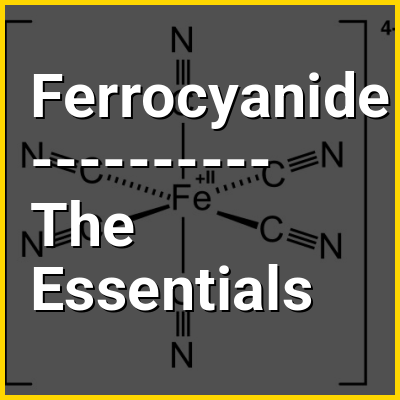
Ferrocyanide is the anion [Fe(CN)6]. Salts of this coordination complex give yellow solutions. It is usually available as the salt potassium ferrocyanide, which has the formula K4Fe(CN)6. [Fe(CN)6] is a diamagnetic species, featuring low-spin iron(II) center in an octahedral ligand environment. Although many salts of cyanide are highly toxic, ferro- and ferricyanides are less toxic because they tend not to release free cyanide. It is of commercial interest as a precursor to the pigment Prussian blue and, as its potassium salt, an anticaking agent.
HINT:
In this Dossier
- ⭐ Core Definition: Ferrocyanide
- Ferrocyanide in the context of Prussian blue
- Ferrocyanide in the context of Ferrous
Ferrocyanide in the context of Prussian blue
Prussian blue (also known as Berlin blue, Brandenburg blue, Parisian and Paris blue) is a dark blue pigment produced by oxidation of ferrous ferrocyanide salts. It has the chemical formula Fe4[Fe(CN)6]3. It consists of Fe cations, where iron is in the oxidation state of +3, and [Fe(CN)6] anions, where iron is in the oxidation state of +2, so, the other name of this salt is iron(III) hexacyanoferrate(II). Turnbull's blue is essentially identical chemically, excepting that it has different impurities and particle sizes—because it is made from different reagents—and thus it has a slightly different color.
Prussian blue was created in the early 18th century and is the first modern synthetic pigment. It is prepared as a very fine colloidal dispersion, because the compound is not soluble in water. It contains variable amounts of other ions and its appearance depends sensitively on the size of the colloidal particles. The pigment is used in paints, it became prominent in 19th-century aizuri-e (藍摺り絵) Japanese woodblock prints, and it is the traditional "blue" in technical blueprints.
View the full Wikipedia page for Prussian blueFerrocyanide in the context of Ferrous
In chemistry, iron(II) refers to the element iron in its +2 oxidation state. The adjective ferrous or the prefix ferro- is often used to specify such compounds, as in ferrous chloride for iron(II) chloride (FeCl2). The adjective ferric is used instead for iron(III) salts, containing the cation Fe. The word ferrous is derived from the Latin word ferrum, meaning "iron".
In ionic compounds (salts), such an atom may occur as a separate cation (positive ion) abbreviated as Fe, although more precise descriptions include other ligands such as water and halides. Iron(II) centres occur in coordination complexes, such as in the anion ferrocyanide, [Fe(CN)6], where six cyanide ligands are bound the metal centre; or, in organometallic compounds, such as the ferrocene [Fe(C5H5)2], where two cyclopentadienyl anions are bound to the Fe centre.
View the full Wikipedia page for Ferrous