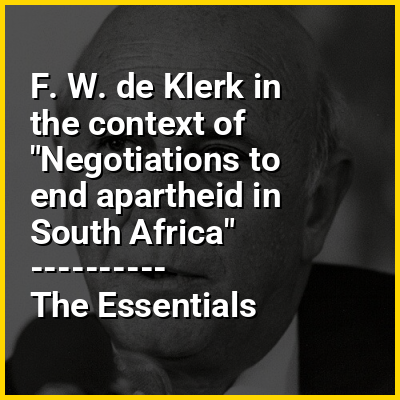
F. W. de Klerk in the context of "Negotiations to end apartheid in South Africa"

Play Trivia Questions online!

or

Skip to study material about F. W. de Klerk in the context of "Negotiations to end apartheid in South Africa"

Ad spacer

⭐ Core Definition: F. W. de Klerk

Frederik Willem de Klerk OMG DMS (/də ˈklɜːrk, də ˈklɛərk/ də-KLURK, də-KLAIRK, Afrikaans: [ˈfriədərək ˈvələm ˈklɛrk]; 18 March 1936 – 11 November 2021) was a South African politician who served as final state president of South Africa from 1989 to 1994 and as deputy president alongside Thabo Mbeki under President Nelson Mandela from 1994 to 1996. As South Africa's last head of state from the era of white-minority rule, he and his government dismantled the apartheid system and introduced universal suffrage. Ideologically a social conservative and an economic liberal, he led the National Party (NP) from 1989 to 1997.

Born in Johannesburg to an influential Afrikaner family, de Klerk studied at Potchefstroom University before pursuing a career in law. Joining the NP, to which he had family ties, he was elected to parliament and sat in the white-minority government of P. W. Botha, holding a succession of ministerial posts. As a minister, he supported and enforced apartheid, a system of racial segregation that privileged white South Africans. After Botha resigned in 1989, de Klerk replaced him, first as leader of the NP and then as State President. Although observers expected him to continue Botha's defence of apartheid, de Klerk decided to end the policy. He was aware that growing ethnic animosity and violence was leading South Africa into a racial civil war. Amid this violence, the state security forces committed widespread human rights abuses and encouraged violence between the Xhosa and Zulu people, although de Klerk later denied sanctioning such actions. He permitted anti-apartheid marches to take place, legalised a range of previously banned anti-apartheid political parties, and freed imprisoned anti-apartheid activists such as Nelson Mandela. He also dismantled South Africa's nuclear weapons program.
↓ Menu

>>>PUT SHARE BUTTONS HERE<<<

👉 F. W. de Klerk in the context of Negotiations to end apartheid in South Africa

The apartheid system in South Africa was ended through a series of bilateral and multi-party negotiations between 1990 and 1993. The negotiations culminated in the passage of a new interim Constitution in 1993, a precursor to the Constitution of 1996; and in South Africa's first non-racial elections in 1994, won by the African National Congress (ANC) liberation movement.

Although there had been gestures towards negotiations in the 1970s and 1980s, the process accelerated in 1990, when the government of F. W. de Klerk took a number of unilateral steps towards reform, including releasing Nelson Mandela from prison and unbanning the ANC and other political organisations. In 1990–91, bilateral "talks about talks" between the ANC and the government established the pre-conditions for substantive negotiations, codified in the Groote Schuur Minute and Pretoria Minute. The first multi-party agreement on the desirability of a negotiated settlement was the 1991 National Peace Accord, consolidated later that year by the establishment of the multi-party Convention for a Democratic South Africa (CODESA). However, the second plenary session of CODESA, in May 1992, encountered stubborn deadlock over questions of regional autonomy, political and cultural self-determination, and the constitution-making process itself.

↓ Explore More Topics
In this Dossier

F. W. de Klerk in the context of KwaZulu

KwaZulu was a semi-independent Bantustan in South Africa, intended by the apartheid government as a homeland for the Zulu people. The capital was moved from Nongoma to Ulundi in 1980.

It was led until its abolition in 1994 by Chief Mangosuthu Buthelezi and head of Inkatha, who implemented the limited self-governing powers decided by the South African government as part of apartheid, but rejected the nominal independence which four other homelands accepted, complaining about the fragmented nature of the state, and the inability of the apartheid government to consolidate a viable and contiguous territory for KwaZulu, in the face of stiff resistance from whites. F. W. de Klerk later commented in an interview that he believed that Buthelezi would have accepted independence had his homeland been given the port of Richards Bay, a proposal that failed due to the white population's resistance to the idea.

↑ Return to Menu