Expected value in the context of Integral


Expected value in the context of Integral

Expected value Study page number 1 of 2

Play TriviaQuestions Online!

or

Skip to study material about Expected value in the context of "Integral"


⭐ Core Definition: Expected value

In probability theory, the expected value (also called expectation, expectancy, expectation operator, mathematical expectation, mean, expectation value, or first moment) is a generalization of the weighted average.

The expected value of a random variable with a finite number of outcomes is a weighted average of all possible outcomes. In the case of a continuum of possible outcomes, the expectation is defined by integration. In the axiomatic foundation for probability provided by measure theory, the expectation is given by Lebesgue integration.

↓ Menu
HINT:

In this Dossier

Expected value in the context of Mean

A mean is a quantity representing the "center" of a collection of numbers and is intermediate to the extreme values of the set of numbers. There are several kinds of means (or "measures of central tendency") in mathematics, especially in statistics. Each attempts to summarize or typify a given group of data, illustrating the magnitude and sign of the data set. Which of these measures is most illuminating depends on what is being measured, and on context and purpose.

The arithmetic mean, also known as "arithmetic average", is the sum of the values divided by the number of values. The arithmetic mean of a set of numbers x1, x2, ..., xn is typically denoted using an overhead bar, . If the numbers are from observing a sample of a larger group, the arithmetic mean is termed the sample mean () to distinguish it from the group mean (or expected value) of the underlying distribution, denoted or .

View the full Wikipedia page for Mean
↑ Return to Menu

Expected value in the context of Entropy (information theory)

In information theory, the entropy of a random variable quantifies the average level of uncertainty or information associated with the variable's potential states or possible outcomes. This measures the expected amount of information needed to describe the state of the variable, considering the distribution of probabilities across all potential states. Given a discrete random variable , which may be any member within the set and is distributed according to , the entropy iswhere denotes the sum over the variable's possible values. The choice of base for , the logarithm, varies for different applications. Base 2 gives the unit of bits (or "shannons"), while base e gives "natural units" nat, and base 10 gives units of "dits", "bans", or "hartleys". An equivalent definition of entropy is the expected value of the self-information of a variable.

The concept of information entropy was introduced by Claude Shannon in his 1948 paper "A Mathematical Theory of Communication", and is also referred to as Shannon entropy. Shannon's theory defines a data communication system composed of three elements: a source of data, a communication channel, and a receiver. The "fundamental problem of communication" – as expressed by Shannon – is for the receiver to be able to identify what data was generated by the source, based on the signal it receives through the channel. Shannon considered various ways to encode, compress, and transmit messages from a data source, and proved in his source coding theorem that the entropy represents an absolute mathematical limit on how well data from the source can be losslessly compressed onto a perfectly noiseless channel. Shannon strengthened this result considerably for noisy channels in his noisy-channel coding theorem.

View the full Wikipedia page for Entropy (information theory)
↑ Return to Menu

Expected value in the context of Fitness (biology)

Fitness (often denoted or ω in population genetics models) is a quantitative representation of individual reproductive success. It is also equal to the average contribution to the gene pool of the next generation, made by the same individuals of the specified genotype or phenotype. Fitness can be defined either with respect to a genotype or to a phenotype in a given environment or time. The fitness of a genotype is manifested through its phenotype, which is also affected by the developmental environment. The fitness of a given phenotype can also be different in different selective environments.

With asexual reproduction, it is sufficient to assign fitnesses to genotypes. With sexual reproduction, recombination scrambles alleles into different genotypes every generation; in this case, fitness values can be assigned to alleles by averaging over possible genetic backgrounds. Natural selection tends to make alleles with higher fitness more common over time, resulting in Darwinian evolution.

View the full Wikipedia page for Fitness (biology)
↑ Return to Menu

Expected value in the context of Variance

In probability theory and statistics, variance is the expected value of the squared deviation from the mean of a random variable. The standard deviation (SD) is obtained as the square root of the variance. Variance is a measure of dispersion, meaning it is a measure of how far a set of numbers are spread out from their average value. It is the second central moment of a distribution, and the covariance of the random variable with itself, and it is often represented by , , , , or .

An advantage of variance as a measure of dispersion is that it is more amenable to algebraic manipulation than other measures of dispersion such as the expected absolute deviation; for example, the variance of a sum of uncorrelated random variables is equal to the sum of their variances. A disadvantage of the variance for practical applications is that, unlike the standard deviation, its units differ from the random variable, which is why the standard deviation is more commonly reported as a measure of dispersion once the calculation is finished. Another disadvantage is that the variance is not finite for many distributions.

View the full Wikipedia page for Variance
↑ Return to Menu

Expected value in the context of Normal distribution

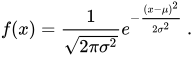
In probability theory and statistics, a normal distribution or Gaussian distribution is a type of continuous probability distribution for a real-valued random variable. The general form of its probability density function is

The parameter is the mean or expectation of the distribution (and also its median and mode), while the parameter is the variance. The standard deviation of the distribution is (sigma). A random variable with a Gaussian distribution is said to be normally distributed and is called a normal deviate.

View the full Wikipedia page for Normal distribution
↑ Return to Menu

Expected value in the context of Standard deviation

In statistics, the standard deviation is a measure of the amount of variation of the values of a variable about its mean. A low standard deviation indicates that the values tend to be close to the mean (also called the expected value) of the set, while a high standard deviation indicates that the values are spread out over a wider range. The standard deviation is commonly used in the determination of what constitutes an outlier and what does not. Standard deviation may be abbreviated SD or std dev, and is most commonly represented in mathematical texts and equations by the lowercase Greek letter σ (sigma), for the population standard deviation, or the Latin letter s, for the sample standard deviation.

The standard deviation of a random variable, sample, statistical population, data set, or probability distribution is the square root of its variance. (For a finite population, variance is the average of the squared deviations from the mean.) A useful property of the standard deviation is that, unlike the variance, it is expressed in the same unit as the data. Standard deviation can also be used to calculate standard error for a finite sample, and to determine statistical significance.

View the full Wikipedia page for Standard deviation
↑ Return to Menu

Expected value in the context of Unbiased estimator

All else being equal, an unbiased estimator is preferable to a biased estimator, although in practice, biased estimators (with generally small bias) are frequently used. When a biased estimator is used, bounds of the bias are calculated. A biased estimator may be used for various reasons: because an unbiased estimator does not exist without further assumptions about a population; because an estimator is difficult to compute (as in unbiased estimation of standard deviation); because a biased estimator may be unbiased with respect to different measures of central tendency; because a biased estimator gives a lower value of some loss function (particularly mean squared error) compared with unbiased estimators (notably in shrinkage estimators); or because in some cases being unbiased is too strong a condition, and the only unbiased estimators are not useful.

View the full Wikipedia page for Unbiased estimator
↑ Return to Menu

Expected value in the context of Sample statistics

A statistic (singular) or sample statistic is any quantity computed from values in a sample which is considered for a statistical purpose. Statistical purposes include estimating a population parameter, describing a sample, or evaluating a hypothesis. The average (or mean) of sample values is a statistic. The term statistic is used both for the function (e.g., a calculation method of the average) and for the value of the function on a given sample (e.g., the result of the average calculation). When a statistic is being used for a specific purpose, it may be referred to by a name indicating its purpose.

When a statistic is used for estimating a population parameter, the statistic is called an estimator. A population parameter is any characteristic of a population under study, but when it is not feasible to directly measure the value of a population parameter, statistical methods are used to infer the likely value of the parameter on the basis of a statistic computed from a sample taken from the population. For example, the sample mean is an unbiased estimator of the population mean. This means that the expected value of the sample mean equals the true population mean.

View the full Wikipedia page for Sample statistics
↑ Return to Menu

Expected value in the context of Von Neumann–Morgenstern utility theorem

In decision theory, the von Neumann–Morgenstern (VNM) utility theorem demonstrates that rational choice under uncertainty involves making decisions that take the form of maximizing the expected value of some cardinal utility function. The theorem forms the foundation of expected utility theory.

In 1947, John von Neumann and Oskar Morgenstern proved that any individual whose preferences satisfied four axioms has a utility function, where such an individual's preferences can be represented on an interval scale and the individual will always prefer actions that maximize expected utility. That is, they proved that an agent is (VNM-)rational if and only if there exists a real-valued function u defined by possible outcomes such that every preference of the agent is characterized by maximizing the expected value of u, which can then be defined as the agent's VNM-utility (it is unique up to affine transformations i.e. adding a constant and multiplying by a positive scalar). No claim is made that the agent has a "conscious desire" to maximize u, only that u exists.

View the full Wikipedia page for Von Neumann–Morgenstern utility theorem
↑ Return to Menu

Expected value in the context of Optimal decision

An optimal decision is a decision that leads to at least as good a known or expected outcome as all other available decision options. It is an important concept in decision theory. In order to compare the different decision outcomes, one commonly assigns a utility value to each of them.

If there is uncertainty as to what the outcome will be but one has knowledge about the distribution of the uncertainty, then under the von Neumann–Morgenstern axioms the optimal decision maximizes the expected utility (a probability–weighted average of utility over all possible outcomes of a decision). Sometimes, the equivalent problem of minimizing the expected value of loss is considered, where loss is (–1) times utility. Another equivalent problem is minimizing expected regret.

View the full Wikipedia page for Optimal decision
↑ Return to Menu

Expected value in the context of Shannon (unit)

The shannon (symbol: Sh) is a unit of information named after Claude Shannon, the founder of information theory. IEC 80000-13 defines the shannon as the information content associated with an event when the probability of the event occurring is 1/2. It is understood as such within the realm of information theory, and is conceptually distinct from the bit, a term used in data processing and storage to denote a single instance of a binary signal. A sequence of n binary symbols (such as contained in computer memory or a binary data transmission) is properly described as consisting of n bits, but the information content of those n symbols may be more or less than n shannons depending on the a priori probability of the actual sequence of symbols.

The shannon also serves as a unit of the information entropy of an event, which is defined as the expected value of the information content of the event (i.e., the probability-weighted average of the information content of all potential events). Given a number of possible outcomes, unlike information content, the entropy has an upper bound, which is reached when the possible outcomes are equiprobable. The maximum entropy of n bits is n Sh. A further quantity that it is used for is channel capacity, which is generally the maximum of the expected value of the information content encoded over a channel that can be transferred with negligible probability of error, typically in the form of an information rate.

View the full Wikipedia page for Shannon (unit)
↑ Return to Menu

Expected value in the context of Mutual information

In probability theory and information theory, the mutual information (MI) of two random variables is a measure of the mutual dependence between the two variables. More specifically, it quantifies the "amount of information" (in units such as shannons (bits), nats or hartleys) obtained about one random variable by observing the other random variable. The concept of mutual information is intimately linked to that of entropy of a random variable, a fundamental notion in information theory that quantifies the expected "amount of information" held in a random variable.

Not limited to real-valued random variables and linear dependence like the correlation coefficient, MI is more general and determines how different the joint distribution of the pair is from the product of the marginal distributions of and . MI is the expected value of the pointwise mutual information (PMI).

View the full Wikipedia page for Mutual information
↑ Return to Menu

Expected value in the context of Fisher information

In mathematical statistics, the Fisher information is a way of measuring the amount of information that an observable random variable X carries about an unknown parameter θ of a distribution that models X. Formally, it is the variance of the score, or the expected value of the observed information.

The role of the Fisher information in the asymptotic theory of maximum-likelihood estimation was emphasized and explored by the statistician Sir Ronald Fisher (following some initial results by Francis Ysidro Edgeworth). The Fisher information matrix is used to calculate the covariance matrices associated with maximum-likelihood estimates. It can also be used in the formulation of test statistics, such as the Wald test.

View the full Wikipedia page for Fisher information
↑ Return to Menu

Expected value in the context of Squared deviations from the mean

Squared deviations from the mean (SDM) result from squaring deviations. In probability theory and statistics, the definition of variance is either the expected value of the SDM (when considering a theoretical distribution) or its average value (for actual experimental data). Computations for analysis of variance involve the partitioning of a sum of SDM.

View the full Wikipedia page for Squared deviations from the mean
↑ Return to Menu

Expected value in the context of Central moment

In probability theory and statistics, a central moment is a moment of a probability distribution of a random variable about the random variable's mean; that is, it is the expected value of a specified integer power of the deviation of the random variable from the mean. The various moments form one set of values by which the properties of a probability distribution can be usefully characterized. Central moments are used in preference to ordinary moments, computed in terms of deviations from the mean instead of from zero, because the higher-order central moments relate only to the spread and shape of the distribution, rather than also to its location.

Sets of central moments can be defined for both univariate and multivariate distributions.

View the full Wikipedia page for Central moment
↑ Return to Menu

Expected value in the context of Sample standard deviation

In statistics, the standard deviation is a measure of the amount of variation of the values of a variable about its mean. A low standard deviation indicates that the values tend to be close to the mean (also called the expected value) of the set, while a high standard deviation indicates that the values are spread out over a wider range. Standard deviation may be abbreviated SD or std dev, and is most commonly represented in mathematical texts and equations by the lowercase Greek letter σ (sigma), for the population standard deviation, or the Latin letter s, for the sample standard deviation.

The standard deviation of a random variable, sample, statistical population, data set, or probability distribution is the square root of its variance. (For a finite population, variance is the average of the squared deviations from the mean.) A useful property of the standard deviation is that, unlike the variance, it is expressed in the same unit as the data. Standard deviation can also be used to calculate standard error for a finite sample, and to determine statistical significance.

View the full Wikipedia page for Sample standard deviation
↑ Return to Menu