Random variable in the context of Central moment


Random variable in the context of Central moment

Random variable Study page number 1 of 5

Play TriviaQuestions Online!

or

Skip to study material about Random variable in the context of "Central moment"


⭐ Core Definition: Random variable

A random variable (also called random quantity, aleatory variable, or stochastic variable) is a mathematical formalization of a quantity or object which depends on random events. The term 'random variable' in its mathematical definition refers to neither randomness nor variability but instead is a mathematical function in which

  • the domain is the set of possible outcomes in a sample space (e.g. the set which are the possible upper sides of a flipped coin heads or tails as the result from tossing a coin); and
  • the range is a measurable space (e.g. corresponding to the domain above, the range might be the set if say heads mapped to -1 and mapped to 1). Typically, the range of a random variable is a subset of the real numbers.

Informally, randomness typically represents some fundamental element of chance, such as in the roll of a die; it may also represent uncertainty, such as measurement error. However, the interpretation of probability is philosophically complicated, and even in specific cases is not always straightforward. The purely mathematical analysis of random variables is independent of such interpretational difficulties, and can be based upon a rigorous axiomatic setup.

↓ Menu
HINT:

In this Dossier

Random variable in the context of Independence (probability theory)

Independence is a fundamental notion in probability theory, as in statistics and the theory of stochastic processes. Two events are independent, statistically independent, or stochastically independent if, informally speaking, the occurrence of one does not affect the probability of occurrence of the other or, equivalently, does not affect the odds. Similarly, two random variables are independent if the realization of one does not affect the probability distribution of the other.

When dealing with collections of more than two events, two notions of independence need to be distinguished. The events are called pairwise independent if any two events in the collection are independent of each other, while mutual independence (or collective independence) of events means, informally speaking, that each event is independent of any combination of other events in the collection. A similar notion exists for collections of random variables. Mutual independence implies pairwise independence, but not the other way around. In the standard literature of probability theory, statistics, and stochastic processes, independence without further qualification usually refers to mutual independence.

View the full Wikipedia page for Independence (probability theory)
↑ Return to Menu

Random variable in the context of Random

In common usage, randomness is the apparent or actual lack of definite patterns or predictability in information. A random sequence of events, symbols or steps often has no order and does not follow an intelligible pattern or combination. Individual random events are, by definition, unpredictable, but if there is a known probability distribution, the frequency of different outcomes over repeated events (or "trials") is predictable. For example, when throwing two dice, the outcome of any particular roll is unpredictable, but a sum of 7 will tend to occur twice as often as 4. In this view, randomness is not haphazardness; it is a measure of uncertainty of an outcome. Randomness applies to concepts of chance, probability, and information entropy.

The fields of mathematics, probability, and statistics use formal definitions of randomness, typically assuming that there is some 'objective' probability distribution. In statistics, a random variable is an assignment of a numerical value to each possible outcome of an event space. This association facilitates the identification and the calculation of probabilities of the events. Random variables can appear in random sequences. A random process is a sequence of random variables whose outcomes do not follow a deterministic pattern, but follow an evolution described by probability distributions. These and other constructs are extremely useful in probability theory and the various applications of randomness.

View the full Wikipedia page for Random
↑ Return to Menu

Random variable in the context of Entropy (information theory)

In information theory, the entropy of a random variable quantifies the average level of uncertainty or information associated with the variable's potential states or possible outcomes. This measures the expected amount of information needed to describe the state of the variable, considering the distribution of probabilities across all potential states. Given a discrete random variable , which may be any member within the set and is distributed according to , the entropy iswhere denotes the sum over the variable's possible values. The choice of base for , the logarithm, varies for different applications. Base 2 gives the unit of bits (or "shannons"), while base e gives "natural units" nat, and base 10 gives units of "dits", "bans", or "hartleys". An equivalent definition of entropy is the expected value of the self-information of a variable.

The concept of information entropy was introduced by Claude Shannon in his 1948 paper "A Mathematical Theory of Communication", and is also referred to as Shannon entropy. Shannon's theory defines a data communication system composed of three elements: a source of data, a communication channel, and a receiver. The "fundamental problem of communication" – as expressed by Shannon – is for the receiver to be able to identify what data was generated by the source, based on the signal it receives through the channel. Shannon considered various ways to encode, compress, and transmit messages from a data source, and proved in his source coding theorem that the entropy represents an absolute mathematical limit on how well data from the source can be losslessly compressed onto a perfectly noiseless channel. Shannon strengthened this result considerably for noisy channels in his noisy-channel coding theorem.

View the full Wikipedia page for Entropy (information theory)
↑ Return to Menu

Random variable in the context of Information theory

Information theory is the mathematical study of the quantification, storage, and communication of information. The field was established and formalized by Claude Shannon in the 1940s, though early contributions were made in the 1920s through the works of Harry Nyquist and Ralph Hartley. It is at the intersection of electronic engineering, mathematics, statistics, computer science, neurobiology, physics, and electrical engineering.

A key measure in information theory is entropy. Entropy quantifies the amount of uncertainty involved in the value of a random variable or the outcome of a random process. For example, identifying the outcome of a fair coin flip (which has two equally likely outcomes) provides less information (lower entropy, less uncertainty) than identifying the outcome from a roll of a die (which has six equally likely outcomes). Some other important measures in information theory are mutual information, channel capacity, error exponents, and relative entropy. Important sub-fields of information theory include source coding, algorithmic complexity theory, algorithmic information theory and information-theoretic security.

View the full Wikipedia page for Information theory
↑ Return to Menu

Random variable in the context of Correlation and dependence

In statistics, correlation or dependence is any statistical relationship, whether causal or not, between two random variables or bivariate data. Although in the broadest sense, "correlation" may indicate any type of association, in statistics it usually refers to the degree to which a pair of variables are linearly related. Familiar examples of dependent phenomena include the correlation between the height of parents and their offspring, and the correlation between the price of a good and the quantity the consumers are willing to purchase, as it is depicted in the demand curve.

Correlations are useful because they can indicate a predictive relationship that can be exploited in practice. For example, an electrical utility may produce less power on a mild day based on the correlation between electricity demand and weather. In this example, there is a causal relationship, because extreme weather causes people to use more electricity for heating or cooling. However, in general, the presence of a correlation is not sufficient to infer the presence of a causal relationship (i.e., correlation does not imply causation).

View the full Wikipedia page for Correlation and dependence
↑ Return to Menu

Random variable in the context of Likelihood

A likelihood function (often simply called the likelihood) measures how well a statistical model explains observed data by calculating the probability of seeing that data under different parameter values of the model. It is constructed from the joint probability distribution of the random variable that (presumably) generated the observations. When evaluated on the actual data points, it becomes a function solely of the model parameters.

In maximum likelihood estimation, the model parameter(s) or argument that maximizes the likelihood function serves as a point estimate for the unknown parameter, while the Fisher information (often approximated by the likelihood's Hessian matrix at the maximum) gives an indication of the estimate's precision.

View the full Wikipedia page for Likelihood
↑ Return to Menu

Random variable in the context of Probability theory

Probability theory or probability calculus is the branch of mathematics concerned with probability. Although there are several different probability interpretations, probability theory treats the concept in a rigorous mathematical manner by expressing it through a set of axioms. Typically these axioms formalise probability in terms of a probability space, which assigns a measure taking values between 0 and 1, termed the probability measure, to a set of outcomes called the sample space. Any specified subset of the sample space is called an event.

Central subjects in probability theory include discrete and continuous random variables, probability distributions, and stochastic processes (which provide mathematical abstractions of non-deterministic or uncertain processes or measured quantities that may either be single occurrences or evolve over time in a random fashion).Although it is not possible to perfectly predict random events, much can be said about their behavior. Two major results in probability theory describing such behaviour are the law of large numbers and the central limit theorem.

View the full Wikipedia page for Probability theory
↑ Return to Menu

Random variable in the context of Skewness

Skewness in probability theory and statistics is a measure of the asymmetry of the probability distribution of a real-valued random variable about its mean. Similarly to kurtosis, it provides insights into characteristics of a distribution. The skewness value can be positive, zero, negative, or undefined.

For a unimodal distribution (a distribution with a single peak), negative skew commonly indicates that the tail is on the left side of the distribution, and positive skew indicates that the tail is on the right. In cases where one tail is long but the other tail is fat, skewness does not obey a simple rule. For example, a zero value in skewness means that the tails on both sides of the mean balance out overall; this is the case for a symmetric distribution but can also be true for an asymmetric distribution where one tail is long and thin, and the other is short but fat. Thus, the judgement on the symmetry of a given distribution by using only its skewness is risky; the distribution shape must be taken into account.

View the full Wikipedia page for Skewness
↑ Return to Menu

Random variable in the context of Quantile

In statistics and probability, quantiles are cut points dividing the range of a probability distribution into continuous intervals with equal probabilities or dividing the observations in a sample in the same way. There is one fewer quantile than the number of groups created. Common quantiles have special names, such as quartiles (four groups), deciles (ten groups), and percentiles (100 groups). The groups created are termed halves, thirds, quarters, etc., though sometimes the terms for the quantile are used for the groups created, rather than for the cut points.

q-quantiles are values that partition a finite set of values into q subsets of (nearly) equal sizes. There are q − 1 partitions of the q-quantiles, one for each integer k satisfying 0 < k < q. In some cases the value of a quantile may not be uniquely determined, as can be the case for the median (2-quantile) of a uniform probability distribution on a set of even size. Quantiles can also be applied to continuous distributions, providing a way to generalize rank statistics to continuous variables (see percentile rank). When the cumulative distribution function of a random variable is known, the q-quantiles are the application of the quantile function (the inverse function of the cumulative distribution function) to the values {1/q, 2/q, …, (q − 1)/q}.

View the full Wikipedia page for Quantile
↑ Return to Menu

Random variable in the context of Variance

In probability theory and statistics, variance is the expected value of the squared deviation from the mean of a random variable. The standard deviation (SD) is obtained as the square root of the variance. Variance is a measure of dispersion, meaning it is a measure of how far a set of numbers are spread out from their average value. It is the second central moment of a distribution, and the covariance of the random variable with itself, and it is often represented by , , , , or .

An advantage of variance as a measure of dispersion is that it is more amenable to algebraic manipulation than other measures of dispersion such as the expected absolute deviation; for example, the variance of a sum of uncorrelated random variables is equal to the sum of their variances. A disadvantage of the variance for practical applications is that, unlike the standard deviation, its units differ from the random variable, which is why the standard deviation is more commonly reported as a measure of dispersion once the calculation is finished. Another disadvantage is that the variance is not finite for many distributions.

View the full Wikipedia page for Variance
↑ Return to Menu

Random variable in the context of Normal distribution

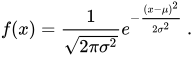
In probability theory and statistics, a normal distribution or Gaussian distribution is a type of continuous probability distribution for a real-valued random variable. The general form of its probability density function is

The parameter is the mean or expectation of the distribution (and also its median and mode), while the parameter is the variance. The standard deviation of the distribution is (sigma). A random variable with a Gaussian distribution is said to be normally distributed and is called a normal deviate.

View the full Wikipedia page for Normal distribution
↑ Return to Menu

Random variable in the context of Probability density function

In probability theory, a probability density function (PDF), density function, or density of an absolutely continuous random variable, is a function whose value at any given sample (or point) in the sample space (the set of possible values taken by the random variable) can be interpreted as providing a relative likelihood that the value of the random variable would be equal to that sample. Probability density is the probability per unit length, in other words. While the absolute likelihood for a continuous random variable to take on any particular value is zero, given there is an infinite set of possible values to begin with. Therefore, the value of the PDF at two different samples can be used to infer, in any particular draw of the random variable, how much more likely it is that the random variable would be close to one sample compared to the other sample.

More precisely, the PDF is used to specify the probability of the random variable falling within a particular range of values, as opposed to taking on any one value. This probability is given by the integral of a continuous variable's PDF over that range, where the integral is the nonnegative area under the density function between the lowest and greatest values of the range. The PDF is nonnegative everywhere, and the area under the entire curve is equal to one, such that the probability of the random variable falling within the set of possible values is 100%.

View the full Wikipedia page for Probability density function
↑ Return to Menu

Random variable in the context of Standard deviation

In statistics, the standard deviation is a measure of the amount of variation of the values of a variable about its mean. A low standard deviation indicates that the values tend to be close to the mean (also called the expected value) of the set, while a high standard deviation indicates that the values are spread out over a wider range. The standard deviation is commonly used in the determination of what constitutes an outlier and what does not. Standard deviation may be abbreviated SD or std dev, and is most commonly represented in mathematical texts and equations by the lowercase Greek letter σ (sigma), for the population standard deviation, or the Latin letter s, for the sample standard deviation.

The standard deviation of a random variable, sample, statistical population, data set, or probability distribution is the square root of its variance. (For a finite population, variance is the average of the squared deviations from the mean.) A useful property of the standard deviation is that, unlike the variance, it is expressed in the same unit as the data. Standard deviation can also be used to calculate standard error for a finite sample, and to determine statistical significance.

View the full Wikipedia page for Standard deviation
↑ Return to Menu

Random variable in the context of Categorical data

In statistics, a categorical variable (also called qualitative variable) is a variable that can take on one of a limited, and usually fixed, number of possible values, assigning each individual or other unit of observation to a particular group or nominal category on the basis of some qualitative property. In computer science and some branches of mathematics, categorical variables are referred to as enumerations or enumerated types. Commonly (though not in this article), each of the possible values of a categorical variable is referred to as a level. The probability distribution associated with a random categorical variable is called a categorical distribution.

Categorical data is the statistical data type consisting of categorical variables or of data that has been converted into that form, for example as grouped data. More specifically, categorical data may derive from observations made of qualitative data that are summarised as counts or cross tabulations, or from observations of quantitative data grouped within given intervals. Often, purely categorical data are summarised in the form of a contingency table. However, particularly when considering data analysis, it is common to use the term "categorical data" to apply to data sets that, while containing some categorical variables, may also contain non-categorical variables. Ordinal variables have a meaningful ordering, while nominal variables have no meaningful ordering.

View the full Wikipedia page for Categorical data
↑ Return to Menu

Random variable in the context of Stochastic processes

In probability theory and related fields, a stochastic (/stəˈkæstɪk/) or random process is a mathematical object usually defined as a family of random variables in a probability space, where the index of the family often has the interpretation of time. Stochastic processes are widely used as mathematical models of systems and phenomena that appear to vary in a random manner. Examples include the growth of a bacterial population, an electrical current fluctuating due to thermal noise, or the movement of a gas molecule. Stochastic processes have applications in many disciplines such as biology, chemistry, ecology, neuroscience, physics, image processing, signal processing, control theory, information theory, computer science, and telecommunications. Furthermore, seemingly random changes in financial markets have motivated the extensive use of stochastic processes in finance.

Applications and the study of phenomena have in turn inspired the proposal of new stochastic processes. Examples of such stochastic processes include the Wiener process or Brownian motion process, used by Louis Bachelier to study price changes on the Paris Bourse, and the Poisson process, used by A. K. Erlang to study the number of phone calls occurring in a certain period of time. These two stochastic processes are considered the most important and central in the theory of stochastic processes, and were invented repeatedly and independently, both before and after Bachelier and Erlang, in different settings and countries.

View the full Wikipedia page for Stochastic processes
↑ Return to Menu

Random variable in the context of Pairwise independence

In probability theory, a pairwise independent collection of random variables is a set of random variables any two of which are independent. Any collection of mutually independent random variables is pairwise independent, but some pairwise independent collections are not mutually independent. Pairwise independent random variables with finite variance are uncorrelated.

A pair of random variables X and Y are independent if and only if the random vector (X, Y) with joint cumulative distribution function (CDF) satisfies

View the full Wikipedia page for Pairwise independence
↑ Return to Menu