Exclusive Economic Zone in the context of "Geography of Venezuela"

Play Trivia Questions online!

or

Skip to study material about Exclusive Economic Zone in the context of "Geography of Venezuela"

Ad spacer

⭐ Core Definition: Exclusive Economic Zone

An exclusive economic zone (EEZ), as prescribed by the 1982 United Nations Convention on the Law of the Sea, is an area of the sea in which a sovereign state has exclusive rights regarding the exploration and use of marine resources, including energy production from water and wind.

It stretches from the outer limit of the territorial sea (22.224 kilometres or 12 nautical miles from the baseline) out 370.4 kilometres (or 200 nautical miles) from the coast of the state in question. It is also referred to as a maritime continental margin and, in colloquial usage, may include the continental shelf. The term does not include either the territorial sea or the continental shelf beyond the 200 nautical mile limit. The difference between the territorial sea and the exclusive economic zone is that the first confers full sovereignty over the waters, whereas the second is merely a "sovereign right" which refers to the coastal state's rights below the surface of the sea. The surface waters are international waters.
↓ Menu

>>>PUT SHARE BUTTONS HERE<<<

👉 Exclusive Economic Zone in the context of Geography of Venezuela

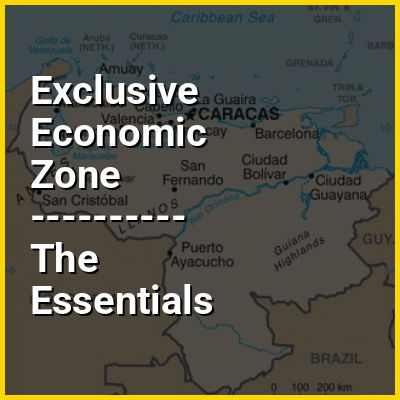
Venezuela is a country in South America, bordering the Caribbean Sea and the North Atlantic Ocean, between Colombia and Guyana. It is situated on major sea and air routes linking North and South America. Located at the northernmost end of South America, Venezuela has a total area of 912,050 km (352,140 sq mi) and a land area of 882,050 km (340,560 sq mi). It is the 32nd largest country and is slightly smaller than Egypt, or half the size of Mexico. Shaped roughly like an inverted triangle, the country has a 2,800 km (1,700 mi) long coastline.

It is bound on the north by the Caribbean Sea and the Atlantic Ocean, on the east by Guyana, on the south by Brazil, and on the west by Colombia. It has the 55th largest Exclusive Economic Zone of 471,507 km (182,050 sq mi). Its maritime territory borders Trinidad and Tobago, Dominica, the Dominican Republic, Grenada, St. Kitts and Nevis, St. Vincent and the Grenadines, France, the United Kingdom, the Netherlands, and the United States. The Guyana–Venezuela territorial dispute has continued since the nineteenth century, with Venezuelan claiming a territory it calls "Guayana Esequiba", which is currently controlled by Guyana.

↓ Explore More Topics
In this Dossier

Exclusive Economic Zone in the context of Outlying territory

An outlying territory or separate area is a state territory geographically separated from its parent territory and lies beyond Exclusive Economic Zone of its parent territory.

The tables below are lists of outlying territories which are marked by distinct, non-contiguous maritime boundaries or land boundaries:

↑ Return to Menu

Exclusive Economic Zone in the context of Cook Islands

The Cook Islands is an island country in Polynesia, part of Oceania, in the South Pacific Ocean. It consists of 15 islands whose total land area is approximately 236.7 square kilometres (91 sq mi). The Cook Islands Exclusive Economic Zone (EEZ) covers 1,960,027 square kilometres (756,771 sq mi) of ocean. Avarua on the main island of Rarotonga is the capital.

The Cook Islands is self-governing while in free association with New Zealand. Since the start of the 21st century, the Cook Islands conducts its own independent foreign and defence policy, and also has its own customs regulations. Like most members of the Pacific Islands Forum, it has no armed forces, but the Cook Islands Police Service owns a Guardian Class Patrol Boat, CIPPB Te Kukupa II, provided by Australia, for policing its waters. In recent decades, the Cook Islands has adopted an increasingly assertive and distinct foreign policy, and a Cook Islander, Henry Puna, served as Secretary General of the Pacific Islands Forum from 2021 to 2024. Most Cook Islanders have New Zealand citizenship, plus the status of Cook Islands nationals, which is not given to other New Zealand citizens. The Cook Islands has been an active member of the Pacific Community, formerly the South Pacific Commission, since 1980.

↑ Return to Menu

Exclusive Economic Zone in the context of Canada–France Maritime Boundary Case

The Canada–France Maritime Boundary Case was a dispute between Canada and France that was decided in 1992 by an arbitral tribunal created by the parties to resolve the dispute. The decision established the extent of the Exclusive Economic Zone of the French territory of Saint Pierre and Miquelon.

↑ Return to Menu

Exclusive Economic Zone in the context of German Maritime Search and Rescue Service

The German Maritime Search and Rescue Service (German: Deutsche Gesellschaft zur Rettung Schiffbrüchiger - DGzRS, German pronunciation: [deːɡeːt͡sɛtʔɛʁˈʔɛs] ; lit. German Society for the Rescue of Shipwrecked Persons) is a membership organisation in Germany. It is responsible for Search and Rescue in German territorial waters in the North Sea and the Baltic Sea, including the Exclusive Economic Zone.

The headquarters and the Maritime Rescue Coordination Centre of the Society are located in Bremen. It was founded in Kiel on 29 May 1865. It owns 60 lifeboats at 55 stations which are operated by 185 employed crew members and 800 volunteers. The society has about 2000 engagements every year. Up to 2019, it rescued approximately 85,000 persons. In 2019 it saved 81 lives, rescued 270 persons from critical situations and carried out 373 medical transports. The DGzRS is entirely financed by membership fees, private donations and legacies.

↑ Return to Menu