Equation in the context of Hyperbolas


Equation in the context of Hyperbolas

Equation Study page number 1 of 4

Play TriviaQuestions Online!

or

Skip to study material about Equation in the context of "Hyperbolas"


⭐ Core Definition: Equation

In mathematics, an equation is a mathematical formula that expresses the equality of two expressions, by connecting them with the equals sign =. The word equation and its cognates in other languages may have subtly different meanings; for example, in French an équation is defined as containing one or more variables, while in English, any well-formed formula consisting of two expressions related with an equals sign is an equation.

Solving an equation containing variables consists of determining which values of the variables make the equality true. The variables for which the equation has to be solved are also called unknowns, and the values of the unknowns that satisfy the equality are called solutions of the equation. There are two kinds of equations: identities and conditional equations. An identity is true for all values of the variables. A conditional equation is only true for particular values of the variables.

↓ Menu
HINT:

In this Dossier

Equation in the context of Pythagorean theorem

In mathematics, the Pythagorean theorem or Pythagoras's theorem is a fundamental relation in Euclidean geometry between the three sides of a right triangle. It states that the area of the square whose side is the hypotenuse (the side opposite the right angle) is equal to the sum of the areas of the squares on the other two sides.

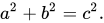
The theorem can be written as an equation relating the lengths of the sides a, b and the hypotenuse c, sometimes called the Pythagorean equation:The theorem is named for the Greek philosopher Pythagoras, born around 570 BC. The theorem has been proved numerous times by many different methods – possibly the most for any mathematical theorem. The proofs are diverse, including both geometric proofs and algebraic proofs, with some dating back thousands of years.

View the full Wikipedia page for Pythagorean theorem
↑ Return to Menu

Equation in the context of Hyperbola

In mathematics, a hyperbola is a type of smooth curve lying in a plane, defined by its geometric properties or by equations for which it is the solution set. A hyperbola has two pieces, called connected components or branches, that are mirror images of each other and resemble two infinite bows. The hyperbola is one of the three kinds of conic section, formed by the intersection of a plane and a double cone. (The other conic sections are the parabola and the ellipse. A circle is a special case of an ellipse.) If the plane intersects both halves of the double cone but does not pass through the apex of the cones, then the conic is a hyperbola.

Besides being a conic section, a hyperbola can arise as the locus of points whose difference of distances to two fixed foci is constant, as a curve for each point of which the rays to two fixed foci are reflections across the tangent line at that point, or as the solution of certain bivariate quadratic equations such as the reciprocal relationship In practical applications, a hyperbola can arise as the path followed by the shadow of the tip of a sundial's gnomon, the shape of an open orbit such as that of a celestial object exceeding the escape velocity of the nearest gravitational body, or the scattering trajectory of a subatomic particle, among others.

View the full Wikipedia page for Hyperbola
↑ Return to Menu

Equation in the context of Algebraic equation

In mathematics, an algebraic equation or polynomial equation is an equation of the form , where P is a polynomial, usually with rational numbers for coefficients.

For example, is an algebraic equation with integer coefficients and

View the full Wikipedia page for Algebraic equation
↑ Return to Menu

Equation in the context of Ad hoc

Ad hoc is a Latin phrase meaning literally 'for this'. In English, it typically signifies a solution designed for a specific purpose, problem, or task rather than a generalized solution adaptable to collateral instances (compare with a priori).

Common examples include ad hoc committees and commissions created at the national or international level for a specific task, and the term is often used to describe arbitration (ad hoc arbitration). In other fields, the term could refer to a military unit created under special circumstances (see task force), a handcrafted network protocol (e.g., ad hoc network), a temporary collaboration among geographically-linked franchise locations (of a given national brand) to issue advertising coupons, or a purpose-specific equation in mathematics or science.

View the full Wikipedia page for Ad hoc
↑ Return to Menu

Equation in the context of Expression (mathematics)

In mathematics, an expression is an arrangement of symbols following the context-dependent, syntactic conventions of mathematical notation. Symbols can denote numbers, variables, operations, and functions. Other symbols include punctuation marks and brackets, used for grouping where there is not a well-defined order of operations.

Expressions are commonly distinguished from formulas: expressions usually denote mathematical objects, whereas formulas are statements about mathematical objects. This is analogous to natural language, where a noun phrase refers to an object, and a whole sentence refers to a fact. For example, and are both expressions, while the inequality is a formula. However, formulas are often considered as expressions that can be evaluated to the Boolean values true or false.

View the full Wikipedia page for Expression (mathematics)
↑ Return to Menu

Equation in the context of Algebraic operation

In mathematics, a basic algebraic operation is a mathematical operation similar to any one of the common operations of elementary algebra, which include addition, subtraction, multiplication, division, raising to a whole number power, and taking roots (fractional power). The operations of elementary algebra may be performed on numbers, in which case they are often called arithmetic operations. They may also be performed, in a similar way, on variables, algebraic expressions, and more generally, on elements of algebraic structures, such as groups and fields.

An algebraic operation on a set may be defined more formally as a function that maps to the tuples of a given length of elements of . The length of the tuples is called the arity of the operation, and each member of the tuple is called an operand. The most common case is the case of arity two, where the operation is called a binary operation and the operands form an ordered pair. A unary operation is an operation of arity one that has only one operand; for example, the square root. An example of a ternary operation (arity three) is the triple product.

View the full Wikipedia page for Algebraic operation
↑ Return to Menu

Equation in the context of Linear equation

In mathematics, a linear equation is an equation that may be put in the form where are the variables (or unknowns), and are the coefficients, which are often real numbers. The coefficients may be considered as parameters of the equation and may be arbitrary expressions, provided they do not contain any of the variables. To yield a meaningful equation, the coefficients are required to not all be zero.

Alternatively, a linear equation can be obtained by equating to zero a linear polynomial over some field, from which the coefficients are taken.

View the full Wikipedia page for Linear equation
↑ Return to Menu

Equation in the context of History of mathematical notation

The history of mathematical notation covers the introduction, development, and cultural diffusion of mathematical symbols and the conflicts between notational methods that arise during a notation's move to popularity or obsolescence. Mathematical notation comprises the symbols used to write mathematical equations and formulas. Notation generally implies a set of well-defined representations of quantities and symbols operators. The history includes Hindu–Arabic numerals, letters from the Roman, Greek, Hebrew, and German alphabets, and a variety of symbols invented by mathematicians over the past several centuries.

The historical development of mathematical notation can be divided into three stages:

View the full Wikipedia page for History of mathematical notation
↑ Return to Menu

Equation in the context of Whewell equation

The Whewell equation of a plane curve is an equation that relates the tangential angle (φ) with arc length (s), where the tangential angle is the angle between the tangent to the curve at some point and the x-axis, and the arc length is the distance along the curve from a fixed point. These quantities do not depend on the coordinate system used except for the choice of the direction of the x-axis, so this is an intrinsic equation of the curve, or, less precisely, the intrinsic equation. If one curve is obtained from another curve by translation then their Whewell equations will be the same.

When the relation is a function, so that tangential angle is given as a function of arc length, certain properties become easy to manipulate. In particular, the derivative of the tangential angle with respect to arc length is equal to the curvature. Thus, taking the derivative of the Whewell equation yields a Cesàro equation for the same curve.

View the full Wikipedia page for Whewell equation
↑ Return to Menu

Equation in the context of Equality (mathematics)

In mathematics, equality is a relationship between two quantities or expressions, stating that they have the same value, or represent the same mathematical object. Equality between A and B is denoted with an equals sign as A = B, and read "A equals B". A written expression of equality is called an equation or identity depending on the context. Two objects that are not equal are said to be distinct.

Equality is often considered a primitive notion, meaning it is not formally defined, but rather informally said to be "a relation each thing bears to itself and nothing else". This characterization is notably circular ("nothing else"), reflecting a general conceptual difficulty in fully characterizing the concept. Basic properties about equality like reflexivity, symmetry, and transitivity have been understood intuitively since at least the ancient Greeks, but were not symbolically stated as general properties of relations until the late 19th century by Giuseppe Peano. Other properties like substitution and function application weren't formally stated until the development of symbolic logic.

View the full Wikipedia page for Equality (mathematics)
↑ Return to Menu

Equation in the context of Equals sign

The equals sign (British English) or equal sign (American English), also known as the equality sign, is the mathematical symbol =, which is used to indicate equality. In an equation it is placed between two expressions that have the same value, or for which one studies the conditions under which they have the same value.

In Unicode and ASCII it has the code point U+003D. It was invented in 1557 by the Welsh mathematician Robert Recorde.

View the full Wikipedia page for Equals sign
↑ Return to Menu

Equation in the context of Equation solving

In mathematics, to solve an equation is to find the solutions of an equation, which are the values (numbers, functions, sets, etc.) that fulfill the condition stated by the equation, consisting generally of two expressions related by an equals sign. When seeking a solution, one or more variables are designated as unknowns. A solution is an assignment of values to the unknown variables that makes the equality in the equation true. In other words, a solution is a value or a collection of values (one for each unknown) such that, when substituted for the unknowns, the equation becomes an equality.A solution of an equation is often called a root of the equation, particularly but not only for polynomial equations. The set of all solutions of an equation is its solution set.

An equation may be solved either numerically or symbolically. Solving an equation numerically means that only numbers are admitted as solutions. Solving an equation symbolically means that expressions can be used for representing the solutions.

View the full Wikipedia page for Equation solving
↑ Return to Menu

Equation in the context of Quadratic equation

In mathematics, a quadratic equation (from Latin quadratus 'square') is an equation that can be rearranged in standard form aswhere the variable represents an unknown number, and a, b, and c represent known numbers, where a ≠ 0. (If a = 0 and b ≠ 0 then the equation is linear, not quadratic.) The numbers a, b, and c are the coefficients of the equation and may be distinguished by respectively calling them, the quadratic coefficient, the linear coefficient and the constant coefficient or free term.

The values of that satisfy the equation are called solutions of the equation, and roots or zeros of the quadratic function on its left-hand side. A quadratic equation has at most two solutions. If there is only one solution, one says that it is a double root. If all the coefficients are real numbers, there are either two real solutions, or a real double root, or two complex solutions that are complex conjugates of each other. A quadratic equation always has two roots, if complex roots are included and a double root is counted for two. A quadratic equation can be factored into an equivalent equation where r and s are the solutions for .

View the full Wikipedia page for Quadratic equation
↑ Return to Menu

Equation in the context of Pore space in soil

The pore space of soil contains the liquid and gas phases of soil, i.e., everything but the solid phase that contains mainly minerals of varying sizes as well as organic compounds.

In order to understand porosity better a series of equations have been used to express the quantitative interactions between the three phases of soil.

View the full Wikipedia page for Pore space in soil
↑ Return to Menu

Equation in the context of Equations of motion

In physics, equations of motion are equations that describe the behavior of a physical system in terms of its motion as a function of time. More specifically, the equations of motion describe the behavior of a physical system as a set of mathematical functions in terms of dynamic variables. These variables are usually spatial coordinates and time, but may include momentum components. The most general choice are generalized coordinates which can be any convenient variables characteristic of the physical system. The functions are defined in a Euclidean space in classical mechanics, but are replaced by curved spaces in relativity. If the dynamics of a system is known, the equations are the solutions for the differential equations describing the motion of the dynamics.

View the full Wikipedia page for Equations of motion
↑ Return to Menu

Equation in the context of Friedmann equations

The Friedmann equations, also known as the Friedmann–Lemaître (FL) equations, are a set of equations in physical cosmology that govern cosmic expansion in homogeneous and isotropic models of the universe within the context of general relativity. They were first derived by Alexander Friedmann in 1922 from Einstein's field equations of gravitation for the Friedmann–Lemaître–Robertson–Walker metric and a perfect fluid with a given mass density ρ and pressure p. The equations for negative spatial curvature were given by Friedmann in 1924.The physical models built on the Friedmann equations are called FRW or FLRW models and form the Standard Model of modern cosmology, although such a description is also associated with the further developed Lambda-CDM model. The FLRW model was developed independently by the named authors in the 1920s and 1930s.

View the full Wikipedia page for Friedmann equations
↑ Return to Menu



