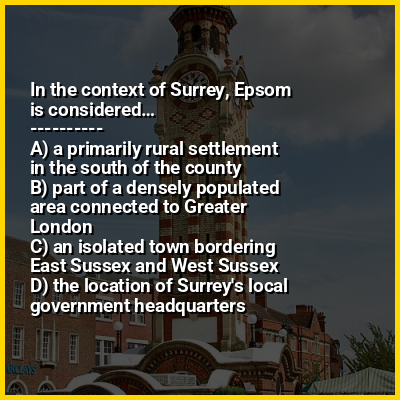
Epsom is a town in the borough of Epsom and Ewell in Surrey, England, about 14 miles (22 kilometres) south of central London. The town is first recorded as Ebesham in the 10th century and its name probably derives from that of a Saxon landowner. The earliest evidence of human activity is from the mid-Bronze Age, but the modern settlement probably grew up in the area surrounding St Martin's Church in the 6th or 7th centuries and the street pattern is thought to have become established in the Middle Ages. Today the High Street is dominated by the clock tower, which was erected in 1847–8.
Like other nearby settlements, Epsom is located on the spring line where the permeable chalk of the North Downs meets the impermeable London Clay. Several tributaries of the Hogsmill River rise in the town and in the 17th and early 18th centuries, the spring on Epsom Common was believed to have healing qualities. The mineral waters were found to be rich in Epsom salts, which were later identified as magnesium sulphate. Charles II was among those who regularly took the waters and several prominent writers, including John Aubrey, Samuel Pepys and Celia Fiennes recorded their visits. The popularity of the spa declined rapidly in the 1720s as a result of competition from other towns, including Bath and Tunbridge Wells.