Epic of Sundiata in the context of "Kouroukan Fouga"

Play Trivia Questions online!

or

Skip to study material about Epic of Sundiata in the context of "Kouroukan Fouga"


👉 Epic of Sundiata in the context of Kouroukan Fouga

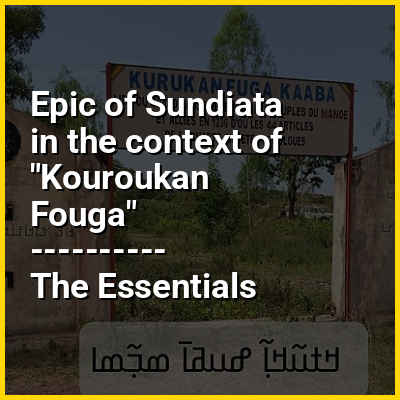
Kouroukan Fouga, or Kurukan Fuga, was the constitution of the Mali Empire created after the Battle of Krina (1235) by an assembly of nobles to create a government for the newly established empire, according to the Epic of Sundiata. According to oral tradition of the jelis of Mali and Guinea, the Kouroukan Fouga established the federation of Mandinka clans under one government, outlined how it would operate and established the laws by which the people would live. The name Kurukan Fuga is a toponym, translating to "clearing on granite/lateritic rock", referring to the plain near where the narrative has Sundiata Keita present the charter. This is often claimed to have been near the town of Ka-ba (present day Kangaba), following the interpretation of Djibril Tamsir Niane, but other scholars have argued that oral histories more commonly place the event at nearby Dakajalan.

The "Manden Charter, proclaimed in Kurukan Fuga", was inscribed in 2009 (4.COM) on the Representative List of the Intangible Cultural Heritage of Humanity kept by UNESCO.

↓ Explore More Topics
In this Dossier

Epic of Sundiata in the context of Sundiata Keita

Sundiata Keita (Mandinka, Malinke: [sʊndʒæta keɪta]; c. 1217 – c. 1255, N'Ko spelling: ߛߏ߲߬ߖߘߊ߬ ߞߋߕߊ߬; also known as Manding Diara, Lion of Mali, Sogolon Djata, son of Sogolon, Nare Maghan and Sogo Sogo Simbon Salaba) was a prince and founder of the Mali Empire. He was also the great-uncle of the Malian ruler Mansa Musa, who is usually regarded as the wealthiest person of all time, although there are no reliable ways to accurately calculate his wealth.

Written sources augment the Mande oral histories, with the Moroccan traveller Muhammad ibn Battúta (1304–1368) and the Tunisian historian Ibn Khaldun (1332–1406) both having travelled to Mali in the century after Sundiata's death, and providing independent verification of his existence. The semi-historical but legendary Epic of Sundiata by the Malinké/Maninka people centers on his life. The epic poem is primarily known through oral tradition, transmitted by generations of Maninka griots (djeli or jeliw). The Manden Charter issued during his reign is listed by UNESCO as one of an intangible cultural heritage.

↑ Return to Menu