Engraved Hourglass Nebula in the context of "Wide Field and Planetary Camera 2"

Play Trivia Questions online!

or

Skip to study material about Engraved Hourglass Nebula in the context of "Wide Field and Planetary Camera 2"

Ad spacer

⭐ Core Definition: Engraved Hourglass Nebula

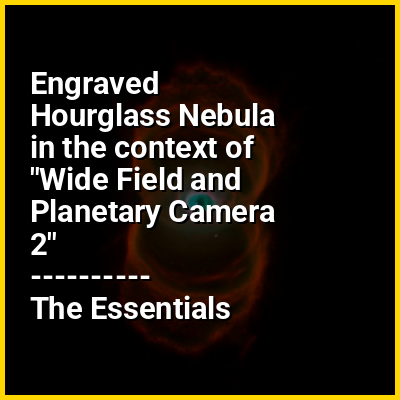
The Engraved Hourglass Nebula (also known as MyCn 18) is a young planetary nebula in the southern constellation Musca. It was discovered by Annie Jump Cannon and Margaret W. Mayall during their work on an extended Henry Draper Catalogue (the catalogue was built between 1918 and 1924). At the time, it was designated simply as a small faint planetary nebula. Much improved telescopes and imaging techniques allowed the hourglass shape of the nebula to be discovered by Romano Coradi and Hugo Schwarz in images taken during 1991–1992 at the European Southern Observatory. It is conjectured that MyCn 18's hourglass shape is produced by the expansion of a fast stellar wind within a slowly expanding cloud which is denser near its equator than its poles. The vivid colours given off by the nebula are the result of different 'shells' of elements being expelled from the dying star, in this case helium, nitrogen, oxygen and carbon. The central star of the nebula is unknown.

The Hourglass Nebula was photographed by the Wide Field and Planetary Camera 2 of the Hubble Space Telescope.
↓ Menu

>>>PUT SHARE BUTTONS HERE<<<

👉 Engraved Hourglass Nebula in the context of Wide Field and Planetary Camera 2

The Wide Field and Planetary Camera 2 (WFPC2) is a camera formerly installed on the Hubble Space Telescope. The camera was built by the Jet Propulsion Laboratory and is roughly the size of a baby grand piano. It was installed by servicing mission 1 (STS-61) in 1993, replacing the telescope's original Wide Field and Planetary Camera (WF/PC). WFPC2 was used to image the Hubble Deep Field in 1995, the Engraved Hourglass Nebula and Egg Nebula in 1996, and the Hubble Deep Field South in 1998. During STS-125, WFPC2 was removed and replaced with the Wide Field Camera 3 as part of the mission's first spacewalk on May 14, 2009. After returning to Earth, the camera was displayed briefly at the National Air and Space Museum and the Jet Propulsion Laboratory before returning to its final home at the Smithsonian's National Air and Space Museum.

↓ Explore More Topics
In this Dossier