Emeric, King of Hungary in the context of "Andrew II of Hungary"

Play Trivia Questions online!

or

Skip to study material about Emeric, King of Hungary in the context of "Andrew II of Hungary"

Ad spacer

⭐ Core Definition: Emeric, King of Hungary

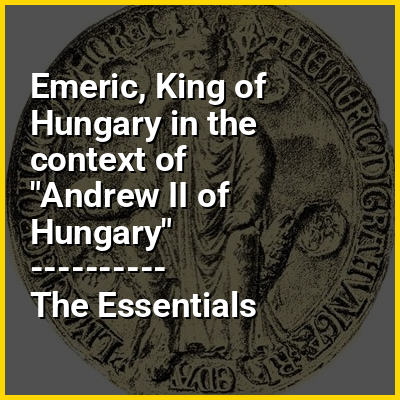
Emeric, also known as Henry or Imre (Hungarian: Imre, Croatian: Emerik, Slovak: Imrich; 1174 – 30 November 1204), was King of Hungary and Croatia between 1196 and 1204. In 1184, his father, Béla III of Hungary, ordered that he be crowned king, and appointed him as ruler of Croatia and Dalmatia around 1195. Emeric ascended the throne after the death of his father. During the first four years of his reign, he fought his rebellious brother, Andrew, who forced Emeric to make him ruler of Croatia and Dalmatia as appanage.

Emeric cooperated with the Holy See against the Bosnian Church, which the Catholic Church considered to be heretical. Taking advantage of a civil war, Emeric expanded his suzerainty over Serbia. He failed to prevent the Republic of Venice, which was assisted by crusaders of the Fourth Crusade, from seizing Zadar in 1202. He also could not impede the rise of Bulgaria along the southern frontiers of his kingdom. Emeric was the first Hungarian monarch to use the "Árpád stripes" as his personal coat of arms and to adopt the title of King of Serbia. Before his death, Emeric had his four-year-old son, Ladislaus III, crowned king.
↓ Menu

>>>PUT SHARE BUTTONS HERE<<<
In this Dossier

Emeric, King of Hungary in the context of Siege of Zara

The siege of Zara or siege of Zadar (Croatian: opsada Zadra; Hungarian: Zára ostroma; 10–24 November 1202) was the first major action of the Fourth Crusade and the first attack against a Catholic city by Catholic crusaders. The crusaders had an agreement with Venice for transport across the sea, but the price far exceeded what they were able to pay. Venice set the condition that the crusaders help them capture Zadar (or Zara), a constant battleground between Venice on one side and the Kingdom of Croatia and Dalmatia (Sclavonia) and Hungary on the other, whose king, Emeric, pledged himself to join the Crusade. Although some of the crusaders refused to take part in the siege, the attack on Zadar began in November 1202 despite letters from Pope Innocent III forbidding such an action and threatening excommunication. Zadar fell on 24 November and the Venetians and the crusaders sacked the city. After wintering in Zadar, the Fourth Crusade continued its campaign, which led to the siege of Constantinople.

↑ Return to Menu