El Kef in the context of "Kef Governorate"

Play Trivia Questions online!

or

Skip to study material about El Kef in the context of "Kef Governorate"


⭐ Core Definition: El Kef

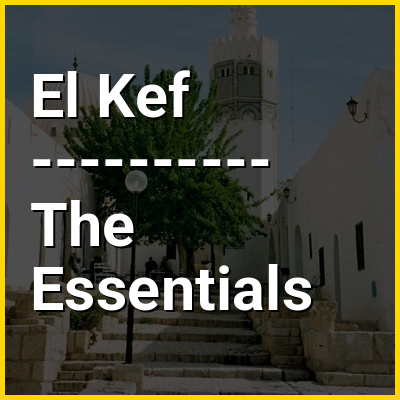
El Kef (Arabic: الكاف il-kāf), also known as Le Kef, is a city in northwestern Tunisia. It serves as the capital of the Kef Governorate.

El Kef is situated 175 kilometres (109 mi) to the west of Tunis and some 40 kilometres (25 mi) east of the border between Algeria and Tunisia. It has a population of 45,191 (2004 census). The old town is built on the cliff face of the table-top Jebel Dyr mountain. El Kef was the provisional capital of Tunisia during World War II. It was the command centre of the Front de Libération Nationale during the Algerian War of Independence against the French in the 1950s.
↓ Menu

👉 El Kef in the context of Kef Governorate

Kef Governorate (Tunisian Arabic: ولاية الكاف Wilāyat el-Kāf pronounced [lke̞ːf]; French: Gouvernorat du Kef) is one of the twenty-four governorates of Tunisia. It comprises chiefly part of the dorsal Atlas Mountains and their foothills in north-western Tunisia, bordering Algeria. It covers an area of 4,965 km and has a population of 243,156 (2014 census). The capital is El Kef. The region is primarily agricultural and mining. The agricultural land, which accounts for 98% of the total area of the governorate, is vast and fertile (485,153 hectares, including 102,215 hectares of forest and 337,489 hectares of agricultural land), enabling it to contribute 4.9% to national agricultural production.

↓ Explore More Topics
In this Dossier

El Kef in the context of Eutychius Proclus

Eutychius Proclus (Ancient Greek: Εὐτύχιος Πρόκλος, Eutychios Proklos, or Tuticius Proculus in some sources) was a grammarian who flourished in the 2nd century AD. He served as one of two Latin tutors for the Roman emperor Marcus Aurelius, along with Trosius Aper. He was from the North African city of Sicca Veneria (modern El Kef in Tunisia).

It is possibly this Proclus who is mentioned by Trebellius Pollio as the most learned grammarian of his age.

↑ Return to Menu

El Kef in the context of Arnobius

Arnobius (died c. 330) was an early Christian apologist of Berber origin during the reign of Diocletian (284–305).

According to Jerome's Chronicle, Arnobius, before his conversion, was a distinguished Numidian rhetorician at Sicca Veneria (El Kef, Tunisia), a major Christian center in Proconsular Africa, and owed his conversion to a premonitory dream. However, Arnobius writes dismissively of dreams in his surviving book.

↑ Return to Menu

El Kef in the context of Ali III ibn al-Husayn

Ali III ibn al-Husayn (Arabic: علي الثالث بن الحسين ; 14 August 1817 – 11 June 1902) commonly known as Ali III Bey (Arabic: علي باي الثالث) was the Husainid Bey of Tunis from 1882 until his death. He was the first ruler under the French protectorate.

He was named Bey al-Mahalla (Heir Apparent) on 23 August 1863 by his brother Muhammad III as-Sadiq and was made a divisional General and placed at the head of an army column operating in the interior of the country (known in Tunisian Arabic as the mhalla) to assert beylical authority in remote regions, rendering justice in the name of the sovereign and collecting taxes from local tribes. A keen horseman, Ali Bey took personal charge of this work and undertook it thoroughly, twice a year - in the north of the country during the summer in Béja and El Kef, and in the south during the winter, in Kairouan and the towns further south. During the Mejba Revolt in 1864, while his ineffective brother remained in the Bardo palace, Ali put down the rebellion with Generals Ahmed Zarrouk, Rustum and Uthman.

↑ Return to Menu