Edward IV in the context of "House of York"

Play Trivia Questions online!

or

Skip to study material about Edward IV in the context of "House of York"

Ad spacer

⭐ Core Definition: Edward IV

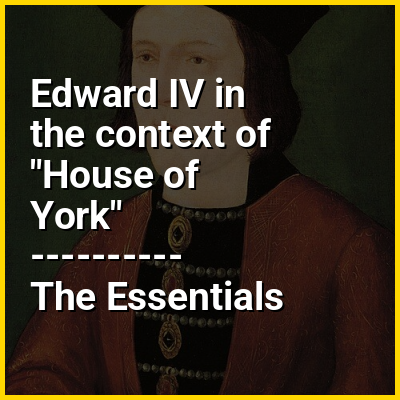
Edward IV (28 April 1442 – 9 April 1483) was King of England from 4 March 1461 to 3 October 1470, then again from 11 April 1471 until his death in 1483. He was a central figure in the Wars of the Roses, a series of civil wars in England fought between the Yorkist and Lancastrian factions between 1455 and 1487.

Edward inherited the Yorkist claim to the throne at the age of eighteen when his father, Richard, Duke of York, was killed at the Battle of Wakefield in December 1460. After defeating Lancastrian armies at Mortimer's Cross and Towton in early 1461, he deposed King Henry VI and took the throne. His marriage to Elizabeth Woodville in 1464 led to conflict with his chief advisor, Richard Neville, Earl of Warwick, known as the "Kingmaker". In 1470, a revolt led by Warwick and Edward's brother George, Duke of Clarence, briefly re-installed Henry VI. Edward fled to Flanders, where he gathered support and invaded England in March 1471; after victories at the battles of Barnet and Tewkesbury (where both the Earl of Warwick and Edward of Westminster, Prince of Wales, were killed), he resumed the throne. Shortly afterwards, Henry VI was found dead in the Tower of London, possibly killed on Edward's orders.
↓ Menu

>>>PUT SHARE BUTTONS HERE<<<

👉 Edward IV in the context of House of York

The House of York was a cadet branch of the English royal House of Plantagenet that fought with the House of Lancaster, another cadet branch of the House of Plantagenet, for the English crown in the second half of the 15th century. The differences ultimately led to the Wars of the Roses. These wars are so named because both houses had roses in their coats of arms, the Yorks a white one and the Lancasters a red one.

Three of the members of the House of York became kings of England in the late 15th century: Edward IV, Edward V and Richard III. The House of York descended in the male line from Edmund of Langley, 1st Duke of York, the fourth surviving son of Edward III. In time, it also represented Edward III's senior line, when an heir of York married the heiress-descendant of Lionel, Duke of Clarence, Edward III's second surviving son. It is based on these descents that they claimed the English crown. Compared with its rival, the House of Lancaster, it had a superior claim to the throne of England according to cognatic primogeniture, but an inferior claim according to agnatic primogeniture. The reign of this dynasty ended with the death of Richard III of England at the Battle of Bosworth Field in 1485. It became extinct in the male line with the death of Edward Plantagenet, 17th Earl of Warwick, in 1499.

↓ Explore More Topics
In this Dossier

Edward IV in the context of Richard III of England

Richard III (2 October 1452 – 22 August 1485) was King of England from 26 June 1483 until his death in 1485. He was the last king of the Plantagenet dynasty and its cadet branch the House of York. His defeat and death at the Battle of Bosworth Field marked the end of the Middle Ages in England.

Richard was created Duke of Gloucester in 1461 after the accession to the throne of his older brother Edward IV. This was during the period known as the Wars of the Roses, an era when two branches of the royal family contested the throne; Edward and Richard were Yorkists, and their side of the family faced off against their Lancastrian cousins. In 1472, Richard married Anne Neville, daughter of Richard Neville, 16th Earl of Warwick, and widow of Edward of Lancaster, son of Henry VI, a Lancastrian. He governed northern England during Edward's reign, and played a role in the invasion of Scotland in 1482. When Edward IV died in April 1483, Richard was named Lord Protector of the realm for Edward's eldest son and successor, the 12-year-old Edward V. Before arrangements were complete for Edward V's coronation, scheduled for 22 June 1483, the marriage of his parents was declared bigamous and therefore invalid. Now officially illegitimate, Edward and his siblings were barred from inheriting the throne. On 25 June, an assembly of lords and commoners endorsed a declaration to this effect, and proclaimed Richard as the rightful king. He was crowned on 6 July 1483. Edward and his younger brother Richard of Shrewsbury, Duke of York, called the "Princes in the Tower", disappeared from the Tower of London around August 1483.

↑ Return to Menu

Edward IV in the context of Henry VII of England

Henry VII (28 January 1457 – 21 April 1509), also known as Henry Tudor, was King of England and Lord of Ireland from his seizure of the crown on 22 August 1485 until his death in 1509. He was the first monarch of the House of Tudor.

Henry was the son of Edmund Tudor, 1st Earl of Richmond, and Lady Margaret Beaufort. His mother was a great-granddaughter of John of Gaunt, an English prince who founded the Lancastrian cadet branch of the House of Plantagenet. Henry's father was the half-brother of the Lancastrian king Henry VI. Edmund Tudor died three months before his son was born, and Henry was raised by his uncle Jasper Tudor, a Lancastrian, and William Herbert, a supporter of the Yorkist branch of the House of Plantagenet. During Henry's early years, his uncles and the Lancastrians fought a series of civil wars against the Yorkist claimant, Edward IV. After Edward retook the throne in 1471, Henry spent 14 years in exile in Brittany. He attained the throne when his forces, supported by France and Scotland, defeated Richard III at the Battle of Bosworth Field. He was the last king of England to win his throne on the field of battle, defending it two years later at the Battle of Stoke Field to decisively end the Wars of the Roses (1455–1487). He strengthened his claim by marrying Elizabeth of York, Edward IV's daughter.

↑ Return to Menu

Edward IV in the context of House of Tudor

The House of Tudor (/ˈtj.dər/, TEW-dər) was an English and Welsh dynasty that held the throne of England from 1485 to 1603. They descended ultimately from Ednyfed Fychan and the Tudors of Penmynydd, a Welsh noble family, and Catherine of Valois. The Tudor monarchs were also descended from the House of Lancaster. They ruled the Kingdom of England and the Lordship of Ireland (later the Kingdom of Ireland) for 118 years with five monarchs: Henry VII, Henry VIII, Edward VI, Mary I and Elizabeth I. The Tudors succeeded the House of Plantagenet as rulers of the Kingdom of England, and were succeeded by the Scottish House of Stuart. The first Tudor monarch, Henry VII, descended through his mother from the House of Beaufort, a legitimised branch of the English royal House of Lancaster, a cadet house of the Plantagenets. The Tudor family rose to power and started the Tudor period in the wake of the Wars of the Roses (1455–1487), which left the main House of Lancaster (with which the Tudors were aligned) extinct in the male line.

Henry VII (a descendant of Edward III, and the son of Edmund Tudor, a half-brother of Henry VI) succeeded in presenting himself as a candidate not only for traditional Lancastrian supporters, but also for discontented supporters of their rival Plantagenet cadet House of York, and he took the throne by right of conquest. Following his victory at the Battle of Bosworth Field (22 August 1485), he reinforced his position in 1486 by fulfilling his 1483 vow to marry Elizabeth of York, daughter of King Edward IV and the heiress of the Yorkist claim to the throne, thus symbolically uniting the former warring factions of Lancaster and York under the new dynasty (represented by the Tudor rose). The Tudors extended their power beyond modern England, achieving the full union of England and the Principality of Wales in 1542 (Laws in Wales Acts 1535 and 1542), and successfully asserting English authority over the Kingdom of Ireland (proclaimed by the Crown of Ireland Act 1542). They also maintained the nominal English claim to the Kingdom of France; although none of them made substance of it, Henry VIII fought wars with France primarily as a matter of international alliances but also asserting claim to the title. After him, his daughter Mary I lost control of all territory in France permanently with the Siege of Calais in 1558.

↑ Return to Menu

Edward IV in the context of Richard Neville, Earl of Warwick

Richard Neville, 16th Earl of Warwick, 6th Earl of Salisbury, KG (22 November 1428 – 14 April 1471), known as Warwick the Kingmaker, was an English nobleman, administrator, landowner of the House of Neville fortune and military commander. The eldest son of Richard Neville, 5th Earl of Salisbury, he became Earl of Warwick through marriage, and was the wealthiest and most powerful English peer of his age, with political connections that went beyond the country's borders. One of the leaders in the Wars of the Roses, originally on the Yorkist side but later switching to the Lancastrian side, he was instrumental in the deposition of two kings, which led to his epithet of "Kingmaker".

Through fortunes of marriage and inheritance, Warwick emerged in the 1450s at the centre of English politics. Originally, he was a supporter of King Henry VI; however, a territorial dispute with Edmund Beaufort, Duke of Somerset, led him to collaborate with Richard, Duke of York, in opposing the king. From this conflict, he gained the strategically valuable post of Captain of Calais, a position that benefited him greatly in the years to come. The political conflict later turned into a full-scale rebellion, where in battle York was slain, as was Warwick's father Salisbury. York's son, however, later triumphed with Warwick's assistance and was crowned King Edward IV. Edward initially ruled with Warwick's support, but the two later fell out over foreign policy and the king's choice to marry Elizabeth Woodville. After a failed plot to crown Edward's brother, George, Duke of Clarence, Warwick instead restored Henry VI to the throne. The triumph was short-lived, however: on 14 April 1471, Warwick was defeated by Edward at the Battle of Barnet, and killed.

↑ Return to Menu

Edward IV in the context of Richard, Duke of York

Richard of York, 3rd Duke of York (21 September 1411 – 30 December 1460), also named Richard Plantagenet, was a leading English magnate and claimant to the throne during the Wars of the Roses. He was a member of the ruling House of Plantagenet by virtue of being a direct male-line descendant of Edmund of Langley, King Edward III's fourth surviving son. However, it was through his mother, Anne Mortimer, a descendant of Edward III's second surviving son, Lionel of Antwerp, that Richard inherited his strongest claim to the throne, as the opposing House of Lancaster was descended from John of Gaunt, Duke of Lancaster, the third surviving son of Edward III. He also inherited vast estates and served in various offices of state in Ireland, France and England, a country he ultimately governed as Lord Protector due to the mental instability of King Henry VI.

Richard's conflicts with Henry's wife, Margaret of Anjou, and other members of Henry's court, such as Edmund Beaufort, 2nd Duke of Somerset, and his competing claim to the throne, were leading factors in the political upheaval of mid-fifteenth-century England, and a major cause of the Wars of the Roses (1455–1487). Richard eventually attempted to take the throne, but was dissuaded, although it was agreed that he would become king on Henry's death. However, within weeks of securing this agreement (the Act of Accord), he was killed at the Battle of Wakefield in 1460, alongside his son, Edmund. Two of his surviving sons later ascended the throne: Edward IV and Richard III.

↑ Return to Menu

Edward IV in the context of Act of Accord

The Act of Accord (39 Hen. 6) was an act of the Parliament of England. It was passed into law on 25 October 1460 during a period of intense political division and partisanship at the top of government. Earlier that month, Richard, Duke of York had entered the Council Chamber—in the presence of several lords—and laid his hand on the empty throne, claiming the crown of England. His grounds were that he and King Henry VI were both direct descendants of Edward III, but York possessed two claims, through both the male and female lines, and Henry's was through only one. Following discussions between royal justices, York and Parliament, the House of Lords decided that Henry was to retain the crown for life, but York and his heirs were to succeed him. This automatically removed Henry's son, Edward, Prince of Wales, from the succession. Henry agreed to the compromise, which became the Act of Accord.

Political partisanship had already erupted into civil war the year before and, far from lowering political pressure, the act split the nobility further. Although Henry had publicly supported the act, Queen Margaret of Anjou refused to accept the disinheritance of their son. In this, she was joined by the majority of the English nobility, who also opposed York. King Henry, nominally the head of state, was still in London, which was controlled by the Yorkist government. Margaret, on the other hand, was in the north with her son, raising an army. This began the systematic destruction of York's and the Nevilles' Yorkshire estates. York led an army to challenge her but was killed at the Battle of Wakefield on 30 December. The Lancastrians, in turn, were defeated three months later at the Battle of Towton by York's son, who was crowned King Edward IV on 28 June 1461.

↑ Return to Menu

Edward IV in the context of Battle of Towton

The Battle of Towton took place on 29 March 1461 during the Wars of the Roses, near Towton in North Yorkshire. Yorkist forces decisively defeated Lancastrian supporters of Henry VI, securing the English throne for Edward IV. Fought for ten hours between an estimated 50,000 soldiers from both sides in a snowstorm on Palm Sunday, it was "probably the largest and bloodiest battle on English soil".

Henry VI succeeded his father, Henry V, when he was nine months old in 1422, but was a weak, ineffectual and mentally unsound ruler, which encouraged the nobles to scheme for control over him. The situation deteriorated in the 1450s into a civil war between his Beaufort relatives and his wife, Queen Margaret, on one side, with those of his cousin Richard, Duke of York, on the other.

↑ Return to Menu