Ecdysis in the context of "Husk"

Play Trivia Questions online!

or

Skip to study material about Ecdysis in the context of "Husk"

Ad spacer

⭐ Core Definition: Ecdysis

Ecdysis is the moulting of the cuticle in many invertebrates of the clade Ecdysozoa. Since the cuticle of these animals typically forms a largely inelastic exoskeleton, it is shed during growth and a new, larger covering is formed. The remnants of the old, empty exoskeleton are called exuviae.

After moulting, an arthropod is described as teneral, a callow; it is "fresh", pale and soft-bodied. Within one or two hours, the cuticle hardens and darkens following a tanning process analogous to the production of leather. During this short phase the animal expands, since growth is otherwise constrained by the rigidity of the exoskeleton. Growth of the limbs and other parts normally covered by the hard exoskeleton is achieved by transfer of body fluids from soft parts before the new skin hardens. A spider with a small abdomen may be undernourished but more probably has recently undergone ecdysis. Some arthropods, especially large insects with tracheal respiration, expand their new exoskeleton by swallowing or otherwise taking in air. The maturation of the structure and colouration of the new exoskeleton might take days or weeks in a long-lived insect; this can make it difficult to identify an individual if it has recently undergone ecdysis.
↓ Menu

>>>PUT SHARE BUTTONS HERE<<<

👉 Ecdysis in the context of Husk

Husk (or hull) in botany is the outer shell or coating of a seed. In the United States, the term husk often refers to the leafy outer covering of an ear of maize (corn) as it grows on the plant. Literally, a husk or hull includes the protective outer covering of a seed, fruit, or vegetable.

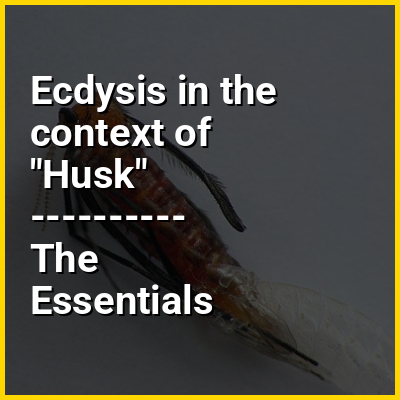
It can also refer to the exuvia of insects or other small animals left behind after moulting.

↓ Explore More Topics
In this Dossier

Ecdysis in the context of Metamorphosis

Metamorphosis is a biological process by which an animal physically develops including birth transformation or hatching, involving a conspicuous and relatively abrupt change in the animal's body structure through cell growth and differentiation. Some insects, fish, amphibians, mollusks, crustaceans, cnidarians, echinoderms, and tunicates undergo metamorphosis, which is often accompanied by a change of nutrition source or behavior. Animals can be divided into species that undergo complete metamorphosis ("holometaboly"), incomplete metamorphosis ("hemimetaboly"), or no metamorphosis ("ametaboly").

Generally organisms with a larval stage undergo metamorphosis, and during metamorphosis the organism loses larval characteristics.

↑ Return to Menu

Ecdysis in the context of Juvenile (organism)

A juvenile is an individual organism (especially an animal) that has not yet reached its adult form, sexual maturity or size. Juveniles can look very different from the adult form, particularly in colour, and may not fill the same niche as the adult form. In many organisms the juvenile has a different name from the adult (see List of animal names).

Some organisms reach sexual maturity in a short metamorphosis, such as ecdysis in many insects and some other arthropods. For others, the transition from juvenile to fully mature is a more prolonged process—puberty in humans and other species (like higher primates and whales), for example. In such cases, juveniles during this transformation are sometimes called subadults.

↑ Return to Menu

Ecdysis in the context of Crustacean

Crustaceans (from Latin word "crustacea" meaning: "those with shells" or "crusted ones") are invertebrate animals that constitute one group of arthropods that are traditionally a part of the subphylum Crustacea (/krəˈstʃə/), a large, diverse group of mainly aquatic arthropods including the more familiar decapods (shrimps, prawns, crabs, lobsters and crayfish), seed shrimps, branchiopods, fish lice, krill, remipedes, isopods, barnacles, copepods, opossum shrimps, amphipods and mantis shrimp. The crustacean group can be treated as a subphylum under the clade Mandibulata. It is now well accepted that the hexapods (insects and entognathans) emerged deep in the crustacean group, with the completed pan-group referred to as Pancrustacea. The three classes Cephalocarida, Branchiopoda and Remipedia are more closely related to the hexapods than they are to any of the other crustaceans (oligostracans and multicrustaceans).

The 67,000 described species range in size from Stygotantulus stocki at 0.1 mm (0.004 in), to the Japanese spider crab with a leg span of up to 3.8 m (12.5 ft) and a mass of 20 kg (44 lb). Like other arthropods, crustaceans have an exoskeleton, which they moult to grow. They are distinguished from other groups of arthropods, such as insects, myriapods and chelicerates, by the possession of biramous (two-parted) limbs, and by their larval forms, such as the nauplius stage of branchiopods and copepods.

↑ Return to Menu

Ecdysis in the context of Imago

In biology, the imago (Latin for "image") is the last stage an insect attains during its metamorphosis, its process of growth and development; it is also called the imaginal stage ("imaginal" being "imago" in adjective form), the stage in which the insect attains maturity. It follows the final ecdysis of the immature instars.

In a member of the Ametabola or Hemimetabola, species in which metamorphosis is "incomplete", the final ecdysis follows the last immature or nymphal stage. In members of the Holometabola, in which there is a pupal stage, the final ecdysis follows emergence from the pupa, after which the metamorphosis is complete, although there is a prolonged period of maturation in some species.

↑ Return to Menu

Ecdysis in the context of Nauplius (larva)

Crustaceans may pass through a number of larval and immature stages between hatching from their eggs and reaching their adult form. Each of the stages is separated by a moult, in which the hard exoskeleton is shed to allow the animal to grow. The larvae of crustaceans often bear little resemblance to the adult, and there are still cases where it is not known what larvae will grow into what adults. This is especially true of crustaceans which live as benthic adults (on the sea bed), more-so than where the larvae are planktonic, and thereby easily caught.

Many crustacean larvae were not immediately recognised as larvae when they were discovered, and were described as new genera and species. The names of these genera have become generalised to cover specific larval stages across wide groups of crustaceans, such as zoea and nauplius. Other terms described forms which are only found in particular groups, such as the glaucothoe of hermit crabs, or the phyllosoma of slipper lobsters and spiny lobsters.

↑ Return to Menu

Ecdysis in the context of Moulting

In biology, moulting (British English), or molting (American English), also known as sloughing, shedding, or in many invertebrates, ecdysis, is a process by which an animal casts off parts of its body to serve some beneficial purpose, either at specific times of the year, or at specific points in its life cycle.

In medieval times, it was also known as "mewing" (from the French verb "muer", to moult), a term that lives on in the name of Britain's Royal Mews where the King's hawks used to be kept during moulting time before becoming horse stables after Tudor times.

↑ Return to Menu