Eastern Min or Min Dong (traditional Chinese: 閩東語; simplified Chinese: 闽东语; pinyin: Mǐndōngyǔ, Foochow Romanized: Mìng-dĕ̤ng-ngṳ̄) is a branch of the Min group of the Chinese languages of China. The prestige form and most commonly cited representative form is the Fuzhou dialect, the speech of the capital of Fujian.
>>>PUT SHARE BUTTONS HERE<<<
In this Dossier
- ⭐ Core Definition: Eastern Min
- Eastern Min in the context of Fujian
- Eastern Min in the context of Min Chinese
- Eastern Min in the context of Zhongshan Min
- Eastern Min in the context of Fuzhou
- Eastern Min in the context of Fuzhou dialect
- Eastern Min in the context of Cangnan County
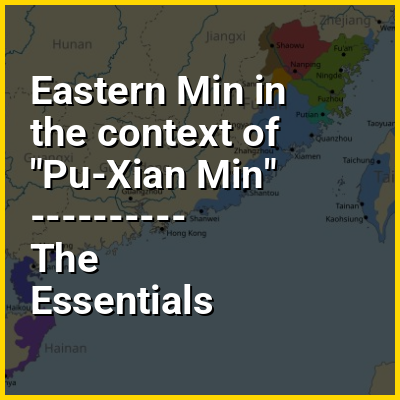
- Eastern Min in the context of Puxian Min
Eastern Min in the context of Fujian
Fujian is a province in southeastern China. Fujian is bordered by Zhejiang to the north, Jiangxi to the west, Guangdong to the south, and the Taiwan Strait to the east. Its capital is Fuzhou and its largest prefecture city by population is Quanzhou, with other notable cities including the port city of Xiamen and Zhangzhou. Fujian is located on the west coast of the Taiwan Strait as the closest province geographically and culturally to Taiwan. This is as a result of the Chinese Civil War. Additionally, a small portion of historical Fujian is administered by Taiwan, romanized as Fuchien.
While the population predominantly identifies as Han, it is one of China's most culturally and linguistically diverse provinces. The dialects of the language group Min Chinese are most commonly spoken within the province, including the Fuzhou dialect and Eastern Min of Northeastern Fujian province and various Southern Min and Hokkien dialects of southeastern Fujian. The capital city of Fuzhou and Fu'an of Ningde prefecture along with Cangnan county-level city of Wenzhou prefecture in Zhejiang province make up the Min Dong linguistic and cultural region of Northeastern Fujian. Hakka Chinese is also spoken in Fujian, by the Hakka people. Min dialects, Hakka, and Standard Chinese are mutually unintelligible. Due to emigration, much of the ethnic Chinese populations of Taiwan, Singapore, Malaysia, Indonesia, and the Philippines speak Southern Min (or Hokkien).
Eastern Min in the context of Min Chinese
Min is a broad group of Sinitic languages with about 75 million native speakers. These languages are spoken in China in a region centered on modern Fujian Province, stretching from Southern Zhejiang to Eastern Guangdong, as well as on Hainan Island and the neighbouring Leizhou Peninsula. Min varieties are also spoken in Taiwan, and by a large international diaspora, particularly in Southeast Asia. The name Min is shared with the Min River in Fujian, and is also the abbreviated name of Fujian Province. Min languages are not mutually intelligible with one another nor with other varieties of Chinese.
The most widely spoken variety of Min outside of China is Hokkien, a variety of Southern Min which has its origin in Southern Fujian. Amoy Hokkien is the prestige dialect of Hokkien in Fujian, while a majority of Taiwanese people speak a dialect called Taiwanese Hokkien or simply Taiwanese. The majority of Chinese Singaporeans, Chinese Malaysians, Chinese Filipinos, Chinese Indonesians, Chinese Thais, and Chinese Cambodians are of Southern Min-speaking background (particularly Hokkien and Teochew), although some of these communities are shifting to national or regional languages. Communities speaking Eastern Min, Pu-Xian Min, Haklau Min, Leizhou Min, and Hainanese can also be found in parts of the Chinese diaspora, such as in Malaysia, Singapore, and Indonesia.
Eastern Min in the context of Zhongshan Min
Zhongshan Min (simplified Chinese: 中山闽语; traditional Chinese: 中山閩語), known as Cunhua (村话; 村話) by its speakers, are three Min Chinese dialect islands in the Zhongshan region of the southern Chinese province of Guangdong. The Zhongshan Min people settled in the region from Fujian Province as early as the Northern Song dynasty period (1023–1031).The three dialects are:
- Longdu dialect, spoken mainly in Shaxi and Dachong in the west of the prefecture,
- Nanlang dialect or Dongxiang dialect, spoken mainly in Nanlang and Zhangjiabian in the east, and
- Sanxiang dialect, spoken in Sanxiang in the south.
According to Nicholas Bodman, the Longdu and Nanlang dialects belong to the Eastern Min group, while the Sanxiang dialect belongs to Southern Min. All three have been heavily influenced by the Shiqi dialect, the local variety of Yue Chinese.
Eastern Min in the context of Fuzhou
Fuzhou is the capital of Fujian, China, lying between the Min River estuary to the south and the city of Ningde to the north. Together, Fuzhou and Ningde make up the Mindong linguistic and cultural region.
Fuzhou's population was 8,291,268 as of the 2020 Chinese census. Like other prefecture-level cities in China, its administrative area contains both urban and rural areas: in 2020, 72.49% of inhabitants (6,010,242) were urban, while 27.51% (2,281,026) were rural. As of 31 December 2018, the total population was estimated at 7,740,000 whom 4,665,000 lived in the built-up (or metro) area made of five urban districts plus Minhou County. In 2015, Fuzhou was ranked as the 10th fastest growing metropolitan area in the world by Brookings Institution. Fuzhou is listed as No. 20 in the China Integrated City Index 2016's total ranking, a study conducted by the National Development and Reform Commission.
Eastern Min in the context of Fuzhou dialect
The Fuzhou language (simplified Chinese: 福州话; traditional Chinese: 福州話; pinyin: Fúzhōuhuà; FR: Hók-ciŭ-uâ [huʔ˨˩ tsiu˥˧ ua˨˦˨] ), also Foochow, Hokchew, Hok-chiu, Fuzhounese, or Fujianese, is the prestige variety of the Eastern Min branch of Min Chinese spoken mainly in the Mindong region of Eastern Fujian Province. As it is mutually unintelligible to neighbouring varieties (e.g. Hinghua and Hokkien) in the province, under a technical linguistic definition Fuzhou is a language and not a dialect (conferring the variety a 'dialect' status is more socio-politically motivated than linguistic). Thus, while Fuzhou may be commonly referred to as a 'dialect' by laypersons, this is colloquial usage and not recognised in academic linguistics. Like many other varieties of Chinese, the Fuzhou dialect is dominated by monosyllabic morphemes that carry lexical tones, and has a mainly analytic syntax. While the Eastern Min branch it belongs to is relatively closer to other branches of Min such as Southern Min or Pu-Xian Min than to other Sinitic branches such as Mandarin, Wu Chinese or Hakka, they are still not mutually intelligible.
Centered in Fuzhou City, the Fuzhou dialect covers 11 cities and counties in China: Fuzhou City Proper, Pingnan, Gutian, Luoyuan, Minqing, Lianjiang, Minhou, Changle, Yongtai, Fuqing and Pingtan; and Lienchiang County (the Matsu Islands), in Taiwan (the ROC). It is also the second local language in many northern and middle Fujian cities and counties such as Nanping, Sanming, Shaowu, Shunchang, and Youxi.
Eastern Min in the context of Cangnan County
Cangnan County (simplified Chinese: 苍南县; traditional Chinese: 蒼南縣; pinyin: Cāngnán Xiàn ) is a county in the prefecture-level city of Wenzhou in southern Zhejiang, China. The county government is in Lingxi. Cangnan has 20 towns, 14 townships, and two nationality townships. Cangnan and Taishun are a part of the Min Dong, Eastern Min cultural region of Zhejiang province. Wenzhou dialect and Jinxiang dialect, are also spoken.
Founded in 1981, Cangnan County is the south gate of Zhejiang Province, the major birthplace of the “Wenzhou Pattern” as well as an open door to the outside world authorised by the State Council. Its total land area is 1,261 square kilometres and its sea area is 3,783 square kilometres. Governing 10 towns, two minority towns and with a registered population of 1.3 million people, it is the most populous county in Zhejiang. In 2014, the county realised a GDP of US$6.3bn and total fiscal revenue of US$658m.
Eastern Min in the context of Puxian Min
Pu–Xian Min (Hinghwa Romanized: Pó-sing-gṳ̂; traditional Chinese: 莆仙話; simplified Chinese: 莆仙话; pinyin: Púxiānhuà), also known as Putian–Xianyou Min, Puxian Min, Pu–Xian Chinese, Xinghua, Henghua, Hinghua or Hinghwa (Hing-hua̍-gṳ̂; traditional Chinese: 興化語; simplified Chinese: 兴化语; pinyin: Xīnghuàyǔ), is a Chinese language that forms a branch of Min Chinese. Pu-Xian is a transitional variety of Coastal Min which shares characteristics with both Eastern Min and Southern Min, although it is closer to the latter.
The native language of Putian people, Pu-Xian is spoken mostly in Fujian province, particularly in Putian city and Xianyou County (after which it is named), parts of Fuzhou, and parts of Quanzhou. It is also widely used as the mother tongue in Wuqiu Township, Kinmen County, Fujian Province, Republic of China (Taiwan). More than 2,000 people in Shacheng, Fuding in northern Fujian also speak Pu-Xian. There are minor differences between the dialects of Putian and Xianyou.