Dungan people in the context of "Hui people"

Play Trivia Questions online!

or

Skip to study material about Dungan people in the context of "Hui people"

Ad spacer

⭐ Core Definition: Dungan people

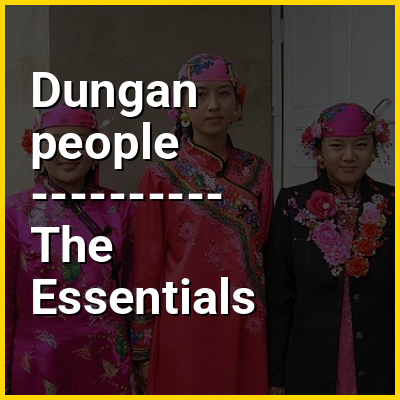
Dungan is a term used in territories of the former Soviet Union to refer to a group of Muslim people of Hui origin. Turkic-speaking peoples in Xinjiang also sometimes refer to Hui Muslims as Dungans. In both China and the former Soviet republics where they reside, however, members of this ethnic group call themselves Hui because Dungans are descendants of historical Hui groups that migrated to Central Asia.

In the censuses of the countries of the former Soviet Union, the Dungans (enumerated separately from Chinese) are found in Kazakhstan (36,900 according to the 1999 census), Kyrgyzstan (58,409 according to the 2009 census) and Russia (801 according to the 2002 census).
↓ Menu

>>>PUT SHARE BUTTONS HERE<<<

👉 Dungan people in the context of Hui people

The Hui people are an East Asian ethnoreligious group predominantly composed of Chinese-speaking adherents of Islam. They are distributed throughout China, mainly in the northwestern provinces and in the Zhongyuan region. According to the 2020 census, China is home to approximately 11.3 million Hui people. Outside China, the 170,000 Dungan people of Kazakhstan and Kyrgyzstan, the Panthays in Myanmar, and many of the Chin Haws in Thailand are also considered part of the Hui ethnicity.

The Hui were referred to as Hanhui during the Qing dynasty to be distinguished from the Turkic Muslims, which were referred to as Chanhui. The Republic of China government also recognised the Hui as a branch of the Han Chinese rather than a separate ethnic group. In the National Assembly of the Republic of China, the Hui were referred to as Nationals in China proper with special convention. The Hui were referred to as Muslim Han people by Bai Chongxi, the Minister of National Defense of the Republic of China at the time and the founder of the Chinese Muslim Association. Some scholars refer to this group as Han Chinese Muslims, Han Muslims, Chinese Muslims or Sino-Muslims. While others call them Chinese-speaking Muslims or Sinophone Muslims.

↓ Explore More Topics
In this Dossier

Dungan people in the context of Pristan'-Przheval'sk

Pristan'-Przheval'sk is an urban-type settlement in the Issyk-Kul Region of Kyrgyzstan. Administratively, it is part of the city Karakol. The town was named after the Russian geographer, Nikolai Mikhailovich Przhevalsky, who is buried nearby. It lies 12 km north west of Karakol. Its population was 2,829 in 2021.

Kyrgyz and Dungan rebels attacked Przheval'sk during the 1916 Basmachi revolt. This was met by repression and in Przheval'sk 70% of the Kyrgyz died along with 90% of their cattle.

↑ Return to Menu

Dungan people in the context of Chüy Region

Chüy is the northernmost region of Kyrgyzstan, surrounding the country's national capital of Bishkek. It is bounded on the north by Kazakhstan, and clockwise, Issyk-Kul Region, Naryn Region, Jalal-Abad Region, and Talas Region. Its administrative center is Bishkek. Its total area is 19,895 km (7,682 sq mi). The resident population of the region was 974,984 as of January 2021. The region has sizeable Russian (20.8% in 2009) and Dungan (6.2% in 2009) minorities. It takes its name from the river Chüy, that flows through the region.

↑ Return to Menu

Dungan people in the context of Dungan language

Dungan (/ˈdʊŋ.ɡɑːn/ or /ˈdʌŋ.ɡən/) is a Sinitic language spoken primarily in the Chu Valley of southeastern Kazakhstan and northern Kyrgyzstan. It is the native language of the Dungan people, a Hui subgroup that fled Qing China in the 19th century. It evolved from the Central Plains Mandarin variety spoken in Gansu and Shaanxi. It is the only Sino-Tibetan language to be officially written in the Cyrillic script. In addition, the Dungan language contains loanwords and archaisms not found in other modern varieties of Mandarin.

↑ Return to Menu