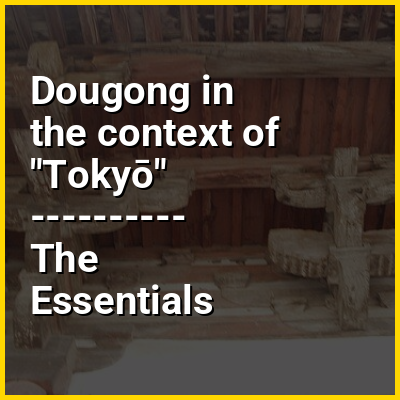
Tokyō (斗栱・斗拱; more often 斗きょう) (also called kumimono (組物) or masugumi (斗組)) is a system of supporting blocks (斗 or 大斗, masu or daito; lit. block or big block) and brackets (肘木, hijiki; lit. elbow wood) supporting the eaves of a Japanese building, usually part of a Buddhist temple or Shinto shrine. The use of tokyō is made necessary by the extent to which the eaves protrude, a functionally essential element of Japanese Buddhist architecture. The system also has an important decorative function. The system is a localized form of the Chinese dougong that has evolved since its arrival into several original forms.
In its simplest configuration, the bracket system has a single projecting bracket and a single block, and is called hitotesaki. If the first bracket and block group support a second similar one, the whole system is called futatesaki, if three brackets are present it is called mitesaki, and so on until a maximum of six brackets as in the photo to the right.