
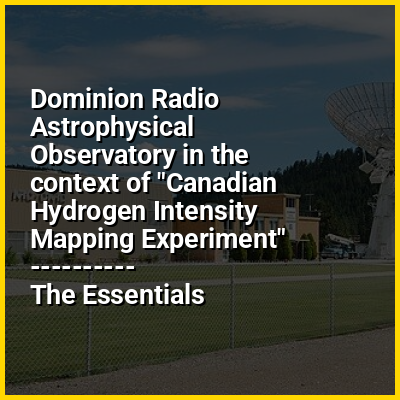
The Canadian Hydrogen Intensity Mapping Experiment (CHIME) is an interferometric radio telescope at the Dominion Radio Astrophysical Observatory in British Columbia, Canada which consists of four antennas consisting of 100 x 20 metre cylindrical parabolic reflectors with 1024 dual-polarization radio receivers suspended on a support above them. The antenna receives radio waves from hydrogen in space at frequencies in the 400–800 MHz range. The telescope's low-noise amplifiers are built with components adapted from the cellphone industry and its data processed using a custom-built FPGA electronic system and 1000-processor high-performance GPGPU cluster. The telescope has no moving parts and observes half of the sky each day as the Earth turns.
It has also turned out to be a great instrument for observing fast radio bursts (FRBs).