Division of Korea in the context of "Korean Peninsula"

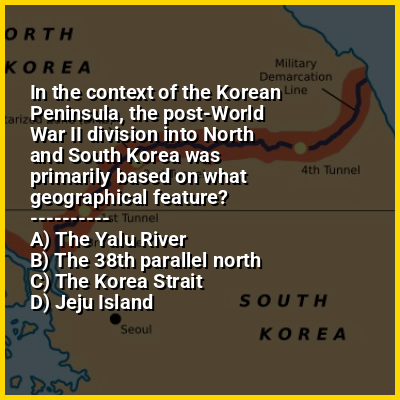
⭐ In the context of the Korean Peninsula, the post-World War II division into North and South Korea was primarily based on what geographical feature?

Ad spacer

⭐ Core Definition: Division of Korea

The division of Korea began at the end of World War II on 2 September 1945, with the establishment of a Soviet occupation zone and a US occupation zone. These zones developed into separate governments, named the Democratic People's Republic of Korea (North Korea) and the Republic of Korea (South Korea), which fought a war from 1950 to 1953. Since then the division has continued.

By the early 20th century, both countries were one single nation: the Korean Empire. During World War II, the Allied leaders had already been considering the question of Korea's future following Japan's eventual surrender in the war. The leaders reached an understanding that Korea would be removed from Japanese control but would be placed under an international trusteeship until the Koreans would be deemed ready for self-rule. In the last days of the war, the United States proposed dividing the Korean peninsula into two occupation zones (a U.S. and Soviet one) with the 38th parallel as the dividing line. The Soviets accepted their proposal and agreed to divide Korea, which led to the declaration of General Order No. 1.

↓ Menu

>>>PUT SHARE BUTTONS HERE<<<

👉 Division of Korea in the context of Korean Peninsula

Korea is a peninsular region in East Asia consisting of the Korean Peninsula, Jeju Island, and smaller islands. Since the end of World War II in Asia in 1945, it has been politically divided at or near the 38th parallel between North Korea (Democratic People's Republic of Korea; DPRK) and South Korea (Republic of Korea; ROK). Both countries proclaimed independence in 1948, and the two countries fought the Korean War from 1950 to 1953. The region is bordered by China to the north and Russia to the northeast, across the Amnok (Yalu) and Duman (Tumen) rivers, and is separated from Japan to the southeast by the Korea Strait.

Known human habitation of the Korean peninsula dates to 40,000 BC. The kingdom of Gojoseon, which according to tradition was founded in 2333 BC, fell to the Han dynasty in 108 BC. It was followed by the Three Kingdoms period, in which Korea was divided into Goguryeo, Baekje, and Silla. In 668 AD, Silla conquered Baekje and Goguryeo with the aid of the Tang dynasty, forming Unified Silla; Balhae succeeded Goguryeo in the north. In the late 9th century, Unified Silla collapsed into three states, beginning the Later Three Kingdoms period. In 918, Goguryeo was resurrected as Goryeo, which achieved what has been called a "true national unification" by Korean historians, as it unified both the Later Three Kingdoms and the ruling class of Balhae after its fall. Goryeo, whose name developed into the modern exonym "Korea", was highly cultured and saw the invention of the first metal movable type. During the 13th century, Goryeo became a vassal state of the Mongol Empire. Goryeo overthrew Mongol rule before falling to a coup led by General Yi Seong-gye, who established the Joseon dynasty in 1392. The first 200 years of Joseon were marked by peace; the Hangul, the Korean alphabet was created and Confucianism became influential. This ended with Japanese and Qing invasions, which brought devastation to Joseon and led to Korean isolationism. After the invasions, an isolated Joseon experienced another nearly 200-year period of peace and prosperity, along with cultural and technological development. In the final years of the 19th century, Japan forced Joseon to open up and Joseon experienced turmoil such as the Kapsin Coup, Donghak Peasant Revolution, and the assassination of Empress Myeongseong. In 1895, Japan defeated China in the First Sino-Japanese War and China lost suzerainty over Korea and Korea was placed under further Japanese influence. In 1897, the centuries old Joseon was replaced by the Korean Empire with the Joseon's last king, Gojong, becoming the Emperor of the Korean Empire. Japan's further victory in the 1904–1905 Russo-Japanese War, expelled Russian influence in Korea and Manchuria. In 1905, the Korean Empire became a protectorate of the Empire of Japan. In 1910, the Empire of Japan officially annexed the Korean peninsula.
↓ Explore More Topics
In this Dossier

Division of Korea in the context of World War II

World War II or the Second World War (1 September 1939 – 2 September 1945) was a global conflict between two coalitions: the Allies and the Axis powers. Nearly all of the world's countries participated, with many nations mobilising all resources in pursuit of total war. Tanks and aircraft played major roles, enabling the strategic bombing of cities and delivery of the first and only nuclear weapons ever used in war. World War II is the deadliest conflict in history, causing the death of 70 to 85 million people, more than half of whom were civilians. Millions died in genocides, including the Holocaust, and by massacres, starvation, and disease. After the Allied victory, Germany, Austria, Japan, and Korea were occupied, and German and Japanese leaders were put on trial for war crimes.

The causes of World War II included unresolved tensions in the aftermath of World War I, the rise of fascism in Europe and militarism in Japan. Key events preceding the war included Japan's invasion of Manchuria in 1931, the Spanish Civil War, the outbreak of the Second Sino-Japanese War in 1937, and Germany's annexations of Austria and the Sudetenland. World War II is generally considered to have begun on 1 September 1939, when Nazi Germany, under Adolf Hitler, invaded Poland, after which the United Kingdom and France declared war on Germany. Poland was divided between Germany and the Soviet Union under the Molotov–Ribbentrop Pact. In 1940, the Soviet Union annexed the Baltic states and parts of Finland and Romania. After the fall of France in June 1940, the war continued mainly between Germany, now assisted by Fascist Italy, and the British Empire, with fighting in the Balkans, Mediterranean, and Middle East, the aerial Battle of Britain and the Blitz, and the naval Battle of the Atlantic. Through campaigns and treaties, Germany gained control of much of continental Europe and formed the Axis alliance with Italy, Japan, and other countries. In June 1941, Germany invaded the Soviet Union, opening the Eastern Front and initially making large territorial gains.

↑ Return to Menu

Division of Korea in the context of North Korea

North Korea, officially the Democratic People's Republic of Korea (DPRK), is a country in East Asia. It constitutes the northern half of the Korean Peninsula and borders China and Russia to the north at the Yalu (Amnok) and Tumen rivers, and South Korea to the south at the Korean Demilitarized Zone (DMZ). The country's western border is formed by the Yellow Sea, while its eastern border is defined by the Sea of Japan. North Korea, like South Korea, claims to be the sole legitimate government of the Korean Peninsula and adjacent islands. Pyongyang is the capital and largest city.

The Korean Peninsula was first inhabited as early as the Lower Paleolithic period. Its first kingdom was noted in Chinese records in the early 7th century BCE. Following the unification of the Three Kingdoms of Korea into Silla and Balhae in the late 7th century, Korea was ruled by the Goryeo dynasty (918–1392) and the Joseon dynasty (1392–1897). The succeeding Korean Empire (1897–1910) was annexed in 1910 into the Empire of Japan. In 1945, after the Japanese surrender at the end of World War II, Korea was divided into two zones along the 38th parallel, with the north occupied by the Soviet Union and the south occupied by the United States. In 1948, separate governments were formed in Korea: the socialist and Soviet-aligned Democratic People's Republic of Korea in the north, and the capitalist, Western-aligned Republic of Korea in the south. The North Korean invasion of South Korea in 1950 started the Korean War. In 1953, the Korean Armistice Agreement brought about a ceasefire and established a demilitarized zone (DMZ), but no formal peace treaty has ever been signed. Post-war North Korea benefited greatly from economic aid and expertise provided by other Eastern Bloc countries. However, Kim Il Sung, North Korea's first leader, promoted his personal philosophy of Juche as the state ideology. Pyongyang's international isolation sharply accelerated from the 1980s onwards as the Cold War came to an end. The fall of the Soviet Union in 1991 then brought about a sharp decline to the North Korean economy. From 1994 to 1998, North Korea suffered a famine with the population continuing to suffer from malnutrition. In 2024, the DPRK formally abandoned efforts to reunify Korea.

↑ Return to Menu

Division of Korea in the context of South Korea

South Korea, officially the Republic of Korea (ROK), is a country in East Asia. It constitutes the southern half of the Korean Peninsula and borders North Korea along the Korean Demilitarized Zone, with the Yellow Sea to the west and the Sea of Japan to the east. Like North Korea, South Korea claims to be the sole legitimate government of the entire peninsula and adjacent islands. It has a population of about 52 million, of which half live in the Seoul metropolitan area, the ninth most populous metropolitan area in the world; other major cities include Busan, Daegu, and Incheon.

The Korean Peninsula was inhabited as early as the Lower Paleolithic period. Its first kingdom was noted in Chinese records in the early seventh century BC. From the mid first century BC, various polities consolidated into the rival kingdoms of Goguryeo, Baekje, and Silla. The lattermost eventually unified most of the peninsula for the first time in the late seventh century AD, while Balhae succeeded Goguryeo in the north. The Goryeo dynasty (918–1392) achieved lasting unification and established the basis for the modern Korean identity. The subsequent Joseon dynasty (1392–1897) generated cultural, economic, and scientific achievements and also established isolationism starting from the mid-17th century. The succeeding Korean Empire (1897–1910) sought modernization and reform but was annexed in 1910 into the Empire of Japan. Japanese rule ended following Japan's surrender in World War II, after which Korea was divided into two zones: the Soviet-occupied northern zone and the United States-occupied southern zone. After negotiations on reunification failed, the southern zone became the Republic of Korea in August 1948, while the northern zone became the communist Democratic People's Republic of Korea the following month.

↑ Return to Menu

Division of Korea in the context of Korean War

The Korean War (25 June 1950 – 27 July 1953) was an armed conflict on the Korean Peninsula fought between North Korea (Democratic People's Republic of Korea; DPRK) and South Korea (Republic of Korea; ROK) and their allies. North Korea was supported by China and the Soviet Union, while South Korea was supported by the United Nations Command (UNC) led by the United States. The conflict was one of the first major proxy wars of the Cold War.

After the end of World War II in 1945, Korea, which had been a Japanese colony for 35 years, was divided by the Soviet Union and the United States into two occupation zones at the 38th parallel, with plans for a future independent state. Due to political disagreements the zones formed their own governments in 1948. North Korea was led by Kim Il Sung in Pyongyang, and South Korea by Syngman Rhee in Seoul; both claimed to be the sole legitimate government of all of Korea. On 25 June 1950, the Korean People's Army (KPA), equipped and trained by the Soviets, launched an invasion of the south. In the absence of the Soviet Union's representative, the UN Security Council denounced the attack and recommended member states to repel the invasion. UN forces comprised 21 countries, with the United States providing around 90% of military personnel.

↑ Return to Menu

Division of Korea in the context of Soviet Civil Administration

The Soviet Civil Administration (SCA) was the government of the northern half of Korea from 24 August 1945 to 9 September 1948 though governed concurrently after the setup of the Provisional People's Committee for North Korea in 1946. Even though formally referred as civilian administration, it was originally a military organization that included civilians of different professions.

It was the administrative structure that the Soviet Union used to govern what would become the Democratic People's Republic of Korea (North Korea) following the division of Korea. General Terentii Shtykov was the main proponent of setting up a centralized structure to coordinate Korean People's Committees. The setup was officially recommended by General Ivan Chistyakov and headed by General Andrei Romanenko in 1945 and by General Nikolai Lebedev in 1946.

↑ Return to Menu