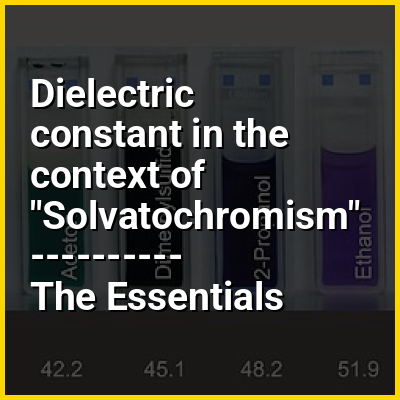
In chemistry, solvatochromism is the phenomenon observed when the colour of a solution is different when the solute is dissolved in different solvents.
The solvatochromic effect is the way the spectrum of a substance (the solute) varies when the substance is dissolved in a variety of solvents. In this context, the dielectric constant and hydrogen bonding capacity are the most important properties of the solvent. With various solvents there is a different effect on the electronic ground state and excited state of the solute, so that the size of energy gap between them changes as the solvent changes. This is reflected in the absorption or emission spectrum of the solute as differences in the position, intensity, and shape of the spectroscopic bands. When the spectroscopic band occurs in the visible part of the electromagnetic spectrum, solvatochromism is observed as a change of colour. This is illustrated by Reichardt's dye, as shown in the image.

