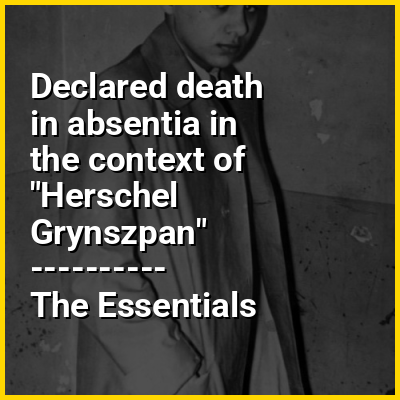
Herschel Feibel Grynszpan (Yiddish: הערשל פײַבל גרינשפּאן; German: Hermann Grünspan; 28 March 1921 – last rumoured to be alive in 1945, declared dead in 1960) was a Polish-Jewish expatriate born and raised in Weimar Germany who shot and killed the Nazi German diplomat Ernst vom Rath on 7 November 1938 in Paris. The Nazis used this assassination as a pretext to launch Kristallnacht, "The Night of Broken Glass", the pogrom of 9–10 November 1938. Grynszpan was seized by the Gestapo after the Fall of France and brought to Germany; his further fate remains unknown.
It is generally assumed that Grynszpan did not survive World War II, and he was declared dead in absentia by the West German government in 1960. This was done at the request of his parents, who said they had not heard anything from him in over 15 years, which was out of character for him. However, this remains a matter of dispute: Kurt Grossman claimed in 1957 that Grynszpan lived in Paris under another identity. A photograph of a man resembling Grynszpan was cited in 2016 as evidence to support the claim that he was still alive in Bamberg, Germany, on 3 July 1946.