In propositional logic and Boolean algebra, De Morgan's laws, also known as De Morgan's theorem, are a pair of transformation rules that are both valid rules of inference. They are named after Augustus De Morgan, a 19th-century British mathematician. The rules allow the expression of conjunctions and disjunctions purely in terms of each other via negation.

HINT:
In this Dossier
De Morgan's laws in the context of Rules of replacement
In logic, a rule of replacement is a transformation rule that may be applied to only a particular segment of an expression. A logical system may be constructed so that it uses either axioms, rules of inference, or both as transformation rules for logical expressions in the system. Whereas a rule of inference is always applied to a whole logical expression, a rule of replacement may be applied to only a particular segment. Within the context of a logical proof, logically equivalent expressions may replace each other. Rules of replacement are used in propositional logic to manipulate propositions.
Common rules of replacement include de Morgan's laws, commutation, association, distribution, double negation, transposition, material implication, logical equivalence, exportation, and tautology.
View the full Wikipedia page for Rules of replacementDe Morgan's laws in the context of De Morgan algebra
In mathematics, a De Morgan algebra (named after Augustus De Morgan, a British mathematician and logician) is a structure A = (A, ∨, ∧, 0, 1, ¬) such that:
- (A, ∨, ∧, 0, 1) is a bounded distributive lattice, and
- ¬ is a De Morgan involution: ¬(x ∧ y) = ¬x ∨ ¬y and ¬¬x = x. (i.e. an involution that additionally satisfies De Morgan's laws)
De Morgan's laws in the context of NAND gate
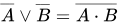
In digital electronics, a NAND (NOT AND) gate is a logic gate which produces an output which is false only if all its inputs are true; thus its output is complement to that of an AND gate. A LOW (0) output results only if all the inputs to the gate are HIGH (1); if any input is LOW (0), a HIGH (1) output results. A NAND gate is made using transistors and junction diodes. By De Morgan's laws, a two-input NAND gate's logic may be expressed as , making a NAND gate equivalent to inverters followed by an OR gate.
The NAND gate is significant because any Boolean function can be implemented by using a combination of NAND gates. This property is called "functional completeness". It shares this property with the NOR gate. Digital systems employing certain logic circuits take advantage of NAND's functional completeness.
View the full Wikipedia page for NAND gateDe Morgan's laws in the context of Augustus De Morgan
Augustus De Morgan (27 June 1806 – 18 March 1871) was a British mathematician and logician. He is best known for De Morgan's laws, relating logical conjunction, disjunction, and negation, and for coining the term "mathematical induction", the underlying principles of which he formalized. De Morgan's contributions to logic are heavily used in many branches of mathematics, including set theory and probability theory, as well as other related fields such as computer science.
View the full Wikipedia page for Augustus De Morgan