DNA polymerase in the context of "DNA virus"

Play Trivia Questions online!

or

Skip to study material about DNA polymerase in the context of "DNA virus"

Ad spacer

⭐ Core Definition: DNA polymerase

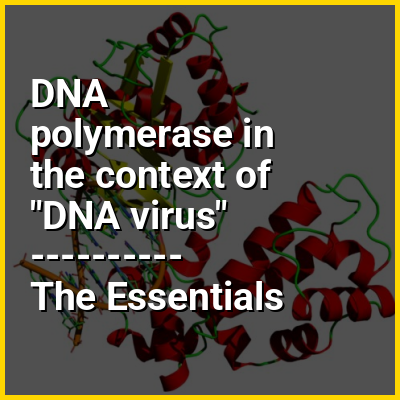
A DNA polymerase is a member of a family of enzymes that catalyze the synthesis of DNA molecules from nucleoside triphosphates, the molecular precursors of DNA. These enzymes are essential for DNA replication and usually work in groups to create two identical DNA duplexes from a single original DNA duplex. During this process, DNA polymerase "reads" the existing DNA strands to create two new strands that match the existing ones.These enzymes catalyze the chemical reaction

DNA polymerase adds nucleotides to the three prime (3')-end of a DNA strand, one nucleotide at a time. Every time a cell divides, DNA polymerases are required to duplicate the cell's DNA, so that a copy of the original DNA molecule can be passed to each daughter cell. In this way, genetic information is passed down from generation to generation.

↓ Menu

>>>PUT SHARE BUTTONS HERE<<<

👉 DNA polymerase in the context of DNA virus

A DNA virus is a virus that has a genome made of deoxyribonucleic acid (DNA) that is replicated by a DNA polymerase. They can be divided between those that have two strands of DNA in their genome, called double-stranded DNA (dsDNA) viruses, and those that have one strand of DNA in their genome, called single-stranded DNA (ssDNA) viruses. dsDNA viruses primarily belong to two realms: Duplodnaviria and Varidnaviria, and ssDNA viruses are almost exclusively assigned to the realm Monodnaviria, which also includes some dsDNA viruses. Additionally, many DNA viruses are unassigned to higher taxa. Reverse transcribing viruses, which have a DNA genome that is replicated through an RNA intermediate by a reverse transcriptase, are classified into the kingdom Pararnavirae in the realm Riboviria.

DNA viruses are ubiquitous worldwide, especially in marine environments where they form an important part of marine ecosystems, and infect both prokaryotes and eukaryotes. They appear to have multiple origins, as viruses in Monodnaviria appear to have emerged from archaeal and bacterial plasmids on multiple occasions, though the origins of Duplodnaviria and Varidnaviria are less clear.

↓ Explore More Topics
In this Dossier

DNA polymerase in the context of Base pair

A base pair (bp) is a fundamental unit of double-stranded nucleic acids consisting of two nucleobases bound to each other by hydrogen bonds. They form the building blocks of the DNA double helix and contribute to the folded structure of both DNA and RNA. Dictated by specific hydrogen bonding patterns, "Watson–Crick" (or "Watson–Crick–Franklin") base pairs (guaninecytosine and adeninethymine/uracil) allow the DNA helix to maintain a regular helical structure that is subtly dependent on its nucleotide sequence. The complementary nature of this based-paired structure provides a redundant copy of the genetic information encoded within each strand of DNA. The regular structure and data redundancy provided by the DNA double helix make DNA well suited to the storage of genetic information, while base-pairing between DNA and incoming nucleotides provides the mechanism through which DNA polymerase replicates DNA and RNA polymerase transcribes DNA into RNA. Many DNA-binding proteins can recognize specific base-pairing patterns that identify particular regulatory regions of genes.

Intramolecular base pairs can occur within single-stranded nucleic acids. This is particularly important in RNA molecules (e.g., transfer RNA), where Watson–Crick base pairs (guanine–cytosine and adenine-uracil) permit the formation of short double-stranded helices, and a wide variety of non–Watson–Crick interactions (e.g., G–U or A–A) allow RNAs to fold into a vast range of specific three-dimensional structures. In addition, base-pairing between transfer RNA (tRNA) and messenger RNA (mRNA) forms the basis for the molecular recognition events that result in the nucleotide sequence of mRNA becoming translated into the amino acid sequence of proteins via the genetic code.

↑ Return to Menu

DNA polymerase in the context of Nuclear pore

The nuclear pore complex (NPC), is a large protein complex giving rise to the nuclear pore. A great number of nuclear pores are studded throughout the nuclear envelope that surrounds the eukaryote cell nucleus. The pores enable the nuclear transport of macromolecules between the nucleoplasm of the nucleus and the cytoplasm of the cell. Small molecules can easily diffuse through the pores. Nuclear transport includes the transportation of RNA and ribosomal proteins from the nucleus to the cytoplasm, and the transport of proteins (such as DNA polymerase and lamins), carbohydrates, signaling molecules, and lipids into the nucleus. Each nuclear pore complex can actively mediate up to 1000 translocations per second.

The nuclear pore complex consists predominantly of a family of proteins known as nucleoporins (Nups). Each pore complex in the human cell nucleus is composed of about 1,000 individual protein molecules, from an evolutionarily conserved set of 35 distinct nucleoporins. The conserved sequences that code for nucleoporins regulate molecular transport through the nuclear pore. Nucleoporin-mediated transport does not entail direct energy expenditure but instead relies on concentration gradients associated with the RAN cycle (Ras-related nuclear protein cycle). In 2022 around 90% of the structure of the human NPC was elucidated in an open and a closed conformation, and published in a special issue of Science, featured on the cover. In 2024 the structure of the nuclear basket was solved, finalising the completion of the structure of the nuclear pore complex.

↑ Return to Menu

DNA polymerase in the context of Polymerase

In biochemistry, a polymerase is an enzyme (EC 2.7.7.6/7/19/48/49) that synthesizes long chains of polymers or nucleic acids. DNA polymerase and RNA polymerase are used to assemble DNA and RNA molecules, respectively, by copying a DNA template strand using base-pairing interactions or half ladder replication.

A DNA polymerase from the thermophilic bacterium, Thermus aquaticus (Taq) (PDB 1BGX, EC 2.7.7.7), is used in the polymerase chain reaction, an important technique of molecular biology.

↑ Return to Menu

DNA polymerase in the context of Molecular biologist

Molecular biology /məˈlɛkjʊlər/ is a branch of biology that seeks to understand the molecular structures and chemical processes that are the basis of biological activity within and between cells. It is centered largely on the study of nucleic acids (such as DNA and RNA) and proteins. It examines the structure, function, and interactions of these macromolecules as they orchestrate processes such as replication, transcription, translation, protein synthesis, and complex biomolecular interactions. The field of molecular biology is multi-disciplinary, relying on principles from genetics, biochemistry, physics, mathematics, and more recently computer science (bioinformatics).

Though cells and other microscopic structures had been observed in organisms as early as the 18th century, a detailed understanding of the mechanisms and interactions governing their behavior did not emerge until the 20th century, when technologies used in physics and chemistry had advanced sufficiently to permit their application in the biological sciences. The term 'molecular biology' was first used in 1945 by the English physicist William Astbury, who described it as an approach focused on discerning the underpinnings of biological phenomena—i.e. uncovering the physical and chemical structures and properties of biological molecules, as well as their interactions with other molecules and how these interactions explain observations of so-called classical biology, which instead studies biological processes at larger scales and higher levels of organization. In 1953, Francis Crick, James Watson, Rosalind Franklin, and their colleagues at the Medical Research Council Unit, Cavendish Laboratory, were the first to describe the double helix model for the chemical structure of deoxyribonucleic acid (DNA), which is often considered a landmark event for the nascent field because it provided a physico-chemical basis by which to understand the previously nebulous idea of nucleic acids as the primary substance of biological inheritance. They proposed this structure based on previous research done by Franklin, which was conveyed to them by Maurice Wilkins and Max Perutz. Their work led to the discovery of DNA in other microorganisms, plants, and animals.
↑ Return to Menu

DNA polymerase in the context of Insertion (genetics)

In genetics, an insertion (also called an insertion mutation) is the addition of one or more nucleotide base pairs into a DNA sequence. This can often happen in microsatellite regions due to the DNA polymerase slipping. Insertions can be anywhere in size from one base pair incorrectly inserted into a DNA sequence to a section of one chromosome inserted into another. The mechanism of the smallest single base insertion mutations is believed to be through base-pair separation between the template and primer strands followed by non-neighbor base stacking, which can occur locally within the DNA polymerase active site. On a chromosome level, an insertion refers to the insertion of a larger sequence into a chromosome. This can happen due to unequal crossover during meiosis.

N region addition is the addition of non-coded nucleotides during recombination by terminal deoxynucleotidyl transferase.

↑ Return to Menu