Czech orthography in the context of "Polish alphabet"

Play Trivia Questions online!

or

Skip to study material about Czech orthography in the context of "Polish alphabet"

Ad spacer

⭐ Core Definition: Czech orthography

Czech orthography is a system of rules for proper formal writing (orthography) in Czech. The earliest form of separate Latin script specifically designed to suit Czech was devised by Czech theologian and church reformist Jan Hus, the namesake of the Hussite movement, in one of his seminal works, De orthographia bohemica (On Bohemian orthography).

The modern Czech orthographic system is diacritic, having evolved from an earlier system which used many digraphs (although one digraph has been kept - ch). The caron (known as háček in Czech) is added to standard Latin letters to express sounds which are foreign to Latin. The acute accent is used for long vowels.
↓ Menu

>>>PUT SHARE BUTTONS HERE<<<

👉 Czech orthography in the context of Polish alphabet

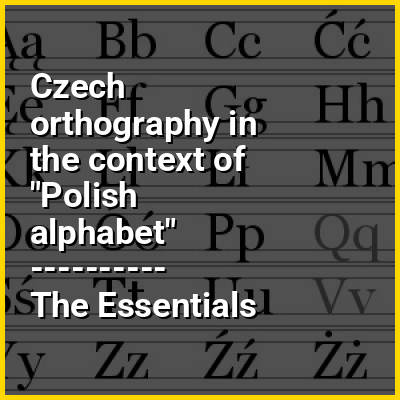
The Polish alphabet (Polish: alfabet polski, abecadło) is the script of the Polish language, the basis for the Polish system of orthography. It is based on the Latin alphabet but includes certain letters (9) with diacritics: the stroke (acute accent or bar) – kreska: ⟨ć, ł, ń, ó, ś, ź⟩; the overdot – kropka: ⟨ż⟩; and the tail or ogonek – ⟨ą, ę⟩. The letters ⟨q⟩, ⟨v⟩, and ⟨x⟩, which are used only in foreign words, are usually absent from the Polish alphabet. Additionally, before the standardization of Polish spelling, ⟨qu⟩ was sometimes used in place of ⟨kw⟩, and ⟨x⟩ in place of ⟨ks⟩.

Modified variations of the Polish alphabet are used for writing Silesian and Kashubian, whereas the Sorbian languages use a mixture of Polish and Czech orthography.

↓ Explore More Topics
In this Dossier