Cylinder in the context of Shape


Cylinder in the context of Shape

Cylinder Study page number 1 of 2

Play TriviaQuestions Online!

or

Skip to study material about Cylinder in the context of "Shape"


⭐ Core Definition: Cylinder

A cylinder (from Ancient Greek κύλινδρος (kúlindros) 'roller, tumbler') has traditionally been a three-dimensional solid, one of the most basic of curvilinear geometric shapes. In elementary geometry, it is considered a prism with a circle as its base.

A cylinder may also be defined as an infinite curvilinear surface in various modern branches of geometry and topology. The shift in the basic meaning—solid versus surface (as in a solid ball versus sphere surface)—has created some ambiguity with terminology. The two concepts may be distinguished by referring to solid cylinders and cylindrical surfaces. In the literature the unadorned term "cylinder" could refer to either of these or to an even more specialized object, the right circular cylinder.

↓ Menu
HINT:

In this Dossier

Cylinder in the context of Pelagic zone

The pelagic zone consists of the water column of the open ocean and can be further divided into regions by depth. The word pelagic is derived from Ancient Greek πέλαγος (pélagos) 'open sea'. The pelagic zone can be thought of as an imaginary cylinder or water column between the surface of the sea and the bottom.

Conditions in the water column change with depth: pressure increases; temperature and light decrease; salinity, oxygen, micronutrients (such as iron, magnesium and calcium) all change. In a manner analogous to stratification in the Earth's atmosphere, the water column can be divided vertically into up to five different layers (illustrated in the diagram), with the number of layers depending on the depth of the water.

View the full Wikipedia page for Pelagic zone
↑ Return to Menu

Cylinder in the context of Hyperboloid of revolution

In geometry, a hyperboloid of revolution, sometimes called a circular hyperboloid, is the surface generated by rotating a hyperbola around one of its principal axes. A hyperboloid is the surface obtained from a hyperboloid of revolution by deforming it by means of directional scalings, or more generally, of an affine transformation.

A hyperboloid is a quadric surface, that is, a surface defined as the zero set of a polynomial of degree two in three variables. Among quadric surfaces, a hyperboloid is characterized by not being a cone or a cylinder, having a center of symmetry, and intersecting many planes into hyperbolas. A hyperboloid has three pairwise perpendicular axes of symmetry, and three pairwise perpendicular planes of symmetry.

View the full Wikipedia page for Hyperboloid of revolution
↑ Return to Menu

Cylinder in the context of Sphericity

Sphericity is a measure of how closely the shape of a physical object resembles that of a perfect sphere. For example, the sphericity of the balls inside a ball bearing determines the quality of the bearing, such as the load it can bear or the speed at which it can turn without failing. Sphericity is a specific example of a compactness measure of a shape.

Sphericity applies in three dimensions; its analogue in two dimensions, such as the cross sectional circles along a cylindrical object such as a shaft, is called roundness.

View the full Wikipedia page for Sphericity
↑ Return to Menu

Cylinder in the context of Circle of latitude

A circle of latitude or line of latitude on Earth is an abstract eastwest small circle connecting all locations around Earth (ignoring elevation) at a given latitude coordinate line.

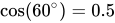
Circles of latitude are often called parallels because they are parallel to each other; that is, planes that contain any of these circles never intersect each other. A location's position along a circle of latitude is given by its longitude. Circles of latitude are unlike circles of longitude, which are all great circles with the centre of Earth in the middle, as the circles of latitude get smaller as the distance from the Equator increases. Their length can be calculated by a common sine or cosine function. For example, the 60th parallel north or south is half as long as the Equator (disregarding Earth's minor flattening by 0.335%), stemming from . On the Mercator projection or on the Gall-Peters projection, a circle of latitude is perpendicular to all meridians. On the ellipsoid or on spherical projection, all circles of latitude are rhumb lines, except the Equator.

View the full Wikipedia page for Circle of latitude
↑ Return to Menu

Cylinder in the context of Skyscraper

A skyscraper is a tall building with many habitable floors. Most modern sources define skyscrapers as being at least 100 metres (330 ft) or 150 metres (490 ft) in height, though there is no universally accepted definition, other than being very tall high-rise buildings. Skyscrapers may host offices, hotels, residential spaces, and retail spaces. Skyscrapers are a common feature of large cities, often due to a high demand for space and limited availability of land.

One common feature of skyscrapers is having a steel frame that supports curtain walls. These curtain walls either bear on the framework below or are suspended from the framework above, rather than resting on load-bearing walls of conventional construction. Some early skyscrapers have a steel frame that enables the construction of load-bearing walls taller than those made of reinforced concrete. Modern skyscraper walls are not load-bearing, and most skyscrapers are characterized by large surface areas of windows made possible by steel frames and curtain walls. However, skyscrapers can have curtain walls that mimic conventional walls with a small surface area of windows. Modern skyscrapers often have a tubular structure, and are designed to act like a hollow cylinder to resist wind, seismic, and other lateral loads. To appear more slender, allow less wind exposure and transmit more daylight to the ground, many skyscrapers have a design with setbacks, which in some cases is also structurally required.

View the full Wikipedia page for Skyscraper
↑ Return to Menu

Cylinder in the context of Compressed natural gas

Compressed natural gas (or simply shortened as CNG) is a fuel gas mainly composed of methane (CH4), compressed to less than 1% of the volume it occupies at standard atmospheric pressure. It is stored and distributed in hard containers at a pressure of 20–25 megapascals (2,900–3,600 psi; 200–250 bar), usually in cylindrical or spherical shapes.

CNG is used in traditional petrol/internal combustion engine vehicles that have been modified, or in vehicles specifically manufactured for CNG use: either alone (dedicated), with a segregated liquid fuel system to extend range (dual fuel), or in conjunction with another fuel (bi-fuel). It can be used in place of petrol, diesel fuel, and liquefied petroleum gas (LPG). CNG combustion produces fewer undesirable gases than the aforementioned fuels. In comparison to other fuels, natural gas poses less of a threat in the event of a spill, because it is lighter than air and disperses quickly when released. Biomethane, biogas from anaerobic digestion or landfill, can be used.

View the full Wikipedia page for Compressed natural gas
↑ Return to Menu

Cylinder in the context of Hockey puck

A hockey puck is either an open or closed disk used in a variety of sports and games. There are designs made for use on an ice surface, such as in ice hockey, and others for the different variants of floor hockey which includes the wheeled skate variant of inline hockey (a.k.a. roller hockey). They are all designed to serve the same function a ball does in ball games.

A closed disk hockey puck having the shape of a short cylinder made of vulcanized rubber is used in the sport of ice hockey. Hockey pucks are designed for use on either an ice surface, dry floor, or underwater, though open disk designs have only been used on floors.

View the full Wikipedia page for Hockey puck
↑ Return to Menu

Cylinder in the context of Roundness (object)

Roundness is the measure of how closely the shape of an object approaches that of a mathematically perfect circle. Roundness applies in two dimensions, such as the cross sectional circles along a cylindrical object such as a shaft or a cylindrical roller for a bearing. In geometric dimensioning and tolerancing, control of a cylinder can also include its fidelity to the longitudinal axis, yielding cylindricity. The analogue of roundness in three dimensions (that is, for spheres) is sphericity.

Roundness is dominated by the shape's gross features rather than the definition of its edges and corners, or the surface roughness of a manufactured object. A smooth ellipse can have low roundness, if its eccentricity is large. Regular polygons increase their roundness with increasing numbers of sides, even though they are still sharp-edged.

View the full Wikipedia page for Roundness (object)
↑ Return to Menu

Cylinder in the context of Drum (architecture)

A tholobate (from Ancient Greek θολοβάτης (tholobátēs) 'dome pedestal'), also called a drum or tambour, is the upright part of a building on which a dome is raised. It is generally in the shape of a cylinder or a polygonal prism. The name derives from the tholos, the Greek term for a round building with a roof and a circular wall. Another architectural meaning of drum is a circular section of a column shaft.

View the full Wikipedia page for Drum (architecture)
↑ Return to Menu

Cylinder in the context of Bayonet mount

A bayonet mount (mainly as a method of mechanical attachment, such as fitting a lens to a camera using a matching lens mount) or bayonet connector (for electrical use) is a fastening mechanism consisting of a cylindrical male side with one or more radial pegs, and a female receptor with matching L-shaped slot(s) and with spring(s) to keep the two parts locked together. The slots are shaped like a capital letter L with serif (a short upward segment at the end of the horizontal arm); the peg slides into the vertical arm of the L, rotates across the horizontal arm, then is pushed slightly upwards into the short vertical "serif" by the spring; the connector is no longer free to rotate unless pushed down against the spring until the peg is out of the "serif".

The bayonet mount is the standard light bulb fitting in the United Kingdom and in many countries that were members of the British Empire including Australia, Hong Kong, Fiji, India, Pakistan, Sri Lanka, Ireland and New Zealand, parts of the Middle East and Africa and, historically, in France and Greece.

View the full Wikipedia page for Bayonet mount
↑ Return to Menu

Cylinder in the context of Right circular cylinder

A right circular cylinder is a cylinder whose generatrices are perpendicular to the bases. Thus, in a right circular cylinder, the generatrix and the height have the same measurements. It is also less often called a cylinder of revolution, because it can be obtained by rotating a rectangle of sides and around one of its sides. Fixing as the side on which the revolution takes place, we obtain that the side , perpendicular to , will be the measure of the radius of the cylinder.

In addition to the right circular cylinder, within the study of spatial geometry there is also the oblique circular cylinder, characterized by not having the generatrices perpendicular to the bases.

View the full Wikipedia page for Right circular cylinder
↑ Return to Menu

Cylinder in the context of Phonograph cylinder

Phonograph cylinders (also referred to as Edison cylinders after their creator Thomas Edison) are the earliest commercial medium for recording and reproducing sound. Known simply as "records" in their heyday (c. 1896–1916), a name since passed to their disc-shaped successors, these hollow cylindrical objects have an audio recording engraved on the outside surface which can be reproduced when they are played on a mechanical cylinder phonograph. The first cylinders were wrapped with tin foil but the improved version made of wax was created a decade later, after which they were commercialized. In the 1910s, the competing disc record system triumphed in the marketplace to become the dominant commercial audio medium.

View the full Wikipedia page for Phonograph cylinder
↑ Return to Menu