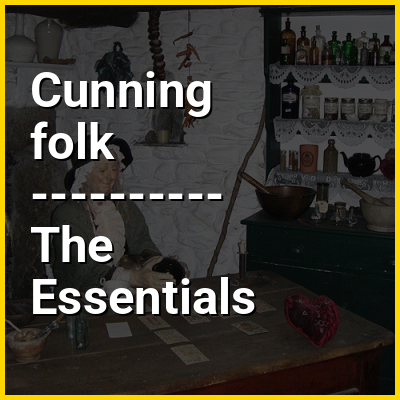
Cunning folk, also known as folk healers or wise folk, were practitioners of folk medicine, helpful folk magic and divination in Europe from the Middle Ages until the 20th century. Their practices were known as the cunning craft. Their services also included thwarting witchcraft. Although some cunning folk were denounced as witches themselves, they made up a minority of those accused, and the common people generally made a distinction between the two. The name 'cunning folk' originally referred to folk-healers and magic-workers in Britain, but the name is now applied as an umbrella term for similar people in other parts of Europe.
HINT:
In this Dossier
- ⭐ Core Definition: Cunning folk
- Cunning folk in the context of Familiar spirit
- Cunning folk in the context of Witchcraft
- Cunning folk in the context of European witchcraft
- Cunning folk in the context of White magic
- Cunning folk in the context of Witch trials in the early modern period
- Cunning folk in the context of Grimoire
- Cunning folk in the context of Cunning folk in Britain
Cunning folk in the context of Familiar spirit
In European folklore of the medieval and early modern periods, familiars (strictly familiar spirits, as "familiar" also meant just "close friend" or companion, and may be seen in the scientific name for dog, Canis familiaris) were believed to be supernatural entities, interdimensional beings, or spiritual guardians that would protect or assist witches and cunning folk in their practice of magic, divination, and spiritual insight. According to records of the time, those alleging to have had contact with familiar spirits reported that they could manifest as numerous forms, usually as an animal, but sometimes as a human or humanoid figure, and were described as "clearly defined, three-dimensional... forms, vivid with colour and animated with movement and sound", as opposed to descriptions of ghosts with their "smoky, undefined form[s]".
When they served witches, they were often thought to be malevolent, but when working for cunning folk, they were often considered benevolent (although there was some ambiguity in both cases). The former were often categorized as demons, while the latter were more commonly thought of and described as fairies. The main purpose of familiars was to serve the witch, providing protection for them as they came into their new powers.
View the full Wikipedia page for Familiar spiritCunning folk in the context of Witchcraft
Witchcraft is the use of magic by a person called a witch. Traditionally, "witchcraft" means the use of magic to inflict supernatural harm or misfortune on others, and this remains the most common and widespread meaning. Though the idea of witchcraft is largely imaginary, it has nevertheless served in many cultures as a way to explain the presence of evil. The belief in witches has been found throughout history in a great number of societies worldwide. Most of these societies have used protective magic or counter-magic against witchcraft, and have shunned, banished, imprisoned, physically punished or killed alleged witches. Anthropologists use the term "witchcraft" for similar beliefs about harmful occult practices in different cultures, and these societies often use the term when speaking in English.
Belief in witchcraft as malevolent magic is attested from ancient Mesopotamia, and in Europe, belief in witches traces back to classical antiquity. In medieval and early modern Europe, accused witches were usually women who were believed to have secretly used black magic (maleficium) against their own community. Usually, accusations of witchcraft were made by neighbors of accused witches, and followed from social tensions. Witches were sometimes said to have communed with demons or with the Devil, though such accusations were mainly made against perceived opponents of the Church. It was thought witchcraft could be thwarted by white magic, provided by 'cunning folk' or 'wise people'. Suspected witches were often prosecuted and punished, if found guilty or simply believed to be guilty. European witch-hunts and witch trials in the early modern period led to tens of thousands of executions. While magical healers and midwives were sometimes accused of witchcraft, they made up a minority of those accused. European belief in witchcraft gradually dwindled during and after the Age of Enlightenment.
View the full Wikipedia page for WitchcraftCunning folk in the context of European witchcraft
European witchcraft can be traced back to classical antiquity, when magic and religion were closely entwined. During the pagan era of ancient Rome, there were laws against harmful magic. After Christianization, the medieval Catholic Church began to see witchcraft (maleficium) as a blend of black magic and apostasy involving a pact with the Devil. During the early modern period, witch hunts became widespread in Europe, partly fueled by religious tensions, societal anxieties, and economic upheaval. European belief in witchcraft gradually dwindled during and after the Age of Enlightenment.
One text that shaped the witch-hunts was the Malleus Maleficarum, a 1486 treatise that provided a framework for identifying, prosecuting, and punishing witches. During the 16th and 17th centuries, there was a wave of witch trials across Europe, resulting in tens of thousands of executions and many more prosecutions. Usually, accusations of witchcraft were made by neighbours and followed from social tensions. Accusations were most often made against women, the elderly, and marginalized individuals. Women made accusations as often as men. The common people believed that magical healers (called 'cunning folk' or 'wise people') could undo bewitchment. These magical healers were sometimes denounced as harmful witches themselves, but seem to have made up a minority of the accused. This dark period of history reflects the confluence of superstition, fear, and authority, as well as the societal tendency of scapegoating. A feminist interpretation of the witch trials is that misogyny led to the association of women and malevolent witchcraft.
View the full Wikipedia page for European witchcraftCunning folk in the context of White magic
White magic has traditionally referred to the use of supernatural powers or magic for selfless purposes. Practitioners of white magic have been given titles such as wise men or women, healers, white witches or wizards. Many of these people claimed to have the ability to do such things because of knowledge or power that was passed on to them through hereditary lines, or by some event later in their lives. White magic is practiced through healing, blessing, charms, incantations, prayers, and songs. White magic is the benevolent counterpart of malicious black magic.
View the full Wikipedia page for White magicCunning folk in the context of Witch trials in the early modern period
In the early modern period, from about 1400 to 1775, about 100,000 people were prosecuted for witchcraft in Europe and British America. Between 40,000 and 60,000 were executed, almost all in Europe. The witch hunts were particularly severe in parts of the Holy Roman Empire. Prosecutions for witchcraft reached a high point from 1560 to 1630, during the Counter-Reformation and the European wars of religion. Among the lower classes, accusations of witchcraft were usually made by neighbors, and women and men made formal accusations of witchcraft. Magical healers or 'cunning folk' were sometimes prosecuted for witchcraft, but seem to have made up a minority of the accused. Roughly 80% of those convicted were women, most of them over the age of 40. In some regions, convicted witches were burnt at the stake, the traditional punishment for religious heresy.
View the full Wikipedia page for Witch trials in the early modern periodCunning folk in the context of Grimoire
A grimoire (/ɡrɪmˈwɑːr/) (also known as a book of spells, magic book, or a spellbook) is a textbook of magic, typically including instructions on how to create magical objects like talismans and amulets; how to perform magical spells, charms, and divination; and how to summon or invoke supernatural entities such as angels, spirits, deities, and demons. In many cases, the books themselves are believed to be imbued with magical powers. The only contents found in a grimoire are information on spells, rituals, the preparation of magical tools, and lists of ingredients and their magical correspondences. In this manner, while all books on magic could be thought of as grimoires, not all magical books should be thought of as grimoires.
While the term grimoire is originally European—and many Europeans throughout history, particularly ceremonial magicians and cunning folk, have used grimoires—the historian Owen Davies has noted that similar books can be found all around the world, ranging from Jamaica to Sumatra. He also noted that in this sense, the world's first grimoires were created in Europe and the ancient Near East.
View the full Wikipedia page for GrimoireCunning folk in the context of Cunning folk in Britain
The cunning folk were professional or semi-professional practitioners of magic in Europe from the medieval period through the early 20th century. In Britain they were known by a variety of names in different regions of the country, including wise men and wise women, pellars, wizards, dyn hysbys, and sometimes white witches.
These people practised folk and low magic – although often combined with elements of "high" or ceremonial magic – which they learned through the study of grimoires. Primarily using spells and charms as a part of their profession, they were most commonly employed to use their magic to combat malevolent witchcraft, to locate criminals, missing persons or stolen property, for fortune telling, for healing, for treasure hunting and to influence people to fall in love. Belonging "to the world of popular belief and custom", the cunning folk's magic has been defined as being "concerned not with the mysteries of the universe and the empowerment of the magus [as ceremonial magic usually is], so much as with practical remedies for specific problems." However, other historians have noted that in some cases, there was apparently an "experimental or 'spiritual' dimension" to their magical practices, something which was possibly shamanic in nature.
View the full Wikipedia page for Cunning folk in Britain