Cuban rumba in the context of "Descarga"

Play Trivia Questions online!

or

Skip to study material about Cuban rumba in the context of "Descarga"


⭐ Core Definition: Cuban rumba

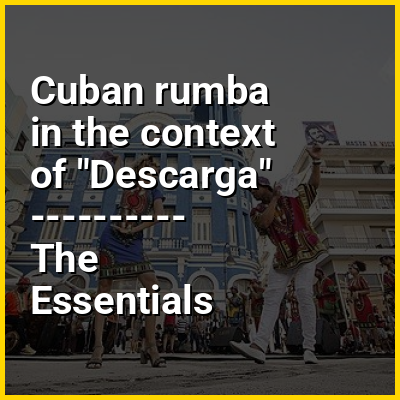
Rumba is a secular genre of Cuban music involving dance, percussion, and song. It originated in the northern regions of Cuba, mainly in urban Havana and Matanzas, during the late 19th century. It is based on African music and dance traditions, namely Abakuá and yuka, as well as the Spanish-based coros de clave. According to Argeliers León, rumba is one of the major "genre complexes" of Cuban music, and the term rumba complex is now commonly used by musicologists. This complex encompasses the three traditional forms of rumba (yambú, guaguancó and columbia), aswell as their contemporary derivatives and other minor styles.

Traditionally performed by poor workers of African descent in streets and solares (courtyards), rumba remains one of Cuba's most characteristic forms of music and dance. Vocal improvisation, elaborate dancing and polyrhythmic drumming are the key components of all rumba styles. Cajones (wooden boxes) were used as drums until the early 20th century, when they were replaced by tumbadoras (conga drums). During the genre's recorded history, which began in the 1940s, there have been numerous successful rumba bands such as Los Papines, Los Muñequitos de Matanzas, Clave y Guaguancó, AfroCuba de Matanzas and Yoruba Andabo.
↓ Menu

In this Dossier

Cuban rumba in the context of Latin American music

The music of Latin America refers to music originating from Latin America, namely the Spanish and Portuguese-speaking regions of the Americas south of the United States. Latin American music also incorporates its African influences into the music of Latin America, while maintaining the identity of indigenous music of Latin America. Due to its highly syncretic nature, Latin American music encompasses a wide variety of styles, including influential genres such as cumbia, bachata, bossa nova, merengue, rumba, salsa, samba, son, candombe and tango. During the 20th century, many styles were influenced by the music of the United States giving rise to genres such as Latin pop, rock, jazz, hip hop, and reggaeton.

Geographically, it usually refers to the Spanish and Portuguese-speaking regions of Latin America, but sometimes includes Francophone countries and territories of the Caribbean and South America as well. It also encompasses Latin American styles that have originated in the United States such as, New Mexico music, Tejano, various forms of country-Western, as well as Chicano rock, Nuyorican rap, and Chicano rap. The origins of Latin American music can be traced back to West Africa, Central Africa, Indigenous, and the Spanish and Portuguese conquest of the Americas in the 16th century, when the European settlers brought their music from overseas. Latin American music is performed in Spanish and Portuguese.

↑ Return to Menu

Cuban rumba in the context of Conga

The conga, also known as tumbadora, is a tall, narrow, single-headed drum from the Congo. Congas are staved like barrels and classified into three types: quinto (lead drum, highest), tres dos or tres golpes (middle), and tumba or salidor (lowest). Congas were originally used in Afro-Cuban music genres such as conga (hence their name) and rumba, in which each drummer would play a single drum. Following numerous innovations in conga drumming and construction during the mid-20th century, as well as its internationalization, it became increasingly common for drummers to play two or three drums. Congas have become a popular instrument in many forms of Latin music such as son (when played by conjuntos), descarga, Afro-Cuban jazz, salsa, songo, merengue and Latin rock.

The origins of the conga drum can be traced back to West and Central Africa, especially regions now known as Congo, Nigeria, and Angola. The modern version of the conga was developed by Cuban people of African descent during the late 19th century or early 20th century. Its direct ancestors are thought to be the yuka and makuta (of Bantu origin) and the bembé drums (of Yoruba origin). In Cuba and Latin America, congas are primarily played as hand drums. In Trinidadian calypso and soca, congas are sometimes struck with mallets, while in the Congos, they are often struck with one hand and one mallet.

↑ Return to Menu

Cuban rumba in the context of Rumba

The term rumba may refer to a variety of unrelated music styles. Originally, "rumba" was used as a synonym for "party" in northern Cuba, and by the late 19th century it was used to denote the complex of secular music styles known as Cuban rumba. Since the early 20th century the term has been used in different countries to refer to distinct styles of music and dance, most of which are only tangentially related to the original Cuban rumba, if at all. The vague etymological origin of the term rumba, as well as its interchangeable use with guaracha in settings such as bufo theatre, is largely responsible for such worldwide polysemy of the term. In addition, "rumba" was the primary marketing term for Cuban music in North America, as well as West and Central Africa, during much of the 20th century, before the rise of mambo, pachanga and salsa.

"Rumba" entered the English lexicon in the early 20th century, at least as early as 1919, and by 1935 it was used as a verb to denote the ballroom dance. In this sense, the anglicised spelling "rhumba" became prevalent and is now recommended to distinguish it from traditional Cuban rumba. Also in the first third of the 20th century, "rumba" entered the Spanish flamenco world as a fast-paced palo (style) inspired in the Cuban guaracha, and which gave rise to other forms of urban music now known as "rumba". Throughout Latin America, "rumba" acquired different connotations, mostly referring to Cubanized, danceable, local styles, such as Colombian rumba criolla (creole rumba). At the same time, "rumba" began to be used a catch-all term for Afro-Cuban music in most African countries, later giving rise to re-Africanized Cuban-based styles such as Congolese rumba.

↑ Return to Menu

Cuban rumba in the context of Music of Africa

The continent of Africa and its music is vast and highly diverse, with different regions and nations maintaining distinct musical traditions. African music includes genres such as makwaya, highlife, mbube, township music, jùjú, fuji, jaiva, afrobeat, afrofusion, mbalax, Congolese rumba, soukous, ndombolo, makossa, kizomba, and taarab, among others. African music also uses a wide variety of instruments from across the continent. The music and dance traditions of the African diaspora, shaped to varying degrees by African musical traditions, include American genres such as Dixieland jazz, blues, and jazz, as well as Caribbean styles such as calypso (see kaiso), and soca. Latin American music genres including cumbia, salsa, son cubano, rumba, conga, bomba, samba, and zouk developed from the music of enslaved Africans and have, in turn, influenced contemporary African popular music.

Like the music of Asia, India, and the Middle East, African music is highly rhythmic. Its complex rhythmic patterns often involve one rhythm played against another to create a polyrhythm. A common example is the three-against-two rhythm, comparable to a triplet played against straight notes. Sub-Saharan African music traditions frequently rely on a wide array of percussion instruments, including xylophones, djembes, drums, and tone-producing instruments such as the mbira or "thumb piano".

↑ Return to Menu

Cuban rumba in the context of Clave (rhythm)

The clave (/ˈklɑːv, klv/; Spanish: [ˈklaβe]) is a rhythmic pattern used as a tool for temporal organization in Brazilian and Cuban music. In Spanish, clave literally means key, clef, code, or keystone. It is present in a variety of genres such as Abakuá music, rumba, conga, son, mambo, salsa, songo, timba and Afro-Cuban jazz. The five-stroke clave pattern represents the structural core of many Cuban rhythms. The study of rhythmic methodology, especially in the context of Afro-Cuban music, and how it influences the mood of a pieceis known as clave theory.

The clave pattern originated in sub-Saharan African music traditions, where it serves essentially the same function as it does in Cuba. In ethnomusicology, clave is also known as a key pattern, guide pattern, phrasing referent, timeline, or asymmetrical timeline. The clave pattern is also found in the African diaspora music of Haitian Vodou drumming, Afro-Brazilian music, African-American music, Louisiana Voodoo drumming, and Afro-Uruguayan music (candombe). The clave pattern (or hambone, as it is known in the United States) is used in North American popular music as a rhythmic motif or simply a form of rhythmic decoration.

↑ Return to Menu

Cuban rumba in the context of Dance and music of Latin America

The music of Latin America refers to music originating from Latin America, namely the Spanish and Portuguese-speaking regions of the Americas south of the United States. Latin American music's origins are a mix of the music of the continent's indigenous peoples with the musical traditions brought to the continent by European colonists and African slaves. Due to its highly syncretic nature, Latin American music encompasses a wide variety of styles, including influential genres such as cumbia, bachata, bossa nova, merengue, rumba, salsa, samba, son, candombe and tango. During the 20th century, many styles were influenced by the music of the United States giving rise to genres such as Latin pop, rock, jazz, hip hop, and reggaeton.

Geographically, it usually refers to the Spanish and Portuguese-speaking regions of Latin America, but sometimes includes Francophone countries and territories of the Caribbean and South America as well. It also encompasses Latin American styles that have originated in the United States such as, New Mexico music, Tejano, various forms of country-Western, as well as Chicano rock, Nuyorican rap, and Chicano rap. The origins of Latin American music can be traced back to West Africa, Central Africa, Indigenous, and the Spanish and Portuguese conquest of the Americas in the 16th century, when the European settlers brought their music from overseas. Latin American music is performed in Spanish and Portuguese.

↑ Return to Menu

Cuban rumba in the context of Rhumba

Rhumba, also known as ballroom rumba, is a genre of ballroom music and dance that appeared in the East Coast of the United States during the 1930s. It combined American big band music with Afro-Cuban rhythms, primarily the son cubano, but also conga and rumba. Although taking its name from the latter, ballroom rumba differs completely from Cuban rumba in both its music and its dance. Hence, authors prefer the Americanized spelling of the word (rhumba) to distinguish between them.

↑ Return to Menu