Crime of apartheid in the context of "Racial segregation"

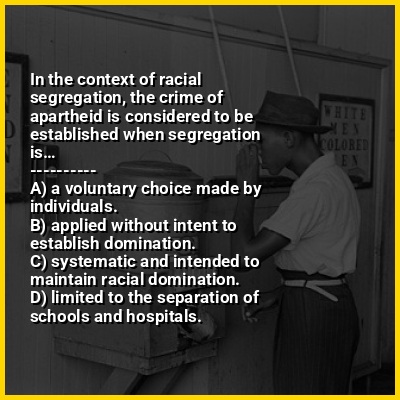
⭐ In the context of racial segregation, the crime of apartheid is considered to be established when segregation is…

Ad spacer

⭐ Core Definition: Crime of apartheid

The crime of apartheid is defined by the 2002 Rome Statute of the International Criminal Court as inhumane acts of a character similar to other crimes against humanity "committed in the context of an institutionalized regime of systematic oppression and domination by one racial group over any other racial group or groups and committed with the intention of maintaining that regime".

On 30 November 1973, the United Nations General Assembly opened for signature and ratification The International Convention on the Suppression and Punishment of the Crime of Apartheid. It defined the crime of apartheid as "inhuman acts committed for the purpose of establishing and maintaining domination by one racial group of persons over any other racial group of persons and systematically oppressing them".

↓ Menu

>>>PUT SHARE BUTTONS HERE<<<

πŸ‘‰ Crime of apartheid in the context of Racial segregation

Racial segregation is the separation of people into racial or other ethnic groups in daily life. Segregation can involve the spatial separation of the races, and mandatory use of different institutions, such as schools and hospitals by people of different races. Specifically, it may be applied to activities such as eating in restaurants, drinking from water fountains, using public toilets, attending schools, going to movie theaters, riding buses, renting or purchasing homes, renting hotel rooms, going to supermarkets, or attending places of worship. In addition, segregation often allows close contact between members of different racial or ethnic groups in hierarchical situations, such as allowing a person of one race to work as a servant for a member of another race. Racial segregation has generally been outlawed worldwide.

Segregation is defined by the European Commission against Racism and Intolerance as "the act by which a (natural or legal) person separates other persons on the basis of one of the enumerated grounds without an objective and reasonable justification, in conformity with the proposed definition of discrimination. As a result, the voluntary act of separating oneself from other people on the basis of one of the enumerated grounds does not constitute segregation". According to the UN Forum on Minority Issues, "The creation and development of classes and schools providing education in minority languages should not be considered impermissible segregation if the assignment to such classes and schools is of a voluntary nature." Racial segregation can amount to the international crime of apartheid and a crime against humanity under the 2002 Rome Declaration of Statute of the International Criminal Court.
↓ Explore More Topics
In this Dossier

Crime of apartheid in the context of The International Convention on the Suppression and Punishment of the Crime of Apartheid

The 1973 United Nations International Convention on the Suppression and Punishment of the Crime of Apartheid was the first binding international treaty which declared the crime of apartheid and racial segregation under international law. It was adopted by the General Assembly on 30 November 1973 and came into force on 18 July 1976. It passed by 91 votes in favor, four against (Portugal, South Africa, the United Kingdom and the United States) and 26 abstentions. 110 countries are currently parties to the convention, with 26 signatories.

↑ Return to Menu

Crime of apartheid in the context of Israeli apartheid

Israeli apartheid is a system of institutionalized segregation and discrimination in the Israeli-occupied Palestinian territories and to a lesser extent in Israel proper. This system is characterized by near-total physical separation between the Palestinian and the Israeli settler population of the West Bank, as well as the judicial separation that governs both communities, which discriminates against the Palestinians in a wide range of ways. Israel also discriminates against Palestinian refugees in the diaspora and against its own Palestinian citizens.

Since the 1948 Palestine war, Israel has denied Palestinian refugees who were expelled or fled from what became its territory the right of return and right to their lost properties. Israel has been occupying the West Bank and the Gaza Strip since the 1967 Six-Day War, which is now the longest military occupation in modern history, and, in contravention of international law, has been constructing large settlements there that separate Palestinian communities from one another and prevent the establishment of a Palestinian state. The settlements are mostly encircled by the Israeli West Bank barrier, which intentionally separates the Israeli and Palestinian populations, a policy called Hafrada. Jewish Israeli settlers are subject to Israeli civil law, but the Palestinian population is subject to military law. Settlers also have access to separate roads and exploit the region's natural resources at the expense of its Palestinian inhabitants.

↑ Return to Menu