Cretaceous–Paleogene extinction event in the context of "Snake"

Play Trivia Questions online!

or

Skip to study material about Cretaceous–Paleogene extinction event in the context of "Snake"

Ad spacer

⭐ Core Definition: Cretaceous–Paleogene extinction event

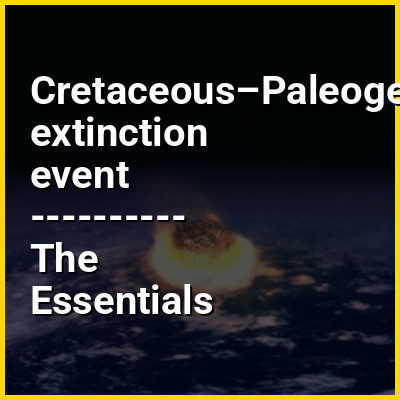
The Cretaceous–Paleogene (K–Pg) extinction event, formerly known as the Cretaceous-Tertiary (K–T) extinction event, was a major mass extinction of three-quarters of the plant and animal species on Earth approximately 66 million years ago. The event caused the extinction of all non-avian dinosaurs. Most other tetrapods weighing more than 25 kg (55 lb) also became extinct, with the exception of some ectothermic species such as sea turtles and crocodilians. It marked the end of the Cretaceous period, and with it the Mesozoic era, while heralding the beginning of the current geological era, the Cenozoic Era. In the geologic record, the K–Pg event is marked by a thin layer of sediment called the K–Pg boundary or K–T boundary, which can be found throughout the world in marine and terrestrial rocks. The boundary clay shows unusually high levels of the metal iridium, which is more common in asteroids than in the Earth's crust.

As originally proposed in 1980 by a team of scientists led by Luis Alvarez and his son Walter, it is now generally thought that the K–Pg extinction resulted from the impact of a massive asteroid 10 to 15 km (6 to 9 mi) wide, 66 million years ago, causing the Chicxulub impact crater and devastating the global environment, mainly through a lingering impact winter which halted photosynthesis in plants and plankton. The impact hypothesis, also known as the Alvarez hypothesis, was bolstered by the discovery of the 180 km (112 mi) Chicxulub crater in the Gulf of Mexico's Yucatán Peninsula in the early 1990s. The temporal match between the ejecta layer, and the onset of the extinctions and the agreement of ecological patterns in the fossil record with modeled environmental perturbations (for example, darkness and cooling), lead to the conclusion that the Chicxulub impact triggered the mass extinction. A 2016 drilling project into the Chicxulub peak ring confirmed that the peak ring comprised granite ejected within minutes from deep in the Earth, but contained hardly any gypsum, the usual sulfate-containing sea floor rock in the region: the gypsum would have vaporized and dispersed as an aerosol into the atmosphere, causing longer-term effects on the climate and food chain. In October 2019, researchers proposed the mechanisms of the mass extinction, arguing that the Chicxulub asteroid impact event rapidly acidified the oceans and produced long-lasting effects on the climate.
↓ Menu

>>>PUT SHARE BUTTONS HERE<<<
In this Dossier

Cretaceous–Paleogene extinction event in the context of Bird

Birds are a group of warm-blooded theropod dinosaurs constituting the class Aves, characterised by feathers, toothless beaked jaws, the laying of hard-shelled eggs, a high metabolic rate, a four-chambered heart, and a strong yet lightweight skeleton. Birds live worldwide and range in size from the 5.5 cm (2.2 in) bee hummingbird to the 2.8 m (9 ft 2 in) common ostrich. There are over 11,000 living species and they are split into 44 orders. More than half are passerine or "perching" birds. Birds have wings whose development varies according to species; the only known groups without wings are the extinct moa and elephant birds. Wings, which are modified forelimbs, gave birds the ability to fly, although further evolution has led to the loss of flight in some birds, including ratites, penguins, and diverse endemic island species. The digestive and respiratory systems of birds are also uniquely adapted for flight. Some bird species of aquatic environments, particularly seabirds and some waterbirds, have further evolved for swimming. The study of birds is called ornithology.

Birds evolved from earlier theropods, and thus constitute the only known living dinosaurs. Likewise, birds are considered reptiles in the modern cladistic sense of the term, and their closest living relatives are the crocodilians. Birds are descendants of the primitive avialans (whose members include Archaeopteryx) which first appeared during the Late Jurassic. According to some estimates, modern birds (Neornithes) evolved in the Late Cretaceous or between the Early and Late Cretaceous (100 Ma) and diversified dramatically around the time of the Cretaceous–Paleogene extinction event 66 million years ago, which killed off the pterosaurs and all non-ornithuran dinosaurs.

↑ Return to Menu

Cretaceous–Paleogene extinction event in the context of Global catastrophic risk

A global catastrophic risk or a doomsday scenario is a hypothetical event that could damage human well-being on a global scale, endangering or even destroying modern civilization. Existential risk is a related term limited to events that could cause full-blown human extinction or permanently and drastically curtail humanity's existence or potential.

In the 21st century, a number of academic and non-profit organizations have been established to research global catastrophic and existential risks, formulate potential mitigation measures, and either advocate for or implement these measures.

↑ Return to Menu

Cretaceous–Paleogene extinction event in the context of Maastricht

Maastricht (/ˈmɑːstrɪxt/ MAH-strikht, US also /mɑːˈstrɪxt/ mah-STRIKHT, Dutch: [maːˈstrɪxt] ; Limburgish: Mestreech [məˈstʀeːx]) is a city and a municipality in the southeastern Netherlands. It is the capital and largest city of the province of Limburg. Maastricht is located on both sides of the Meuse (Dutch: Maas), at the point where the river is joined by the Jeker. Mount Saint Peter (Sint-Pietersberg) is largely situated within the city's municipal borders. Maastricht is adjacent to the border with Belgium and is part of the Meuse-Rhine Euroregion, an international metropolis with a population of about 3.9 million, which includes the nearby German and Belgian cities of Aachen, Liège, and Hasselt.

Maastricht developed from a Roman settlement (Trajectum ad Mosam) to a medieval river trade and religious centre. In the 16th century it became a garrison town and in the 19th century an early industrial centre. Today, the city is a thriving cultural and regional hub. It became well known through the Maastricht Treaty and as the birthplace of the euro. Maastricht has 1,677 national heritage buildings (rijksmonumenten), the second highest number in the Netherlands, after Amsterdam. The city is visited by tourists for shopping and recreation, and has a large international student population. The last stage of the Cretaceous period and the Mesozoic era, the Maastrichtian, is named after this city, at the end of which was the Cretaceous–Paleogene extinction event, which resulted in the extinction of the non-avian dinosaurs.

↑ Return to Menu

Cretaceous–Paleogene extinction event in the context of Cenozoic

The Cenozoic Era (also known as Caenozoic, Kainozoic, or Neozoic Era; /ˌsnəˈz.ɪk, ˌsɛn-/; SEE-nə-ZOH-ik, SEN-ə-; lit.'new life') is Earth's current geological era, representing the last 66 million years of Earth's history. It is characterized by the dominance of mammals, insects, birds and angiosperms (flowering plants). It is the latest of three geological eras of the Phanerozoic Eon, preceded by the Mesozoic and Paleozoic. The Cenozoic started with the Cretaceous–Paleogene extinction event, when many species, including the non-avian dinosaurs, became extinct in an event attributed by most experts to the impact of a large asteroid or other celestial body, the Chicxulub impactor.

The Cenozoic is also known as the Age of Mammals because the terrestrial animals that dominated both hemispheres were mammals – the eutherians (placentals) in the Northern Hemisphere and the metatherians (marsupials, now mainly restricted to Australia and to some extent South America) in the Southern Hemisphere. The extinction of many groups allowed mammals and birds to greatly diversify so that large mammals and birds dominated life on Earth. The continents also moved into their current positions during this era.

↑ Return to Menu

Cretaceous–Paleogene extinction event in the context of Dinosaur

Dinosaurs are a diverse group of reptiles of the clade Dinosauria. They first appeared during the Triassic period, between 243 and 233.23 million years ago (mya), although the exact origin and timing of the evolution of dinosaurs is a subject of active research. They became the dominant terrestrial vertebrates after the Triassic–Jurassic extinction event 201.3 mya and their dominance continued throughout the Jurassic and Cretaceous periods. The fossil record shows that birds are feathered dinosaurs, having evolved from earlier theropods during the Late Jurassic epoch, and are the only dinosaur lineage known to have survived the Cretaceous–Paleogene extinction event approximately 66 mya. Dinosaurs can therefore be divided into avian dinosaurs—birds—and the extinct non-avian dinosaurs, which are all dinosaurs other than birds.

Dinosaurs are varied from taxonomic, morphological and ecological standpoints. Birds, at over 11,000 living species, are among the most diverse groups of vertebrates. Using fossil evidence, paleontologists have identified over 900 distinct genera and more than 1,000 different species of non-avian dinosaurs. Dinosaurs are represented on every continent by both extant species (birds) and fossil remains. Through most of the 20th century, before birds were recognized as dinosaurs, most of the scientific community believed dinosaurs to have been sluggish and cold-blooded. Most research conducted since the 1970s, however, has indicated that dinosaurs were active animals with elevated metabolisms and numerous adaptations for social interaction. Some were herbivorous, others carnivorous. Evidence suggests that all dinosaurs were egg-laying, and that nest-building was a trait shared by many dinosaurs, both avian and non-avian.

↑ Return to Menu

Cretaceous–Paleogene extinction event in the context of Evolution of birds

The evolution of birds began in the Jurassic Period, with the earliest birds derived from a clade of theropod dinosaurs named Paraves. Birds are categorized as a biological class, Aves. For more than a century, the small theropod dinosaur Archaeopteryx lithographica from the Late Jurassic period was considered to have been the earliest bird. Modern phylogenies place birds in the dinosaur clade Theropoda. According to the current consensus, Aves and a sister group, the order Crocodilia, together are the sole living members of an unranked reptile clade, the Archosauria. Four distinct lineages of bird survived the Cretaceous–Paleogene extinction event 66 million years ago, giving rise to ostriches and relatives (Palaeognathae), waterfowl (Anseriformes), ground-living fowl (Galliformes), and "modern birds" (Neoaves).

Phylogenetically, Aves is usually defined as all descendants of the most recent common ancestor of a specific modern bird species (such as the house sparrow, Passer domesticus), and either Archaeopteryx, or some prehistoric species closer to Neornithes (to avoid the problems caused by the unclear relationships of Archaeopteryx to other theropods). If the latter classification is used then the larger group is termed Avialae. Currently, the relationship between non-avian dinosaurs, Archaeopteryx, and modern birds is still under debate.

↑ Return to Menu

Cretaceous–Paleogene extinction event in the context of Impact event

An impact event is a collision between astronomical objects causing measurable effects. Impact events have been found to regularly occur in planetary systems, though the most frequent involve asteroids, comets or meteoroids and have minimal effect. When large objects impact terrestrial planets such as the Earth, there can be significant physical and biospheric consequences, as the impacting body is usually traveling at several kilometres per second (km/s), with a minimum impact speed of 11.2 km/s (25,054 mph; 40,320 km/h) for bodies striking Earth. While planetary atmospheres can mitigate some of these impacts through the effects of atmospheric entry, many large bodies retain sufficient energy to reach the surface and cause substantial damage. This results in the formation of impact craters and structures, shaping the dominant landforms found across various types of solid objects found in the Solar System. Their prevalence and ubiquity present the strongest empirical evidence of the frequency and scale of these events.

Impact events appear to have played a significant role in the evolution of the Solar System since its formation. Major impact events have significantly shaped Earth's history, and have been implicated in the formation of the Earth–Moon system. Interplanetary impacts have also been proposed to explain the retrograde rotation of Uranus and Venus. Impact events also appear to have played a significant role in the evolutionary history of life. Impacts may have helped deliver the building blocks for life (the panspermia theory relies on this premise). Impacts have been suggested as the origin of water on Earth. They have also been implicated in several mass extinctions. The prehistoric Chicxulub impact, 66 million years ago, is believed to be the cause not only of the Cretaceous–Paleogene extinction event but acceleration of the evolution of mammals, leading to their dominance and, in turn, setting in place conditions for the eventual rise of humans.

↑ Return to Menu

Cretaceous–Paleogene extinction event in the context of Asteroid impact avoidance

Asteroid impact avoidance encompasses the methods by which near-Earth objects (NEO) on a potential collision course with Earth could be diverted, preventing destructive impact events. An impact by a sufficiently large asteroid or other NEOs would cause, depending on its impact location, massive tsunamis or multiple firestorms, and an impact winter caused by the sunlight-blocking effect of large quantities of pulverized rock dust and other debris placed into the stratosphere. A collision 66 million years ago between the Earth and an object approximately 10 kilometers (6 miles) wide is thought to have produced the Chicxulub crater and triggered the Cretaceous–Paleogene extinction event that is understood by the scientific community to have caused the extinction of all non-avian dinosaurs.

While the chances of a major collision are low in the near term, it is a near-certainty that one will happen eventually unless defensive measures are taken. Astronomical events—such as the Shoemaker-Levy 9 impacts on Jupiter and the 2013 Chelyabinsk meteor, along with the growing number of near-Earth objects discovered and catalogued on the Sentry Risk Table—have drawn renewed attention to such threats. The popularity of the 2021 movie Don't Look Up helped to raise awareness of the possibility of avoiding NEOs. Awareness of the threat has grown rapidly during the past few decades, but much more needs to be accomplished before the human population can feel adequately protected from a potentially catastrophic asteroid impact.

↑ Return to Menu